
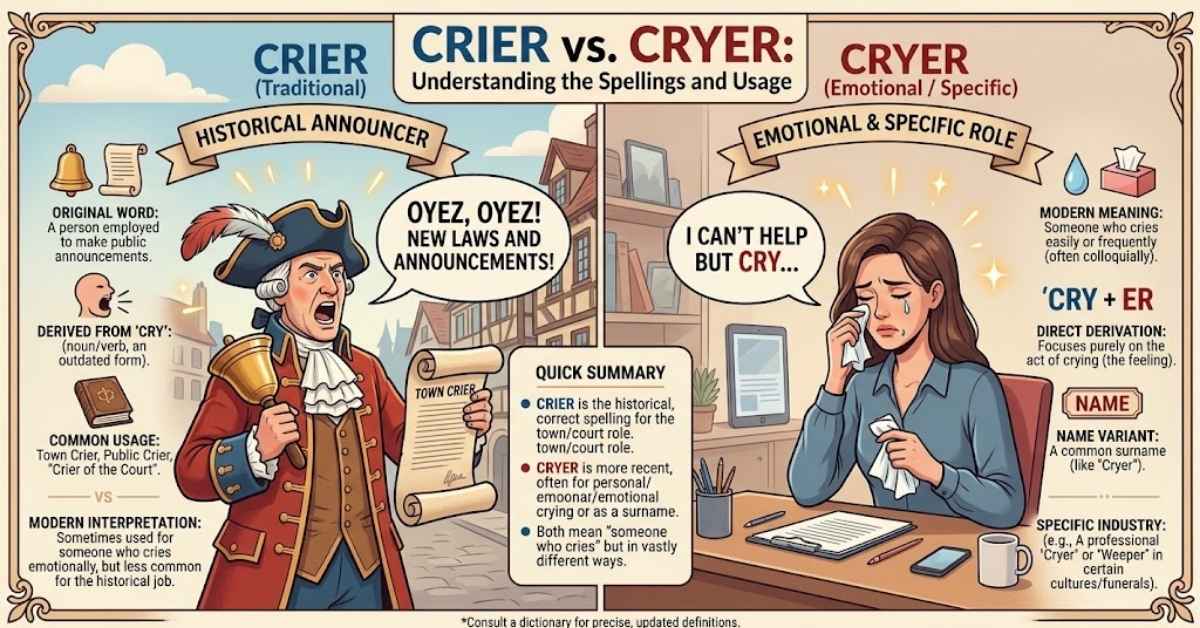
Crier is the standard spelling to use in modern American English when you mean someone who cries or a person who publicly announces something, as in town crier. Cryer does exist as a less common spelling variant and appears in surnames and historical contexts, but it is not the spelling most readers expect in ordinary modern writing.
The confusion is understandable. Both forms look like they could come from the verb cry, and they are pronounced very similarly. If you have ever wondered, “is it cryer or crier?”, the practical answer is simple: use crier for normal contemporary writing.
But there is a little more to the story than “one is right and one is wrong.”
Crier or Cryer: The Short Answer
| Word | Modern standard usage | Meaning |
|---|---|---|
| crier | Yes | Someone who cries; historically, a public announcer |
| cryer | Less common/variant | Historical spelling and surname; not the normal modern choice |
So, if you are writing an email, essay, article, school assignment, or professional document, crier is generally the form you want.
For example:
- Correct: She is a crier during emotional movies.
- Correct: The town crier announced the news.
- Less common: She is a cryer.
- Name: Jon Cryer — the surname must keep its established spelling.
The important distinction is that cryer should not automatically be treated as a meaningless or nonexistent word. Current dictionary-based evidence recognizes crier as the established form, while historical and variant usage explains why cryer can still be encountered.
What Does Crier Mean?
The word crier is a noun. Its meaning depends on context.
1. Crier means someone who cries
In everyday American English, a crier can mean a person who cries easily or frequently.
For example:
- “I’m not usually a crier, but that movie made me tear up.”
- “My sister is a big crier during emotional scenes.”
- “He wasn’t much of a crier as a child.”
Cambridge defines crier as someone who cries and provides examples of the word being used in this emotional sense.
So if your question is specifically “crier or cryer for crying?”, choose crier.
2. Crier can mean a public announcer
There is another meaning that is easy to miss.
Historically, a crier was a person who called out news, official announcements, orders, or other information publicly.
This is where the familiar expression town crier comes from.
Oxford describes the historical crier as someone whose job was to walk through a town shouting news and official announcements.
Collins also records meanings involving court officials and people who publicly announced information or advertised goods.
What Is a Town Crier?
A town crier was traditionally a public announcer who delivered information by calling it out in a public place.
For example:
The town crier announced the new market regulations.
The phrase is still understood today, although the occupation is largely historical or ceremonial.
This second meaning helps explain something important: crier is connected not only with tears but also with the older sense of “cry” meaning to call or shout aloud.
Is Cryer a Real Word?
Yes, but context matters.
It is too simplistic to say that cryer never exists. The spelling can be found in historical material and as a surname, and current dictionary-based sources describe it as a variant form rather than treating it as an ordinary preferred modern spelling.
That creates an important distinction:
“Cryer exists” does not mean “cryer is the normal spelling to use.”
If you are writing a modern sentence about someone who cries, crier is the familiar standard form.
If you are reproducing an old document that spells a name or word Cryer, changing it automatically could actually introduce an error.
Cryer as a surname
One familiar example is actor Jon Cryer.
Here, Cryer is a proper name. You should not change it to Crier simply because crier is the standard common noun.
Proper names preserve their established spelling.
That gives you a useful rule:
Use crier for the ordinary noun; preserve Cryer when it is someone’s established name.
Why Is It Spelled Crier Instead of Cryer?
This is where the spelling becomes interesting.
At first glance, cry + er seems as though it should produce cryer.
English, however, does not always form words through a perfectly predictable “base word + suffix” formula.
The spelling crier has a much older history. Oxford traces it through late Middle English to Old French criere, from crier, meaning “to shout.” Collins likewise gives a Middle English and Old French origin.
So crier is not simply a modern spelling accident.
It is an established English word whose spelling developed historically.
This is also why a rule such as “just add -er to cry” is not enough to explain everything.
Why “cryer” looks so natural
The confusion comes from pronunciation.
In American English, crier is pronounced approximately /ˈkraɪ.ɚ/. Cambridge gives this U.S. pronunciation, while Oxford lists the American pronunciation as /ˈkraɪər/.
Because the word sounds like the spoken sequence “cry-er,” it is easy to spell it phonetically as cryer.
In other words, your brain is not making a ridiculous connection. The spelling really is less obvious than the pronunciation.
Crier or Cryer for Crying?
If you mean a person who cries, use crier.
Correct examples
- “I’m a crier when I watch sad movies.”
- “She’s always been a crier.”
- “The baby was a frequent crier.”
- “He says he’s not much of a crier.”
- “I became more of a crier after becoming a parent.”
Avoid in ordinary modern writing
- “I’m a cryer when I watch sad movies.”
- “She’s such a cryer.”
The meaning may still be understood, but crier is the established spelling readers are more likely to expect.
Crier or Cryer Definition and Meaning
Here is the simplest crier or cryer definition:
Crier: a noun referring to someone who cries, or historically to someone who calls out public information or announcements.
Cryer: a less common variant spelling that may appear in historical usage or as a surname, but is not normally the preferred spelling for the everyday noun.
Dictionary sources support the multiple meanings of crier. Cambridge gives the emotional and town-crier senses, while Collins also records court-announcement and public-selling senses.
Crier Pronunciation in American English
In U.S. English, crier is pronounced approximately /ˈkraɪ.ɚ/.
That pronunciation is one reason people write cryer.
The important point is:
The sound does not determine the spelling.
You may hear something that sounds like “cry-er,” but the conventional spelling of the noun is crier.
Crier vs. Cryer: Examples in Context
Seeing the words in realistic sentences makes the distinction easier.
Someone who cries
Crier:
“I’m usually a crier during emotional movies.”
Public announcer
Crier:
“The town crier announced the festival.”
Historical usage
Crier:
“The court crier called the proceedings to order.”
A person’s surname
Cryer:
“Jon Cryer is an actor.”
The last example is not an alternative spelling that you should “correct.” It is a proper name.
Historical source
If an old document contains the spelling Cryer, preserve the original spelling when quoting or transcribing it unless you are specifically modernizing the text.
Is Crier a Noun or a Verb?
Crier is a noun.
It names a person who performs an action or has a particular characteristic.
Compare:
- cry — verb
- crier — noun
- cries — verb form
- cried — past-tense verb
- crying — present participle/gerund depending on context
For example:
She cries during sad movies.
Here, cries is a verb.
She is a crier.
Here, crier is a noun.
This distinction is useful when answering the question “crier or cryer meaning?” because the word is not another form of the verb cry. It is a noun derived from the broader sense of the verb.
What Is the Plural of Crier?
The plural is criers.
For example:
- “The babies were frequent criers.”
- “Several criers gathered outside.”
- “The town employed two criers.”
The spelling remains crier before the plural ending:
crier → criers
Not cryers in ordinary modern usage.
Is “Town Cryer” Correct?
The standard expression is town crier.
Oxford specifically lists town crier as the established term for the historical public announcer. Cambridge likewise defines a town crier as someone who publicly made official announcements in a town or village.
So write:
The town crier announced the news.
rather than:
The town cryer announced the news.
The second version may be understandable, but it is not the established modern expression.
Crier in Formal and Professional Writing
If you are writing an:
- essay
- business document
- article
- school assignment
- report
- professional publication
use crier when you mean the ordinary noun.
For example:
“Although she is not normally a crier, the farewell ceremony moved her.”
That sounds natural and immediately recognizable.
Using cryer in the same sentence may make a reader stop and wonder whether it is a typo.
This is a useful distinction between possible and preferred usage. English contains many historical and variant spellings. The fact that a form can be found somewhere does not necessarily mean it is the best default for contemporary edited English.
LEARN MORE: Comit or Commit
Common Mistakes With Crier and Cryer
Mistake 1: Writing “cryer” because it sounds logical
The pronunciation makes cryer look tempting.
But the established modern spelling is crier.
Mistake 2: Assuming “cryer” never existed
That goes too far.
Historical and variant forms exist, and Cryer is also used as a surname.
Mistake 3: Changing a person’s surname
If someone’s surname is Cryer, keep it that way.
Names do not have to follow the spelling of ordinary vocabulary words.
Mistake 4: Writing “town cryer”
The traditional expression is town crier.
Mistake 5: Assuming pronunciation tells you the spelling
English spelling frequently contains forms that are not obvious from pronunciation alone.
The fact that crier sounds like “cry-er” does not make cryer the standard spelling.
The Easiest Way to Remember It
Use this memory shortcut:
Someone who cries = crier.
And remember the familiar phrase:
town crier.
If you see Cryer with a capital C, check whether it is a surname or proper name before changing it.
That one distinction prevents most mistakes.
Frequently Asked Questions
Is it crier or cryer?
Crier is the standard spelling for modern everyday English when you mean someone who cries or a public announcer.
Is cryer a real word?
Cryer does exist as a variant spelling and in proper names, but it is much less common than crier in ordinary contemporary writing.
Is crier the correct spelling for someone who cries?
Yes. If you mean someone who cries easily or frequently, crier is the normal spelling.
What does crier mean?
A crier can mean someone who cries. It can also refer to a historical public announcer, such as a town crier.
What is the crier or cryer meaning?
The ordinary modern noun is crier, meaning someone who cries. Historically, crier can also mean a person who publicly calls out announcements.
Is “crier” a noun?
Yes. Crier is a noun.
How do you spell someone who cries a lot?
The usual spelling is crier.
For example:
“She is a big crier.”
Is “town cryer” correct?
The established expression is town crier.
Why do people spell crier as cryer?
The pronunciation sounds like “cry-er,” so cryer looks like a logical phonetic spelling. Historical variation also contributes to the confusion.
Is Cryer a surname?
Yes. Cryer is used as a surname, so it can be completely correct when it is someone’s established family name.
What is the plural of crier?
The plural is criers.
Is crier used in American English?
Yes. American dictionaries and pronunciation resources recognize crier. Oxford’s American entry lists the word, and Cambridge provides a U.S. pronunciation.
Final Answer: Crier or Cryer?
If you’re deciding which spelling to put in your sentence, choose crier in normal modern English.
Crier is the established spelling for someone who cries and for expressions such as town crier. Cryer can still appear as a historical or variant spelling and is also found as a surname, so it is not accurate to claim that the form can never exist.
The easiest rule to remember is:
Someone who cries is a crier. A public announcer can also be a crier. A person’s surname may be Cryer.
That distinction gives you the correct spelling without oversimplifying the history of the English language.