
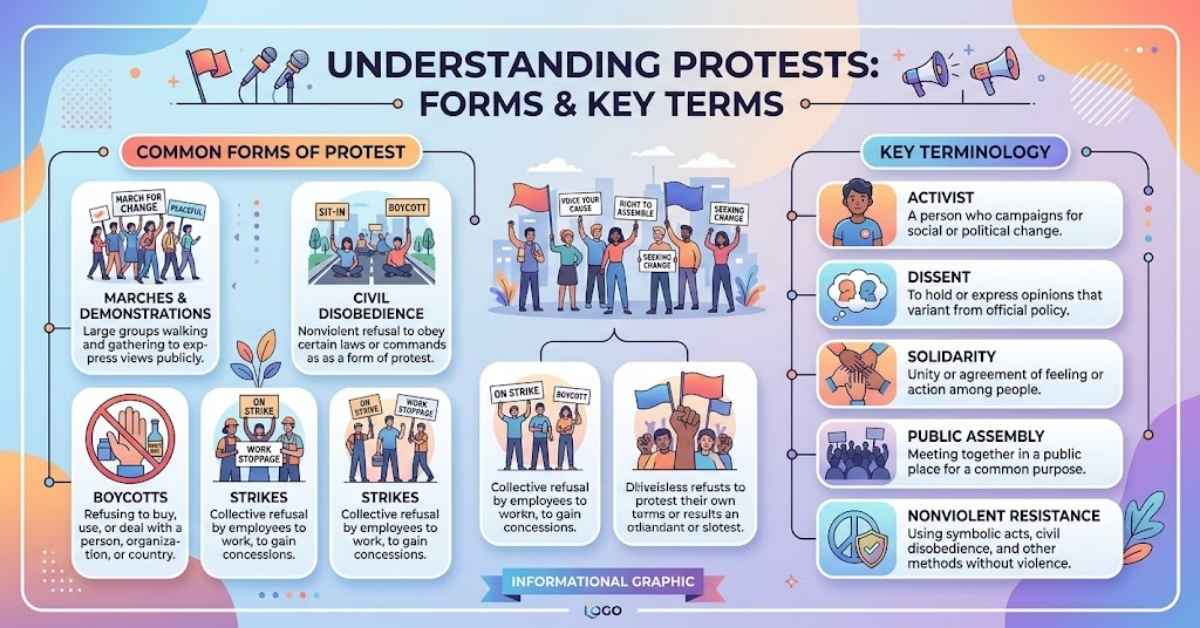
Protesters or protestors? If you have paused over these two spellings, you are not alone. Both forms are recognized in English, but “protesters” is the better default for most modern U.S. writing. “Protestors” is an accepted alternative spelling, not simply a spelling mistake. Cambridge’s U.S. dictionary lists protester and notes protestor as another form, while Merriam-Webster has a dedicated entry for protester.
So, if you are writing an essay, article, email, report, or website for an American audience, choose “protesters” unless you have a specific reason to preserve or follow “protestors.”
Protesters or Protestors: What Is the Correct Spelling?
Here is the simplest comparison:
| Word | Status | Meaning | General U.S. usage |
|---|---|---|---|
| protester | Standard, preferred default | A person who protests | Common |
| protesters | Plural of protester | More than one person who protests | Common |
| protestor | Recognized alternative | A person who protests | Less common |
| protestors | Plural of protestor | More than one person who protests | Less common |
The important point is that the meaning does not normally change.
For example:
The protesters gathered outside the building.
and
The protestors gathered outside the building.
Both sentences identify people taking part in a protest. The spelling is different, but the basic meaning is the same. Cambridge explicitly records protestor as an alternative form of protester.
Is “Protestor” a Real Word?
Yes.
It is too strong to describe protestor as simply an incorrect spelling. Cambridge lists it as an alternative form, and Wiktionary also identifies protestor as an alternative spelling of protester.
The more useful distinction is preferred versus alternative.
In other words:
- Protester — the usual choice for most general writing.
- Protestor — an established alternative that is less common.
This distinction matters because English contains many words with multiple accepted forms. A spelling can be less common without being an outright error.
What Does “Protester” Mean?
A protester is a person who publicly expresses disagreement, objection, or opposition.
The person might participate in a:
- protest
- march
- rally
- demonstration
- sit-in
- public campaign
- other form of organized protest
Cambridge defines a protester as someone who shows disagreement through actions such as standing somewhere, shouting, or carrying signs.
Merriam-Webster gives protester several senses, including a person who disagrees or disapproves.
For example:
The protester held a sign outside the courthouse.
The plural is:
The protesters held signs outside the courthouse.
What Is the Difference Between Protesters and Protestors?
The main difference is spelling preference, not meaning.
Both words describe someone who protests. Both can function as countable nouns, and both have singular and plural forms.
The practical difference is that protester is more familiar and is generally the safer default for contemporary American English.
Consider these forms:
| Singular | Plural |
|---|---|
| protester | protesters |
| protestor | protestors |
The pronunciation is also essentially the same in ordinary English speech. That is one reason the spelling can be confusing: you can hear the word without knowing which spelling the writer chose.
Why Do Both Spellings Exist?
English does not use a single perfectly consistent system for creating nouns that describe people who perform an action.
One common pattern is verb + -er:
- teach → teacher
- work → worker
- drive → driver
- write → writer
- protest → protester
But English also has many words ending in -or:
- act → actor
- edit → editor
- create → creator
- direct → director
- invent → inventor
That makes protestor look perfectly plausible to an English speaker.
The history of the word also helps explain why the alternative exists. Etymonline records protester and protestor historically and traces protester to the verb protest.
So it is better to think of protester as the established modern default rather than inventing an absolute rule saying that every verb must always take -er.
Protesters or Protestors in American English
For a U.S. audience, protesters is the straightforward choice.
Use protesters when you are writing:
- school assignments
- blog posts
- website content
- reports
- general correspondence
- informational articles
- most professional content
- general news-style writing
For example:
Hundreds of protesters gathered outside the state capitol.
The protesters called for changes to the policy.
Local protesters organized a peaceful demonstration.
Choosing the more familiar form makes the sentence immediately recognizable to most readers.
However, this does not mean that protestors suddenly becomes an invalid American-English word. The dictionary evidence supports treating it as an alternative spelling.
Is “Protestors” the British Spelling?
No.
This is one of the most common misconceptions.
There is no simple rule saying:
American English = protesters British English = protestors
Both forms can occur in different varieties of English.
Cambridge’s U.S. dictionary itself lists protester and identifies protestor as an alternative form.
So the difference should not be treated like:
- color vs. colour
- center vs. centre
- organize vs. organise
Those are well-known regional spelling differences. Protester vs. protestor is different.
For most general writing in either variety, protester is the more familiar default.
Which Spelling Should You Use?
If nobody has given you a particular style requirement, use protester/protesters.
A simple editorial rule is:
When in doubt, use “protester.”
That does not mean you must “correct” every occurrence of protestor. Context matters.
Follow a house style when one exists
If your employer, university, publication, or organization has a style guide that uses protestor, follow that established preference.
Consistency is often more important than changing an accepted alternative simply because another form is more common.
Preserve quotations accurately
Suppose a source or quotation uses protestors.
You generally should not silently rewrite the person’s spelling inside a direct quotation.
For example:
The organization described its members as “protestors.”
If you are quoting the source exactly, preserve the wording according to your publication’s quotation rules.
Don’t switch randomly
One of the easiest ways to make editing look careless is to use both forms in the same document without a reason.
For example:
The protesters arrived early. Later, the protestors spoke with reporters.
There is no obvious reason for the spelling change.
A cleaner version is:
The protesters arrived early. Later, the protesters spoke with reporters.
Pick a form and use it consistently.
Examples of “Protesters” in Sentences
Here are natural examples using the preferred general form:
- The protesters gathered outside the city hall.
- Hundreds of protesters marched through downtown.
- The protesters carried signs calling for reform.
- Several student protesters spoke with reporters.
- Police monitored the crowd as protesters entered the square.
- The mayor met with representatives of the protesters.
- Peaceful protesters gathered near the courthouse.
- The organizers asked protesters to remain in the designated area.
- Local protesters held a rally Saturday morning.
- The protesters’ signs were visible from across the street.
Notice the last example. Protesters’ contains an apostrophe because the signs belong to multiple protesters.
Examples of “Protestors” in Sentences
The alternative spelling can also be used:
- The protestors gathered outside the building.
- Several protestors spoke to reporters.
- The protestors carried banners during the demonstration.
- Police officers spoke with the protestors before the event.
- Local protestors organized a rally.
These sentences do not suddenly acquire a different meaning.
The important distinction is that protestors is less common as a general default, while protesters is the form most writers will usually choose.
Common Mistakes With Protesters and Protestors
1. Assuming “protestor” is always wrong
That is too absolute.
Better: Protestor is a recognized alternative spelling, while protester is generally the preferred default.
2. Assuming the words have different meanings
They normally do not.
Protester and protestor both refer to someone who protests.
3. Assuming “protestors” is exclusively British
It isn’t.
Both forms can appear in American and British English.
4. Mixing the spellings unnecessarily
Choose one form and remain consistent throughout your document.
5. Confusing singular and plural
Correct:
One protester arrived.
Correct:
Five protesters arrived.
Also possible:
One protestor arrived.
Five protestors arrived.
6. Misusing the possessive
Plural possessive:
The protesters’ signs were visible.
Singular possessive:
The protester’s sign was visible.
The apostrophe changes depending on whether the noun is singular or plural.
LEARN MORE: BYOE Meaning
Protester vs. Demonstrator: Are They the Same?
These words overlap, but they are not always perfect synonyms.
A protester specifically suggests someone expressing objection, disagreement, or opposition.
A demonstrator can refer more broadly to someone participating in a public demonstration.
In everyday news and general writing, the terms can overlap heavily.
For example:
Climate protesters marched downtown.
The word protesters highlights opposition or advocacy.
A sentence such as:
Hundreds of demonstrators gathered downtown.
focuses more on participation in a public demonstration.
This distinction can help you choose the most precise word rather than repeatedly using protester throughout an article.
A Simple Memory Trick
If you frequently forget which spelling to use, remember:
protest + er = protester
You can connect it with familiar words such as:
- teach → teacher
- work → worker
- drive → driver
- report → reporter
- protest → protester
This is a memory aid, not a universal rule for English word formation. English contains plenty of exceptions, including many words ending in -or.
What Does “Protesters or Protestors” Mean in Search Queries?
When someone types “protesters or protestors” into Google, they are usually not asking for a difference in definition.
They are asking:
Which spelling should I type?
The most useful answer is therefore:
Use “protesters” as your default spelling in modern U.S. English. “Protestors” is an accepted alternative spelling with the same basic meaning.
That answer is more accurate than simply labeling protestors “wrong.”
Frequently Asked Questions
Is it protesters or protestors?
Protesters is the preferred default for most modern U.S. writing. Protestors is also a recognized alternative spelling.
Is “protestor” a correct word?
Yes. Protestor is an established alternative spelling of protester, rather than merely a typing error. Cambridge explicitly lists it as an alternative form.
Which spelling is more common in American English?
Protester/protesters is generally the more familiar and widely used choice in contemporary general American writing.
Are protesters and protestors pronounced differently?
Generally, no meaningful pronunciation difference is intended. The distinction is primarily written spelling.
Is “protestors” the British spelling?
No. Protestors is not exclusively British. Both forms can appear in British and American English.
What is the singular of protesters?
The singular is protester.
Example:
One protester held a sign.
What is the plural of protestor?
The plural is protestors.
Example:
Several protestors gathered outside.
Can I use “protestors” in formal writing?
Yes, it is an established alternative. However, if you have no house-style requirement, protesters is generally the safer default for formal U.S. writing.
Should I use both spellings in the same article?
Usually, no. Choose one spelling and use it consistently unless there is a specific reason to preserve another spelling, such as a direct quotation or source-specific wording.
Final Answer: Protesters or Protestors?
Protesters is the spelling to choose when you need the most natural default for modern U.S. English.
But there is an important qualification: protestors is not simply “wrong.” It is a recognized alternative spelling of protester. Cambridge explicitly records the alternative, and historical sources show that both forms have existed.
So remember the distinction:
Protesters = preferred general default
Protestors = accepted alternative
Both refer to people who protest. If you are writing for an American audience and no specific style guide tells you otherwise, protesters is the clearest choice.