
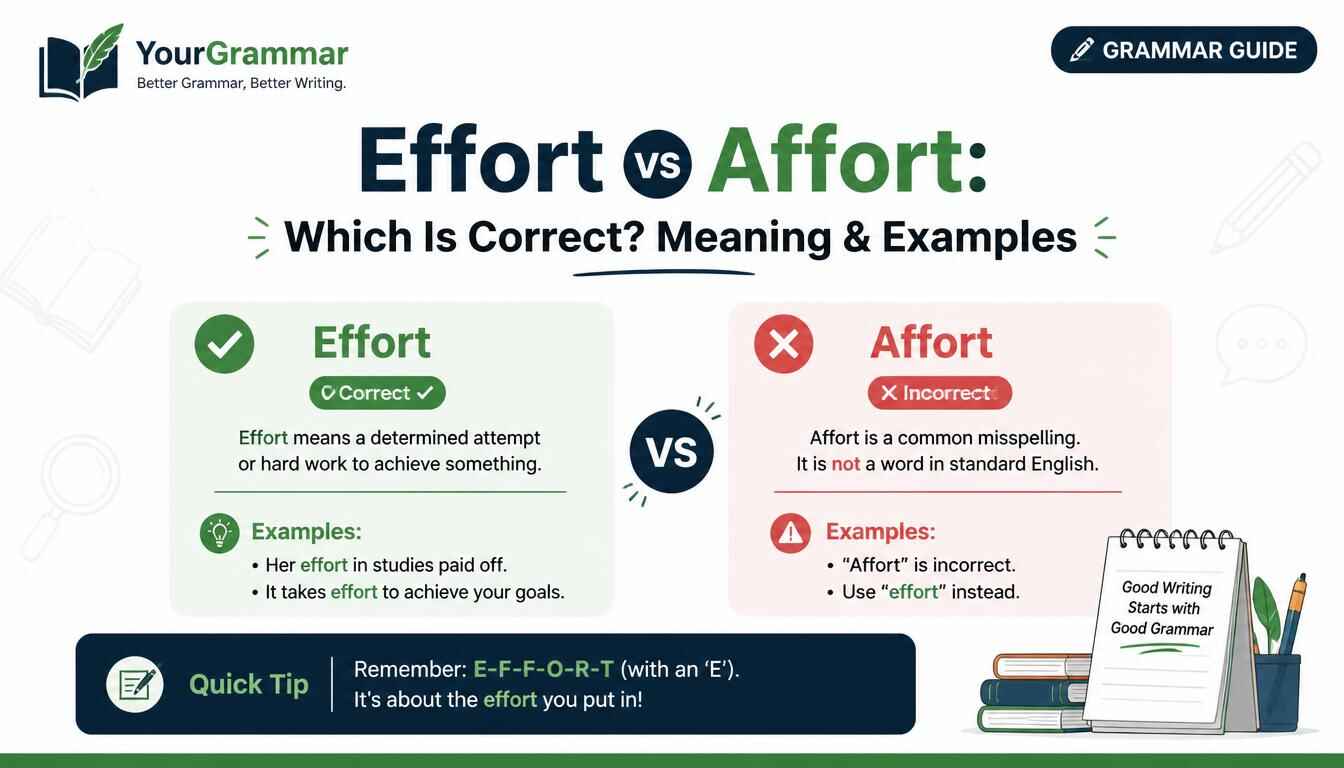
Effort vs affort is a common spelling question, but the answer is straightforward: effort is the correct standard English spelling. Affort is not the standard spelling of the word that means work, energy, exertion, or an attempt.
There is another word that can make this confusion especially easy: afford. Unlike affort, afford is a real English word, but it has a completely different meaning. Effort is about trying or using energy, while afford is about having enough money, time, ability, or resources to do something.
For example:
- She made an effort to help.
- We cannot afford a new car.
- She made an affort to help. ❌
In this guide, you’ll learn why effort is correct, what it means, why affort is commonly written by mistake, how effort differs from afford, and how to use effort naturally in everyday English.
Quick Answer: Effort or Affort?
Effort is the correct spelling when you mean work, energy, exertion, or an attempt to accomplish something.
Affort is not the standard English spelling of this word. If you see affort in ordinary English writing, it is usually a spelling mistake.
However, afford is a correct word with a different meaning. It usually means having enough money, time, ability, or resources to do or obtain something.
| Word | Correct? | Meaning | Example |
|---|---|---|---|
| Effort | Yes | Work, energy, exertion, or an attempt | She made an effort to help. |
| Afford | Yes | Have enough money, time, or ability | We can’t afford a new car. |
| Affort | No | Not the standard spelling of effort or afford | ❌ She made an affort. |
The easiest rule is:
Effort = trying or working. Afford = having the means or ability.
What Does “Effort” Mean?
Effort is a noun that generally refers to the work, energy, or exertion someone uses to accomplish something. It can also mean an attempt to do something.
The word can describe physical work, mental work, or simply someone’s attempt to achieve a particular result.
Effort as Work or Energy
When effort refers to work or energy, it describes how much energy is required or used.
For example:
Climbing the hill required a lot of effort.
Here, effort refers to the physical energy needed to climb the hill.
You can also use it for mental work:
Solving the puzzle took considerable effort.
And for general work:
The project required a great deal of effort from the entire team.
In each example, the focus is on the work or energy involved.
Effort as an Attempt
Effort can also describe an attempt to accomplish something.
She made an effort to arrive on time.
He made an effort to apologize.
They made every effort to solve the problem.
In these examples, effort is closely related to the idea of trying.
This is important because effort does not necessarily mean that the person succeeded.
Effort Does Not Always Mean Success
Someone can make a genuine effort without achieving the desired result.
For example:
He made an effort to fix the computer, but it still wouldn’t turn on.
The sentence tells us that he tried and put work into the task. It does not say that he succeeded.
Similarly:
Despite their efforts, the project was delayed.
This shows that effort and outcome are not the same thing. Effort describes the work or attempt, while the outcome describes what happened afterward.
Is “Affort” a Word?
For standard English usage, affort is not the correct spelling of the word effort.
If you want to describe work, energy, exertion, or an attempt, write effort.
Incorrect and Correct Examples
❌ She put a lot of affort into her studies.
✅ She put a lot of effort into her studies.
❌ Thank you for your affort.
✅ Thank you for your effort.
❌ The task required too much affort.
✅ The task required too much effort.
The important point is not simply that affort looks unusual. It is that effort is the established standard spelling for this meaning.
Could “Affort” Mean Something Else?
You may occasionally encounter unusual strings of letters online, including usernames, names, typing errors, or other nonstandard uses. That does not make affort the standard English spelling of effort.
So if you are writing a normal English sentence and mean work, energy, or an attempt, use effort.
Why Do People Confuse “Effort” and “Affort”?
There is no single reason everyone makes this mistake. Several things can make affort look plausible.
Spelling From Sound
People sometimes spell unfamiliar words according to how they think the word sounds.
The beginning of effort may not always be easy to identify in quick or casual speech. Someone who has heard the word many times but has not memorized its written form may therefore choose the wrong first vowel.
However, pronunciation is not a reliable way to determine English spelling. The standard written form is effort.
Confusion With “Afford”
This is an especially useful explanation.
Afford is a real English word, and it begins with aff-. Someone who knows afford but is uncertain about effort may unintentionally combine the spelling pattern of one word with the meaning of another.
Compare:
She made an effort to help.
with:
She couldn’t afford to help.
The words look somewhat similar, but their meanings are completely different.
Typing and Memory Errors
A person may also write affort because of:
- fast typing
- remembering the pronunciation but not the spelling
- unfamiliarity with the written word
- accidentally substituting the spelling pattern of afford
The practical solution is simple: determine what you mean first, then choose effort or afford.
Effort vs Afford: What’s the Difference? Effort vs Affort
The difference between effort and afford is one of the most useful things to understand when dealing with this spelling confusion.
Effort = Work, Energy, or Trying
Effort is a noun.
It describes work, energy, exertion, or an attempt.
She made an effort to improve her writing.
The sentence means that she tried and put work into improving.
Afford = Have Enough Means or Ability
Afford is a verb.
It generally refers to having enough money, time, resources, or ability to do or obtain something.
I can’t afford a new laptop.
Here, afford refers to having enough money.
But afford is not limited to money:
We can’t afford to waste another hour.
Here, the issue is time.
You can also use it more broadly for capacity or circumstances:
The company can’t afford to lose another customer.
The meaning is that the company cannot reasonably accept or manage that loss.
Grammar Gives You a Clue
The words also commonly appear in different grammatical structures.
| Word | Part of speech | Common structure |
|---|---|---|
| Effort | Noun | make an effort to + verb |
| Afford | Verb | can/can’t afford to + verb |
| Affort | — | Not standard English |
Compare:
She made an effort to finish early.
She couldn’t afford to stay another week.
The first sentence is about trying. The second is about having the means or ability.
This grammatical difference can help you identify the correct word when spelling alone is confusing.
The 3-Word Check: Effort, Afford, or Affort?
When you’re unsure which word belongs in a sentence, use this simple three-word check.
1. Do You Mean “Try” or “Work”?
Choose effort.
He made an effort to improve.
Ask yourself:
Am I talking about trying, working, energy, or exertion?
If yes, effort is probably the word you need.
2. Do You Mean “Have Enough”?
Choose afford.
We can’t afford to wait.
Ask yourself:
Am I talking about having enough money, time, resources, or ability?
If yes, use afford.
3. Did You Write “Affort”?
Stop and check which meaning you intended.
For example:
I can’t affort a new phone.
You probably mean:
I can’t afford a new phone.
But:
She made an affort to help.
should be:
She made an effort to help.
A Simple Memory Rule
Think:
E = Effort = Energy
If the sentence is about trying or using energy, think effort.
If it is about having enough resources or ability, think afford.
READ MORE >>> Insue or Ensue: Which Spelling Is Correct? Exclusive Guide 2026
How to Use “Effort” Correctly
Knowing the definition is helpful, but knowing the common sentence patterns makes your writing more natural.
Make an Effort
Make an effort is one of the most common expressions.
She made an effort to arrive early.
I made an effort to understand the instructions.
The common pattern is:
make an effort + to + verb
Make Every Effort
Use make every effort when emphasizing that someone is trying as much as possible.
We will make every effort to help you.
The team made every effort to meet the deadline.
Put Effort Into Something
This expression focuses on the work someone invests in a task or activity.
She puts a lot of effort into her writing.
He put considerable effort into the presentation.
The structure is:
put effort into + noun/activity
Put In Effort
You can also say put in effort.
You need to put in more effort.
They put a lot of effort into their training.
This is particularly common in everyday and conversational English.
Effort to + Verb
Effort can also appear directly with an infinitive phrase.
Her effort to improve her grades paid off.
Their effort to reduce costs was successful.
For multiple actions or attempts, the plural is also common:
Their efforts to improve the system were successful.
Effort or Efforts? Understanding the Difference
Both effort and efforts are correct. The choice depends on what you are describing.
When to Use “Effort”
Use singular effort when talking about work, energy, or contribution generally.
I appreciate your effort.
The task required a lot of effort.
His effort was impressive.
When to Use “Efforts”
Use plural efforts when referring to multiple actions, attempts, or contributions.
I appreciate your efforts to improve the situation.
Their efforts helped the community.
The difference is often one of emphasis rather than a completely different meaning.
A useful way to think about it is:
- effort → the work or energy generally
- efforts → particular actions or attempts
Effort vs Attempt vs Exertion
These words are related, but they are not always interchangeable.
| Word | Main emphasis | Example |
|---|---|---|
| Effort | Work, energy, or an attempt | Her effort was impressive. |
| Attempt | The act of trying | His first attempt failed. |
| Exertion | Use of physical or mental energy, often with strain | The climb required considerable exertion. |
Effort vs Attempt
Attempt focuses more directly on trying to accomplish something.
His first attempt to repair the bike failed.
Effort can focus on the work or energy involved.
He put a lot of effort into repairing the bike.
The two words can overlap, but the emphasis is different.
Effort vs Exertion
Exertion often emphasizes the use of energy, particularly when the activity requires physical or mental strain.
The exercise involved considerable exertion.
Effort is the more general everyday word:
The exercise required considerable effort.
Understanding these distinctions is more useful than simply memorizing a list of synonyms.
Effort in Different Contexts
Effort is used across many areas of everyday English.
At Work
Thank you for the effort you put into the presentation.
Here, effort refers to the work the person contributed.
At School
Her effort improved throughout the semester.
This refers to the work and application she put into her studies.
In Relationships
He made an effort to stay in touch.
Here, the word describes an intentional attempt.
In Fitness
The workout required considerable effort.
Here, effort refers primarily to physical energy.
In Problem-Solving
The team made every effort to find a solution.
Here, it describes a serious attempt to accomplish something.
These examples show why effort cannot be reduced to only “hard work.” Depending on context, it can describe energy, work, contribution, or an attempt.
Common Mistakes With “Effort”
Mistake 1: Writing “Affort” Instead of “Effort”
❌ She made an affort to help.
✅ She made an effort to help.
Why: The standard spelling is effort.
Mistake 2: Writing “Effort” When You Mean “Afford”
❌ I can’t effort a new computer.
✅ I can’t afford a new computer.
Why: The sentence is about having enough money to buy something.
Mistake 3: Using “Effort” as a Verb
❌ I effort to finish the project.
✅ I made an effort to finish the project.
✅ I put effort into finishing the project.
In ordinary modern English, effort is primarily used as a noun, so these natural noun constructions are preferable.
Mistake 4: Assuming “Affort” Is a British Spelling
❌ British English uses affort.
✅ British English uses effort.
There is no standard American/British spelling difference here.
Is “Effort” Spelled Differently in American and British English?
No. Effort has the same standard spelling in American and British English.
Unlike words such as color/colour or organize/organise, there is no standard regional spelling variation between effort and another form.
| English variety | Standard spelling |
|---|---|
| American English | effort |
| British English | effort |
So whether you are writing for a US audience, a UK audience, or another English-speaking audience, effort is the standard spelling.
Pronunciation: Why the Spelling Can Be Confusing
The pronunciation of effort begins with an “ef-” sound, but spoken language does not always make spelling obvious.
When people hear unfamiliar words in fast or casual speech, they may remember the sound imperfectly. This can lead to spelling errors when they later write the word.
That does not mean effort and affort are standard alternative pronunciations or spellings. Effort remains the correct spelling.
The best approach is to remember the written form rather than trying to reconstruct the spelling entirely from pronunciation.
How to Remember the Correct Spelling
Use one simple memory trick:
E = Effort = Energy
If you mean:
- energy
- exertion
- work
- trying
think:
E → Effort
Then remember the contrast:
Afford → have enough money, time, or ability
This is more useful than memorizing affort as simply “wrong,” because it helps you distinguish the two real words that are easiest to confuse.
Examples: Effort vs Affort in Sentences
Here are several examples that show the correct usage clearly.
Correct Use of “Effort”
She made an effort to arrive on time.
The project required a lot of effort.
I appreciate your effort.
He put considerable effort into his studies.
They made every effort to solve the problem.
Despite their efforts, the plan failed.
Incorrect Use of “Affort”
❌ She made an affort to arrive on time.
❌ The project required a lot of affort.
❌ I appreciate your affort.
In all three examples, replace affort with effort.
Effort vs Afford in Context
She made an effort to help her friend.
The sentence is about trying.
She couldn’t afford to miss work.
The sentence is about having the resources or ability to do something.
He put more effort into the project.
sentence is about work.
We can’t afford to waste another day.
The sentence is about whether there is enough time or capacity.
Frequently Asked Questions
Is “affort” a correct English word?
Affort is not the standard English spelling of effort. If you mean work, energy, exertion, or an attempt, use effort.
Is it “effort” or “affort”?
The correct spelling is effort.
What does “effort” mean?
Effort means the work, energy, or exertion used to accomplish something. It can also mean an attempt to do something.
Why do people spell “effort” as “affort”?
The mistake may come from spelling the word based on sound, typing errors, uncertainty about the spelling, or confusion with the real word afford.
What is the difference between “effort” and “afford”?
Effort is about trying, work, energy, or exertion.
Afford is about having enough money, time, ability, or resources to do or obtain something.
Is “effort” a noun or a verb?
Effort is primarily used as a noun in ordinary modern English.
For example:
She made an effort to help.
Rather than using effort as a verb, use a natural construction such as make an effort or put effort into something.
What is the plural of “effort”?
The plural is efforts.
For example:
Their efforts were appreciated.
What is the difference between “effort” and “attempt”?
An attempt emphasizes the act of trying to accomplish something. Effort can emphasize the work, energy, or exertion involved in that attempt.
Is “effort” the same in American and British English?
Yes. Effort is the standard spelling in both American and British English.
Is “make an effort” correct?
Yes. Make an effort is a common and natural English expression.
She made an effort to arrive early.
Is “put effort into” correct?
Yes.
He put a lot of effort into his work.
You can also say put in effort:
You need to put in more effort.
Conclusion
When choosing between effort vs affort, use effort if you mean work, energy, exertion, or an attempt. Affort is not the standard English spelling of that word.
The bigger source of confusion is often afford, which is a completely different word. Effort is about trying or working, while afford is about having enough money, time, ability, or resources. effort vs affort
A simple way to remember the difference is:
E = Effort = Energy.
If you’re talking about trying or putting energy into something, use effort. If you’re talking about whether you have enough resources or ability to do something, use afford.
Once you understand that distinction, effort, afford, and affort become much easier to tell apart. effort vs affort