
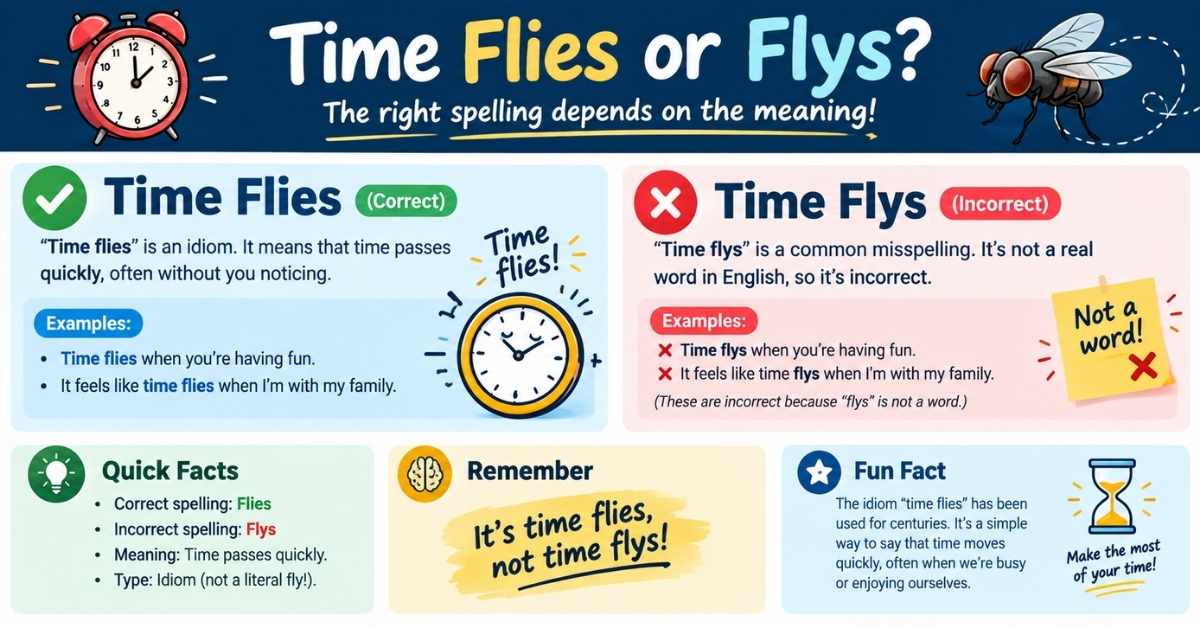
Time flies or flys may look like two possible spellings, but “time flies” is the correct expression. Write flies, not flys, because time is a singular subject and flies is the third-person singular present-tense form of the verb fly. The expression means that time seems to pass surprisingly quickly, especially when you’re busy, enjoying yourself, or looking back on an experience. Cambridge and Collins both recognize time flies as a standard English idiom or saying.
The simple rule is:
Time flies. ✅
Time flys. ❌
Once you understand why fly becomes flies, this spelling becomes much easier to remember.
Time Flies or Flys: Quick Answer
Use time flies in standard American English.
Correct:
Time flies when you’re having fun.
Time flies so quickly during vacation.
I can’t believe your son is already ten. Time flies!
Incorrect:
Time flys when you’re having fun.
The spelling flys does not work here because the verb fly changes to flies when its subject is third-person singular.
The rule is similar to:
try → tries
cry → cries
carry → carries
fly → flies
What Does “Time Flies” Mean?
Time flies means that time appears to pass much more quickly than expected.
Cambridge defines the expression as meaning that time passes surprisingly quickly, while Collins says it describes the feeling that time passes very quickly.
For example:
I can’t believe our vacation is already over. Time flies.
No one means that time literally grew wings and flew through the air.
Instead, the phrase describes our perception of passing time.
You often hear it when someone:
- notices how quickly children have grown,
- reaches an anniversary,
- finishes an enjoyable vacation,
- looks through old photographs,
- realizes several years have passed,
- spends time doing something engaging.
For example:
It feels like we graduated yesterday, but it has already been five years. Time flies.
The phrase can express surprise, nostalgia, happiness, or even sadness depending on the context.
Why Is It “Time Flies” Instead of “Time Flys”?
The answer comes from ordinary English grammar.
The sentence has:
Subject: time
Verb: fly
The noun time is grammatically singular.
In the simple present tense, a verb normally changes form with a third-person singular subject.
Compare:
I fly.
You fly.
We fly.
They fly.
But:
He flies.
She flies.
The plane flies.
Time flies.
So flies is not plural in this sentence. It is a singular present-tense verb form.
That distinction matters because some explanations incorrectly describe flies here as a plural form.
The Consonant + Y Spelling Rule
Why don’t we simply write flys?
Because fly ends in a consonant followed by y.
Its final two letters are:
l + y
When many English verbs ending in consonant + y take the third-person singular -s ending, the spelling changes:
y → i + es
Therefore:
fly → flies
Compare:
try → tries
cry → cries
study → studies
carry → carries
This is a normal English spelling pattern, not an unusual spelling that belongs only to fly.
Why “Play” Becomes “Plays” but “Fly” Becomes “Flies”
There is another part of the rule worth knowing.
If a vowel comes immediately before y, you normally keep the y and add s.
For example:
play → plays
enjoy → enjoys
stay → stays
But when a consonant comes before the y:
fly → flies
try → tries
cry → cries
Compare:
The child plays outside.
The bird flies outside.
Learning this contrast makes the spelling rule much easier to remember.
How to Spell Time Flies or Flys
If you’re specifically wondering how to spell time flies or flys, write:
TIME FLIES
The second word is spelled:
F-L-I-E-S
not:
F-L-Y-S
A quick memory pattern is:
fly → flies
Just as:
try → tries
If you remember that someone tries, it becomes easier to remember that time flies.
Is It “How Time Flies” or “How Time Flys”?
The correct expression is:
How time flies!
Not:
How time flys!
Oxford includes “How time flies!” as a standard example of the expression, used when someone is surprised by how quickly time has passed.
For example:
Your daughter is starting college already? How time flies!
It has been ten years since we moved here. How time flies!
This construction often carries more emotion than simply saying time flies.
It can communicate:
- surprise,
- nostalgia,
- disbelief,
- affection,
- reflection.
The grammar, however, remains the same:
time = singular subject
flies = correct verb
Is It “My, How Time Flies” or “My, How Time Flys”?
If you’re asking my how time flies or flys, the correct wording is:
My, how time flies!
The spelling is still flies.
The word my in this type of sentence is an interjection expressing surprise or emotion.
For polished punctuation, a comma after my is natural:
My, how time flies!
Example:
My, how time flies! It seems like only yesterday that you started school.
You can also omit my and simply say:
How time flies!
Both expressions are natural.
What Does “Time Flies When You’re Having Fun” Mean?
Time flies when you’re having fun means that time often seems to pass faster when you’re enjoying yourself.
Cambridge and Collins both use this sentence as a representative example of the expression.
Imagine spending a fun afternoon with close friends.
You arrive at 2 p.m., start talking, laughing, eating, and enjoying yourself. Suddenly you look at the clock and it’s already 8 p.m.
You might say:
Wow, time flies when you’re having fun.
The clock did not actually speed up.
Your experience of time made those hours feel shorter.
The expression is therefore figurative.
Is “Time Flies” an Idiom?
Yes.
Cambridge explicitly categorizes time flies as an idiom/saying.
Its meaning cannot be interpreted completely literally because time does not physically fly.
The phrase uses motion as an image for the rapid passage of time.
This makes it closely related to expressions such as:
Where did the time go?
The years flew by.
It was over in the blink of an eye.
Before I knew it, the day was over.
All describe the subjective feeling that time passed quickly.
Is “Time Flies” a Metaphor or Personification?
It can reasonably be discussed as figurative language.
The verb fly gives the abstract concept time a physical kind of movement.
Depending on how a teacher or stylistic analysis categorizes the sentence, it may be described as metaphorical and sometimes as personification-like imagery.
For ordinary writing, however, you don’t need to label the figure of speech. It functions naturally as a familiar idiom.
Time Flies, Time Flew, or Time Has Flown?
All three can be correct, but they refer to different grammatical time frames.
Present: Time Flies
Use flies for a general observation:
Time flies when we’re together.
Time flies as you get older.
Past: Time Flew
The ordinary past tense of fly is flew.
Example:
Time flew while we were on vacation.
The afternoon flew by.
Do not write:
Time flied.
when describing the normal passage of time.
Present Perfect: Time Has Flown
The past participle of fly is flown.
Therefore:
Time has flown.
Oxford gives “Time has flown since the holiday began” as an example connected with the expression.
Compare:
Time flies.
Present.
Time flew.
Past.
Time has flown.
Present perfect.
This three-form pattern is useful for both grammar and semantic SEO:
fly → flew → flown
while the third-person present is:
flies
Is “Time Flies By” Correct?
Yes.
Time flies by is a natural extension of the expression.
Example:
Time flies by when you’re busy.
The phrase emphasizes that time seems to pass rapidly.
Collins includes examples using time flies by in contemporary usage.
Past tense:
The weekend flew by.
Perfect form:
The last few years have flown by.
Flies vs. Fly’s in “Time Flies”
Never write:
Time fly’s
when you mean that time passes quickly.
The apostrophe form fly’s usually indicates possession or a contraction in a different context.
For example:
The fly’s wings are transparent.
That means:
the wings belonging to the fly
But in:
Time flies
there is no apostrophe.
Here, flies is a verb.
Correct:
Time flies.
Incorrect:
Time fly’s.
Incorrect:
Time flys.
Is “Flys” Ever Correct?
For the expression about rapidly passing time, no.
Always write:
time flies
A spelling such as Flys could appear in a proper name, brand, username, title, or another intentionally nonstandard context, but that has nothing to do with the English expression.
For ordinary writing:
time flies ✅
time flys ❌
American vs. British English: Is There a Difference?
No meaningful regional difference applies to this phrase.
Both American English and British English use “time flies.”
Oxford, Cambridge, and Collins all recognize the expression with the spelling flies.
So whether your audience is in:
the United States
the United Kingdom
Canada
Australia
or another English-speaking country, the standard phrase is:
time flies
Where Does the Expression “Time Flies” Come From?
The idea is strongly associated with the Latin expression tempus fugit, conventionally rendered in English as “time flies.”
The Latin wording is connected with Virgil’s Georgics, written in antiquity. Collins defines tempus fugit simply as “time flies,” while Dictionary.com traces the phrase to Virgil’s Georgics.
The literal Latin idea is closer to time fleeing or escaping, which fits the modern English sense remarkably well: time seems to disappear before we notice it.
However, you do not need to know Latin to use the English expression naturally.
How to Use “Time Flies” Naturally
Talking About Children Growing Up
I can’t believe she’s already sixteen. Time flies.
Looking Back on a Friendship
We’ve known each other for twenty years. How time flies!
After a Vacation
I can’t believe our trip is over already. Time flies when you’re having fun.
On an Anniversary
Ten years of marriage already—my, how time flies!
In an Email
It’s hard to believe it’s already been a year since our last meeting. Time flies.
Social Media
Five years ago today. How time flies!
Storytelling
The first few months felt slow, but after that, time flew by.
These examples show that the phrase works particularly well when the writer wants to emphasize surprise at the passage of time.
Can You Use “Time Flies” in Formal Writing?
Yes, but tone matters.
Time flies is a familiar idiom, so it works naturally in:
- personal essays,
- speeches,
- emails,
- memoirs,
- articles,
- social posts,
- informal business communication,
- narrative writing.
In highly technical or academic prose, a more literal phrase may fit better.
Instead of:
Time flies during periods of high engagement.
you might write:
People may perceive time as passing more quickly during highly engaging activities.
The first sounds conversational.
The second sounds more analytical.
Neither is inherently grammatically wrong; style determines which fits better.
LEARN MORE: Rehirable or Rehireable?
Common Time Flies vs. Flys Mistakes
Mistake 1: Writing “Time Flys”
Incorrect:
Time flys when you’re having fun.
Correct:
Time flies when you’re having fun.
Mistake 2: Thinking “Flies” Is Plural Here
In time flies, flies is a verb, not a plural noun.
Mistake 3: Writing “How Time Flys”
Incorrect:
How time flys!
Correct:
How time flies!
Mistake 4: Writing “Time Fly’s”
Incorrect:
Time fly’s.
Correct:
Time flies.
No apostrophe is needed.
Mistake 5: Using “Flies” for the Past
Incorrect:
Time flies quickly yesterday.
Correct:
Time flew quickly yesterday.
Mistake 6: Using “Flew” After Has
Incorrect:
Time has flew.
Correct:
Time has flown.
Easy Way to Remember Time Flies or Flys
Remember this short chain:
TRY → TRIES
FLY → FLIES
If try becomes tries, then fly becomes flies.
You can also memorize the famous sentence itself:
Time flies when you’re having fun.
Once that phrase looks natural to you, time flys will start to look obviously wrong.
Frequently Asked Questions
Is It Time Flies or Flys?
Time flies is correct. Time flys is not standard English.
How Do You Spell Time Flies?
Spell it:
T-I-M-E F-L-I-E-S
Why Is It Time Flies Instead of Time Flys?
Because fly ends in a consonant + y. In the third-person singular present tense, y changes to i and -es is added:
fly → flies
Is Flies a Verb in “Time Flies”?
Yes. Flies is a verb in this expression.
Time is the subject.
Flies is the predicate verb.
What Does Time Flies Mean?
It means that time seems to pass very quickly.
Is It How Time Flies or Flys?
Write:
How time flies!
Oxford uses this exact form as an example of the expression.
Is It “My How Time Flies” or “My How Time Flys”?
The correct spelling is:
My, how time flies!
The comma after my is natural because my functions as an interjection.
Is Time Flies an Idiom?
Yes. Cambridge identifies time flies as an idiom/saying meaning that time passes surprisingly quickly.
What Does “Time Flies When You’re Having Fun” Mean?
It means that enjoyable experiences can make time feel as though it passes more quickly.
Is “Time Flies By” Correct?
Yes.
Example:
Time flies by when we’re together.
What Is the Past Tense of “Time Flies”?
Use:
Time flew.
Example:
Time flew while we were on vacation.
Is “Time Has Flown” Correct?
Yes.
Flown is the ordinary past participle of fly.
Example:
Time has flown since we first met.
Is Time Fly’s Correct?
No. Do not use an apostrophe.
Correct:
Time flies.
Is “Time Flies” Correct in American English?
Yes. Time flies is the standard U.S. form.
Do British Writers Also Use “Time Flies”?
Yes. There is no meaningful U.S.-UK spelling difference for this expression.
Final Answer: Time Flies or Flys?
If you’re deciding between time flies or flys, the correct phrase is always time flies in standard English.
The grammar is simple:
time = singular subject
fly = base verb
flies = third-person singular present form
So write:
Time flies.
How time flies!
My, how time flies!
Time flies when you’re having fun.
For the past, use:
Time flew.
And with has:
Time has flown.
The easiest spelling rule to remember is:
consonant + y → change y to i and add -es
Therefore:
fly → flies
not:
fly → flys