
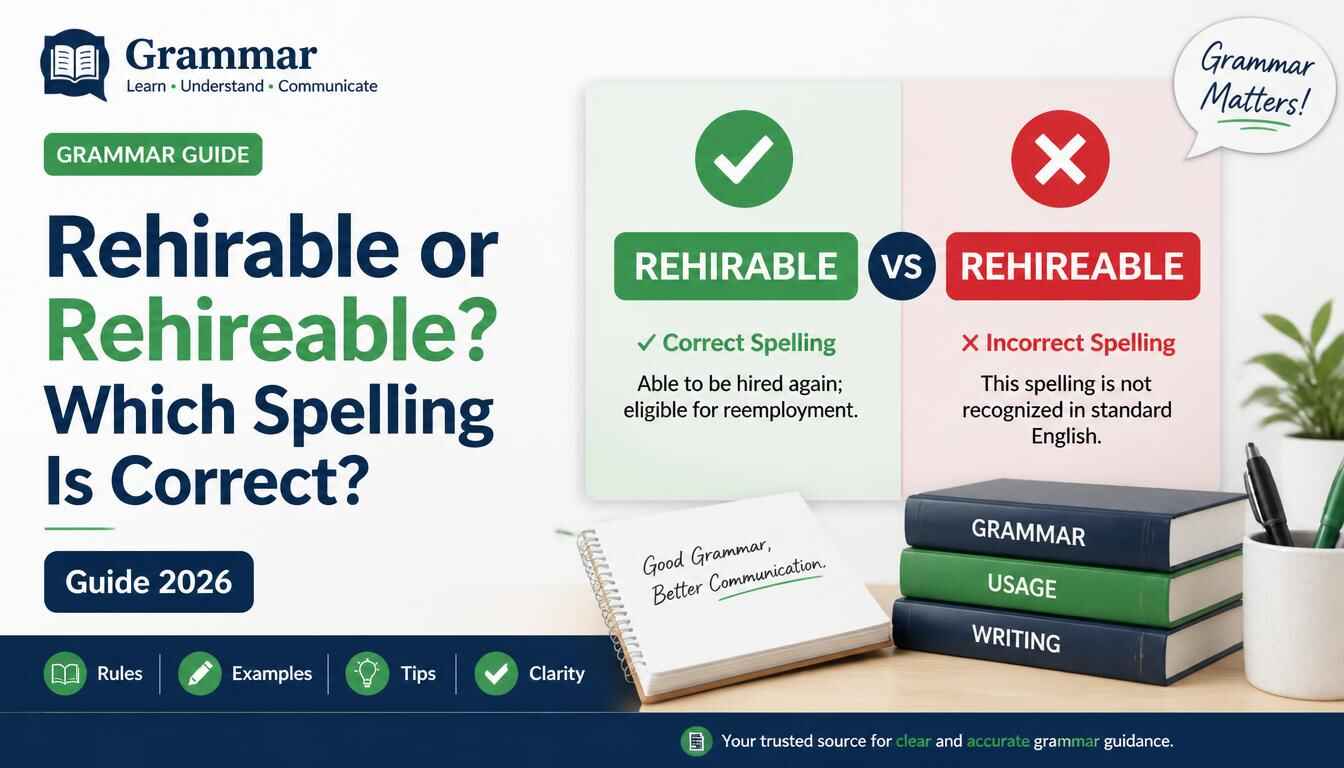
Rehirable or rehireable can be confusing because both spellings look reasonable, especially in workplace and HR contexts. If you need a concise adjective meaning that someone can potentially be hired again, rehirable is the better choice. Rehireable is also encountered and is generally intended to express the same idea. In formal HR writing, eligible for rehire can be even clearer.
The important point is that these words should not be confused with rehired. Someone who is rehirable may be considered for employment again, while someone who was rehired has actually been hired again.
This guide explains the difference between the two spellings, how the words are formed, what they mean, and which wording works best in professional and employment contexts.
Rehirable or Rehireable: Quick Answer

Rehirable is the preferred concise form when you need an adjective meaning “able or potentially eligible to be hired again.” Rehireable also appears in workplace usage and is generally intended to convey the same meaning.
For formal HR communication, eligible for rehire is often more explicit.
The distinction is:
- Rehirable = able or potentially able to be hired again.
- Rehireable = an alternative form used with the same intended meaning.
- Rehired = actually hired again.
- Eligible for rehire = meets the conditions to be considered for future employment.
The underlying verb rehire is well established in English and is commonly used to describe employing a former employee again.
Rehirable vs. Rehireable at a Glance
| Form | Meaning | Typical use |
|---|---|---|
| rehire | Hire someone again | Verb or noun |
| rehired | Hired again | Completed action |
| rehiring | Hiring again | Process or action |
| rehirable | Able or potentially eligible to be hired again | Concise adjective |
| rehireable | Alternative form intended to express the same idea | Workplace usage |
| eligible for rehire | Eligible to be considered for future employment | HR and formal communication |
The most important distinction is between rehirable and rehired.
If someone is rehirable, another job may be possible.
If someone was rehired, the hiring has already happened.
What Does “Rehirable” Mean?
Rehirable means that someone can potentially be hired again, usually by a former employer.
For example:
The former employee is rehirable.
This sentence suggests that the person could be considered for employment again. It does not say that the employer has offered the person another job.
Rehirable Meaning in Simple Terms
You can think of rehirable as:
Able or potentially eligible to be hired again.
The word is useful when talking about a former employee’s possibility of returning to an organization.
For example:
After leaving the company on good terms, Maria remained rehirable.
The sentence describes a possibility. It does not say that Maria actually returned to the company.
Examples of “Rehirable”
- “The former employee is considered rehirable.”
- “HR confirmed that he is rehirable.”
- “Employees who leave under certain circumstances may remain rehirable.”
- “The manager considers the former worker rehirable.”
- “She was marked as rehirable in the company’s records.”
The exact meaning of the status can depend on the employer’s own policies and terminology.
What Does Rehirable Not Mean?
Being rehirable does not necessarily mean that:
- the company currently has a job available;
- the company has promised to hire the person;
- the person will automatically be selected;
- the person can return without going through any hiring process;
- the person is currently employed;
- the person will return to the same position.
This distinction matters because eligibility or possibility is not the same as actual employment.
A former employee can potentially be considered for another position without having any guarantee of being hired.
What Does “Rehireable” Mean?
Rehireable is used to express essentially the same idea as rehirable: someone can potentially be hired again.
For example:
The HR system lists the former employee as rehireable.
The intended meaning is clear from the context.
The spelling looks natural because a writer may form it directly from:
rehire + able → rehireable
However, when choosing a concise adjective for polished general writing, rehirable is the more streamlined form.
This explains why both spellings can appear even though they are not normally intended to describe two different employment statuses.
Is “Rehireable” a Word?
This question deserves a more careful answer than simply calling the spelling “wrong.”
Rehireable is encountered in real-world workplace and HR writing, and readers can generally understand what it means. But actual usage does not automatically establish that a form is the preferred choice in edited professional English.
There are really three separate questions:
- Is the form used and understandable?
- Is it the preferred form?
- Is there a clearer way to express the idea?
For rehireable, the first answer is yes.
For a concise adjective, rehirable is the cleaner choice.
a formal employment status, eligible for rehire can be more explicit.
That distinction is more useful than simply labeling one spelling “right” and the other “wrong.”
Why Are “Rehirable” and “Rehireable” Spelled Differently?
The spelling becomes easier to understand when you look at how the words are formed.
The base verb is:
rehire
The prefix re- carries the idea of doing something again, while hire means to employ someone.
So:
hire → rehire
When the suffix -able is added, the resulting adjective expresses the idea of being capable of or suitable for an action.
That gives us:
rehire → rehirable
But a writer may also look at the complete word rehire and attach -able directly:
rehire + able → rehireable
That makes rehireable easy to understand, even though rehirable is the more concise established form to choose when you need an adjective.
Compare “Hire” and “Rehire”
The related word hirable makes the relationship clearer:
| Base word | Adjective | Meaning |
|---|---|---|
| hire | hirable | Able to be hired |
| rehire | rehirable | Able to be hired again |
So:
hirable → can be hired
rehirable → can be hired again
This is one reason rehirable fits naturally into the word family.
Why Does “Rehireable” Look So Natural?
There is a straightforward reason people hesitate between the two.
They see:
rehire + able
and naturally produce:
rehireable
That is understandable word formation.
However, English spelling does not always work by mechanically attaching a suffix to the full spelling of a base word. Established forms can follow different patterns, and usage also influences which forms become conventional.
For that reason, it is better to learn rehirable as the preferred concise form than to rely on an absolute rule claiming that every word ending in e behaves exactly the same way before -able.
Rehirable vs. Rehireable: Is There a Meaning Difference?
Generally, no established difference in meaning separates rehirable from rehireable.
Both forms are intended to describe someone who can potentially be hired again.
Compare:
The former employee is rehirable.
and:
The former employee is rehireable.
Both communicate essentially the same idea.
The main issue is usage and form, not two separate employment statuses.
It would be misleading to invent a distinction such as saying that one means “legally allowed to return” while the other means “the employer wants to hire the person.”
If you need to communicate a specific employment status, state it directly:
The former employee is eligible for rehire.
That wording tells the reader exactly what is meant.
Rehirable vs. Rehireable Comparison
| Feature | Rehirable | Rehireable |
|---|---|---|
| Basic intended meaning | Can potentially be hired again | Generally the same |
| Part of speech | Adjective | Adjective |
| Related verb | Rehire | Rehire |
| Established meaning difference | None generally established | None generally established |
| Concise professional choice | Preferred | Less streamlined |
| Can appear in workplace writing | Yes | Yes |
| Clear HR alternative | Eligible for rehire | Eligible for rehire |
The practical lesson is simple: do not treat these as two different employment categories.
READ MORE >>> Authorised or Authorized: Which Spelling Is Correct? Guide 2026
Rehirable vs. Rehired: They Are Not the Same
This is one of the most important distinctions in the topic.
Rehirable describes a possibility.
Rehired describes a completed action.
Compare:
John is rehirable.
with:
John was rehired.
The first means John can potentially be hired again.
The second means John actually received another job with the employer.
Rehirable Means Possible Future Employment
Suppose an employee leaves a company and remains eligible to return.
You could say:
The former employee is rehirable.
The statement does not tell us whether the person will actually return.
Rehired Means the Hiring Happened
Now imagine the company brings that employee back.
You could say:
The employee was rehired in 2026.
Here, the employment event has already occurred.
Rehire, Rehired, Rehiring, and Rehirable Explained
Understanding the whole word family can make the spelling much easier.
| Word | Meaning | Example |
|---|---|---|
| rehire | Hire someone again | “The company may rehire him.” |
| rehired | Already hired again | “She was rehired last year.” |
| rehiring | The process or action of hiring again | “The company began rehiring workers.” |
| rehirable | Able to be hired again | “He is rehirable.” |
| rehireable | Alternative form with the same intended meaning | “The system marks him as rehireable.” |
| eligible for rehire | Eligible to be considered for future employment | “She is eligible for rehire.” |
The core word rehire is established in both general and business English.
What Does “Eligible for Rehire” Mean?
Eligible for rehire is an important phrase in employment and HR writing.
In simple terms, it means that a former employee can potentially be considered for future employment under the employer’s applicable conditions.
The phrase is commonly used to describe the status of someone who previously worked for an organization and may be considered for another position.
The word eligible generally refers to meeting the necessary conditions or requirements for something.
Does “Eligible for Rehire” Mean You Will Be Rehired?
No.
This is one of the most important practical distinctions.
Consider:
Sarah is eligible for rehire.
That does not mean:
Sarah has a new job waiting for her.
It means she can potentially be considered for future employment.
The company may still have to determine whether there is an appropriate opening, whether Sarah meets the requirements of that position, and whether other hiring procedures apply.
So:
Eligible for rehire = can be considered
Rehired = was actually hired again
These are not the same thing.
Why “Eligible for Rehire” Can Be Clearer
Compare these two sentences:
John is rehirable.
John is eligible for rehire.
The first is shorter.
The second explicitly describes the person’s employment status.
That can make eligible for rehire useful in formal contexts such as HR documentation, employment forms, policies, and job applications.
Rehire Eligibility Can Depend on the Employer
There is no single rehire policy that applies identically to every employer.
Organizations can establish their own rules for determining whether former employees may be considered for future positions.
Depending on the organization, factors can include:
- the circumstances surrounding the employee’s departure;
- company policy;
- employment records;
- requirements for the new position;
- whether an appropriate position is available;
- the employer’s current hiring process.
Therefore, you should not interpret rehirable as a universal legal guarantee.
A former employee may be considered eligible for rehire while still needing to apply for a position and satisfy the requirements for that job.
Which Should You Use in Professional Writing?
The right choice depends on what you are trying to communicate.
Use “Rehirable” for a Concise Adjective
Use rehirable when you simply need an adjective describing the possibility of being hired again.
For example:
The former employee is considered rehirable.
This is short and understandable.
Use “Rehireable” When Matching Existing Terminology
If an employer, HR platform, database, or internal document specifically uses rehireable, you may need to preserve that wording when referring to its terminology.
For example:
The HR system lists the employee as rehireable.
In this situation, you’re describing the system’s label rather than making a claim about the preferred spelling in general English.
Use “Eligible for Rehire” When Clarity Matters Most
For formal employment communication, consider:
The employee is eligible for rehire.
This avoids ambiguity and makes the intended status explicit.
Rehirable vs. Eligible for Rehire: Which Is Clearer?
These expressions overlap, but they have different strengths.
| Situation | Suitable wording |
|---|---|
| Need a concise adjective | Rehirable |
| Formal HR communication | Eligible for rehire |
| Employment application question | Eligible for rehire |
| Referring to an employer’s existing system label | Match the system’s wording |
| Person has already returned to the company | Rehired |
| Talking about hiring someone again | Rehire |
| Describing the process | Rehiring |
A useful way to decide is to ask:
What exactly does my reader need to know?
If you mean that someone may be hired again, rehirable works.
If you mean that a former employee meets an employer’s criteria for consideration, eligible for rehire is more explicit.
the person has already returned to work, use rehired.
Can You Use “Rehirable” on a Resume?
You can use rehirable when the context specifically requires that information, but it is usually unnecessary on a general resume.
A resume normally focuses on qualifications, work experience, skills, education, and accomplishments.
If an application asks:
Are you eligible for rehire by a previous employer?
then answering the question directly is clearer:
Eligible for rehire: Yes
rather than changing the wording to:
Rehirable: Yes
The first answer matches the terminology used by the application and makes the intended status easier to understand.
When an HR System Says “Rehireable”
A common source of confusion is an HR system that uses rehireable as a field or status label.
Suppose a company’s internal database contains:
Rehireable: Yes
If you are referring specifically to that database field, preserving the system’s terminology can be appropriate.
This is different from claiming that rehireable is the universally preferred spelling.
Company Terminology vs. General English
An organization’s internal terminology can be specific to that organization.
Therefore:
- Internal system label: Match the organization’s wording when identifying the field.
- General professional writing: Prefer the clearer, more conventional form.
- Formal HR explanation: Consider eligible for rehire when you want the status to be immediately understandable.
This distinction is especially useful when you’re writing about HR software, employee records, or company policies.
Is There a US vs. UK Spelling Difference?
There is no strong basis for presenting rehirable and rehireable as a simple American-English-versus-British-English spelling pair.
The underlying word rehire is recognized in both US and UK English.
Some online explanations make more specific regional claims about rehirable and rehireable, but those claims should not be treated as an established US-versus-UK rule without stronger evidence.
For general professional writing, rehirable is the more streamlined adjective. If employment status needs to be especially clear, eligible for rehire avoids the spelling question altogether.
Common Mistakes With Rehirable and Rehireable
Mistake 1: Treating the Two Forms as Completely Different Words
The two spellings are generally intended to communicate the same basic concept.
The main difference is form and usage preference.
Mistake 2: Confusing “Rehirable” With “Rehired”
These words describe different situations.
Rehirable: can potentially be hired again.
Rehired: was actually hired again.
Mistake 3: Assuming Eligibility Guarantees a Job
Being eligible for rehire does not mean an employer has promised another position.
Eligibility means the person can potentially be considered.
Mistake 4: Assuming Every Employer Uses the Same Terminology
Companies can use different labels in their policies, databases, and employment forms.
An internal HR field should not automatically be treated as a universal English spelling rule.
Mistake 5: Inventing a Special Meaning for “Rehireable”
There is no established general rule that gives rehireable a completely different employment meaning from rehirable.
If a precise status matters, state the status directly.
Examples of Rehirable, Rehireable, and Related Terms
| Situation | Example |
|---|---|
| Potential future employment | “The former employee is rehirable.” |
| Alternative workplace spelling | “The HR system lists him as rehireable.” |
| Formal employment status | “She is eligible for rehire.” |
| Completed return to work | “She was rehired in 2026.” |
| Hiring someone again | “The company plans to rehire former employees.” |
| Hiring process | “The company began rehiring workers.” |
Each sentence answers a slightly different question.
The important part is not simply knowing which spelling looks right. It is knowing what stage or status you are describing.
A Simple Decision Guide
When you’re unsure which term to use, start with the meaning you want to communicate.
Has the person already been hired again?
Use:
Rehired
The company rehired James last year.
Could the person potentially be hired again?
Use:
Rehirable
James is rehirable.
Are you describing a formal HR status?
Use:
Eligible for rehire
James is eligible for rehire.
Are you referring to an employer’s existing HR system?
Use the terminology used by that system when you need to identify its specific field or label.
Are you simply choosing between the two spellings?
For a concise adjective, rehirable is the practical choice.
Important Facts to Remember
- Rehire means to hire someone again.
- Rehired means someone was actually hired again.
- Rehiring refers to the process or action of hiring again.
- Rehirable means someone can potentially be hired again.
- Rehireable is encountered as an alternative form with the same intended meaning.
- Eligible for rehire is a clear phrase for describing an employment status.
- Being eligible for rehire does not guarantee that someone will be hired again.
- Employer policies can affect rehire eligibility.
- An organization’s internal HR terminology may differ from general English usage.
- There is no need to invent a separate US/UK meaning for these two spellings.
Frequently Asked Questions
Is “rehirable” a word?
Yes. Rehirable functions as an adjective meaning that someone can potentially be hired again.
Is “rehireable” a word?
Rehireable is encountered in workplace and HR writing and is generally understandable. However, rehirable is the cleaner concise form, while eligible for rehire can be clearer in formal communication.
Is it rehirable or rehireable?
For a concise adjective, rehirable is the practical choice. Rehireable is also encountered and generally carries the same intended meaning.
How do you spell rehireable?
If you specifically need that form, it is spelled rehireable. However, if you are choosing a concise adjective for professional writing, rehirable is the more streamlined choice.
What does rehirable mean?
Rehirable means able or potentially eligible to be hired again, usually by a former employer.
Is rehirable the same as rehired?
No. Rehirable describes a possibility, while rehired describes an actual completed hiring event.
She is rehirable.
means she may be hired again.
She was rehired.
means the company actually hired her again.
What does “eligible for rehire” mean?
It means a former employee can potentially be considered for future employment under the employer’s applicable rules or criteria.
Does “eligible for rehire” mean I will be rehired?
No. Eligibility is not a guarantee of employment. A suitable position may not exist, and the employer may still require an application, interview, or other hiring steps.
Is “rehire” one word or two?
Rehire is normally written as one word when used as the modern verb or noun.
For example:
The company plans to rehire former employees.
Can I use “rehirable” on a resume?
You can if the context specifically calls for it, but it is usually unnecessary on a general resume. If a job application asks whether you’re eligible for rehire, use the wording provided by the application.
Why do people spell it “rehireable”?
The spelling looks natural because writers may see rehire + able and preserve the final e. That produces rehireable. The shorter form rehirable fits the relationship between hire and hirable more closely.
Is there a British and American difference between rehirable and rehireable?
There is no strong basis for treating these two forms as a straightforward British-versus-American spelling difference. The underlying word rehire is established in both varieties of English.
What if my employer’s HR system says “rehireable”?
If you are referring specifically to the employer’s system or its official field name, retaining the system’s terminology can make sense. That does not necessarily mean rehireable is the preferred spelling for general English writing.
Conclusion
When choosing between rehirable or rehireable, remember that both forms are generally used to express the same basic idea: someone can potentially be hired again.
For a concise adjective, rehirable is the practical choice. Rehireable is also encountered, particularly in workplace and HR contexts, so it is more useful to understand it as an alternative form than to assign it a completely different meaning.
The more important distinction is between rehirable, rehired, and eligible for rehire:
- Rehirable describes potential future employment.
- Rehired describes an actual return to employment.
- Eligible for rehire describes a former employee’s potential eligibility under an employer’s rules.
If you are writing a formal HR document, job application, or employment record and want the meaning to be immediately clear, eligible for rehire is an explicit choice.
If you simply need a concise adjective, rehirable is the better choice.