
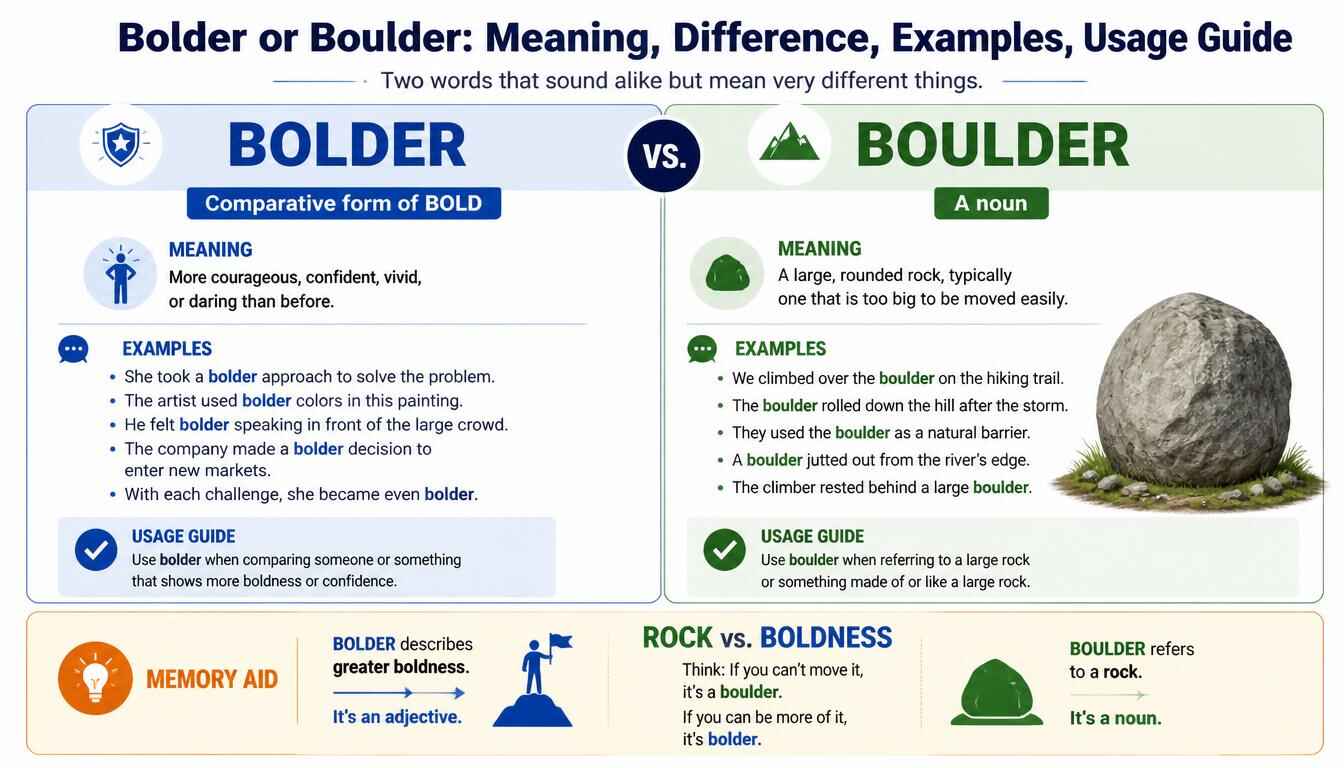
Bolder or Boulder which spelling is correct? Both words are spelled correctly, but they have completely different meanings. Bolder means more bold, confident, daring, or noticeable, while a boulder is a large rock. The two words are pronounced alike in standard American English, making them easy to confuse. The right choice depends on what you want to say: describing a stronger personality or a more striking design requires bolder, while talking about a large rock requires boulder.
Bolder or Boulder: Quick Answer
The difference between bolder and boulder comes down to meaning and grammar. Bolder is the comparative form of the adjective bold, while boulder is a noun referring to a large rock. Although they sound the same, they cannot be used interchangeably.
| Word | Meaning | Part of Speech | Example |
|---|---|---|---|
| Bolder | More confident, daring, or striking | Comparative adjective | She made a bolder decision. |
| Boulder | A large rock | Noun | A boulder blocked the path. |
Easy way to remember: If you mean “more bold,” use bolder. If you mean a large rock, use boulder.
Bolder or Boulder Meaning: What Does Each Word Mean?
Understanding the individual meanings makes choosing the correct spelling much easier. Although the words share the same pronunciation, one describes a quality or degree, while the other names a physical object.
What Does Bolder Mean?
Bolder is the comparative form of bold, an adjective used to describe someone or something that shows courage, confidence, directness, or a strong visual presence.
When you use bolder, you are comparing one person, action, idea, or object with another. It generally means more bold.
For example:
- Confidence: “She became bolder when speaking in public.”
- Courage: “The firefighter made a bolder move to rescue the trapped dog.”
- Decision-making: “He chose a bolder approach to solve the problem.”
- Design: “The designer selected bolder colors for the new collection.”
- Communication: “Her second presentation included a bolder argument.”
In each sentence, bolder describes a quality that has increased or is greater in comparison with something else.
The adjective follows this pattern:
Bold → Bolder → Boldest
- Bold: He has a bold personality.
- Bolder: He has a bolder personality than his brother.
- Boldest: He made the boldest decision of his career.
Remember that bolder does not only describe people. It can also refer to colors, fonts, ideas, strategies, statements, and creative choices.
What Does Boulder Mean?
A boulder is a large rock, typically found in natural environments such as mountains, forests, riverbanks, and hiking trails. It can also appear in landscaping and construction.
Unlike bolder, the word boulder names a physical object rather than describing a quality.
Here are some examples:
- “A huge boulder rested at the foot of the mountain.”
- “The hikers carefully climbed over a boulder on the trail.”
- “Heavy rain caused a boulder to slide onto the road.”
- “They placed a decorative boulder in the garden.”
- “The river flowed around a smooth boulder.”
In these examples, boulder refers to a large rock that someone can see, encounter, climb around, or move.
There is no single everyday size measurement that determines whether every rock should be called a boulder. The word generally refers to a rock that is notably large in its surroundings.
Is It Bolder or Boulder Rock?
If you are referring to a large rock, boulder is the correct word.
The phrase boulder rock may be understood, but it is often unnecessarily repetitive because a boulder is already a type of rock. In most sentences, simply using boulder sounds more natural.
Compare these examples:
- Natural: A large boulder blocked the hiking trail.
- Also correct: A large rock blocked the hiking trail.
- Less concise: A large boulder rock blocked the hiking trail.
However, if you are describing something as more daring or visually striking, use bolder instead.
- “The artist chose a bolder color for the painting.”
- “The climbers stopped beside a large boulder.”
The key is to decide whether you mean a quality that is stronger or a physical rock.
Bolder and Boulder Homophones: Do They Sound the Same?
Yes. Bolder and boulder are homophones in standard American English. Homophones are words that share the same pronunciation but have different meanings and spellings.
Other familiar examples of homophones include their and there, or write and right.
Because bolder and boulder sound alike, you may not be able to identify the intended spelling by hearing the word alone. The surrounding sentence provides the necessary clue.
For example:
- “We need a bolder plan.” The speaker wants a more daring plan.
- “We need to move the boulder.” The speaker is referring to a large rock.
The pronunciation remains essentially the same, but the meaning changes completely.
How to Pronounce Bolder and Boulder
Both words are commonly pronounced approximately BOHL-der in American English.
Their similar pronunciation explains why people sometimes confuse them in text messages, emails, school assignments, and other writing.
When proofreading, do not rely on how the word sounds. Instead, consider the sentence’s meaning:
- If the word describes something more confident, daring, or striking, choose bolder.
- If it names a large rock, choose boulder.
This simple context-based approach is more reliable than trying to distinguish the words by sound.
Are Bolder and Boulder Interchangeable?
No. Although they are homophones, bolder and boulder are not interchangeable.
Using one instead of the other can make a sentence confusing or unintentionally humorous.
Consider these examples:
Incorrect: “She wanted to be boulder during the interview.”
Correct: “She wanted to be bolder during the interview.”
The sentence describes confidence, so bolder is appropriate.
Now consider another example:
Incorrect: “A bolder blocked the entrance to the cave.”
Correct: “A boulder blocked the entrance to the cave.”
Here, the sentence refers to a physical object, so boulder is the correct choice.
Bolder in a Sentence: Examples You Can Actually Use
The easiest way to understand bolder is to see how it works in everyday situations. It can describe personal confidence, creative decisions, communication, or anything that becomes more noticeable or daring.
Bolder in Everyday Conversation
- “I feel bolder about sharing my opinion now.”
- “She became bolder after practicing her speech.”
- “He made a bolder choice this time.”
- “You should take a bolder step toward your goals.”
- “Their new approach was bolder than the previous one.”
These examples show how bolder describes an increase in confidence, courage, or willingness to take action.
Bolder in Work, School, and Decision-Making
- “The company introduced a bolder marketing campaign.”
- “Her essay presents a bolder argument than her earlier draft.”
- “The student asked a bolder question during class.”
- “Our team needs a bolder strategy to compete.”
- “He made a bolder proposal during the meeting.”
In professional and academic writing, bolder often describes an idea or approach that is more direct, ambitious, or unconventional.
Bolder in Art, Fashion, and Design
The word also has an important visual meaning. Something can be bolder because it attracts more attention, uses stronger colors, or creates a more striking appearance.
Examples include:
- “The designer chose bolder colors for the new collection.”
- “A bolder font made the headline stand out.”
- “She added bolder patterns to the living room.”
- “The second logo uses a bolder design.”
- “The artist created a bolder contrast between light and dark.”
In these sentences, bolder does not mean braver. It means more visually striking or noticeable.
Bolder in a Sentence: Incorrect vs. Correct
| Incorrect sentence | Correct sentence | Why? |
|---|---|---|
| She chose a boulder color for the room. | She chose a bolder color for the room. | The color is more striking. |
| He wanted to be boulder during the interview. | He wanted to be bolder during the interview. | The sentence describes confidence. |
| The company needs a boulder strategy. | The company needs a bolder strategy. | The strategy should be more daring. |
| Her second design looks boulder. | Her second design looks bolder. | The design is more noticeable. |
Notice that the incorrect versions still contain recognizable English words. That is precisely why this mistake can slip through basic spelling checks.
Boulder in a Sentence: Examples of the Correct Usage
Unlike bolder, the word boulder refers to a large rock. You will commonly encounter it in descriptions of outdoor adventures, landscapes, geology, and construction.
Boulder in Nature and Outdoor Activities
- “A massive boulder sat beside the hiking trail.”
- “The river flowed around a smooth boulder.”
- “The climbers carefully moved past the boulder.”
- “A large boulder stood near the entrance to the cave.”
- “The storm pushed loose rocks and a boulder down the hillside.”
These sentences describe physical objects in natural settings.
Boulder in Landscaping and Construction
- “They placed a decorative boulder near the garden entrance.”
- “Workers removed a boulder from the construction site.”
- “The landscaping plan included several large boulders.”
- “A boulder had to be cleared before the road could reopen.”
- “The architect used natural boulders to create a rugged outdoor design.”
The plural form is boulders, which refers to more than one large rock.
Boulder in a Sentence: Incorrect vs. Correct
| Incorrect sentence | Correct sentence | Why? |
|---|---|---|
| The bolder blocked the road. | The boulder blocked the road. | The word refers to a large rock. |
| We climbed over a bolder on the trail. | We climbed over a boulder on the trail. | The object is a rock. |
| A huge bolder rested beside the river. | A huge boulder rested beside the river. | The sentence describes a physical object. |
| The workers moved several bolders. | The workers moved several boulders. | The plural noun is boulders. |
The simplest way to check these sentences is to ask whether the word represents something physical that can be found in a landscape. If it does, boulder is probably the intended word.
Bolder vs. Boulder: The Easiest Way to Remember the Difference
You do not need to memorize complicated spelling rules to distinguish these words. Two straightforward memory cues are enough for most situations.
Remember That Bolder Comes From Bold
Think of the familiar adjective bold. When you want to describe something as more bold, you use bolder.
The pattern is:
- Bold → Bolder
- Tall → Taller
- Bright → Brighter
- Fast → Faster
The ending -er commonly forms comparative adjectives, although English has other comparative patterns too.
For example, “Her second idea was bolder than her first” compares two ideas. The word describes a difference in degree.
Memory tip: If you can replace the word with “more bold,” use bolder.
Picture a Boulder as a Big Rock
To remember boulder, picture a large rock on a mountain, beside a river, or along a hiking trail.
For example, in the sentence “The hikers rested beside a boulder,” you can visualize the object being described. Because the sentence names a rock rather than a quality, boulder is the correct spelling.
Memory tip: If you can point to the large rock you mean, use boulder.
A Two-Question Test for Choosing the Right Word
When you are unsure which spelling to use, ask yourself these two questions:
Question 1: Am I describing someone or something as more confident, daring, direct, or visually striking?
- Yes: Use bolder.
- Example: “We need a bolder design.”
Question 2: Am I naming a large rock?
- Yes: Use boulder.
- Example: “A boulder lay beside the road.”
If neither meaning fits, reread the sentence and identify the idea you are trying to communicate. Context is the deciding factor.
READ MORE >>> Scarey or Scary: Which Spelling Is Correct? Exclusive Guide
Common Bolder and Boulder Mistakes to Avoid
Even experienced writers can confuse words that sound alike. The best way to avoid this mistake is to understand how the words function in a sentence rather than depending entirely on a spell-checker.
Choosing the Word by Sound Alone
Because bolder and boulder are homophones, listening to the sentence may not help you select the correct spelling.
For example, if someone says, “The design needs to be bolder,” you must understand that the person wants a more striking design. The sentence has nothing to do with a rock.
Practical tip: When editing, identify what the word refers to before checking its spelling.
Confusing Bolder With Boulder in Spell-Check
Most basic spell-checkers recognize both bolder and boulder as valid English words. If you accidentally type one in place of the other, the software may not flag the error.
For example:
- Intended meaning: A more daring proposal.
- Typed sentence: “She presented a boulder proposal.”
- Correct sentence: “She presented a bolder proposal.”
The spelling tool may accept boulder, but the sentence does not communicate the intended meaning.
To catch this type of error, proofread for meaning as well as spelling. Reading a sentence slowly and asking whether the word makes sense in context can reveal mistakes that automated tools miss.
Forgetting That Bolder Can Describe Things, Not Just People
Some writers assume bolder only describes brave or confident people. In reality, it can describe a wide range of things.
You can use it for:
- Colors: bolder shades of blue.
- Designs: a bolder visual style.
- Ideas: a bolder proposal.
- Statements: a bolder claim.
- Strategies: a bolder business plan.
- Actions: a bolder decision.
Whenever you mean “more daring,” “more confident,” or “more striking,” bolder may be appropriate.
Confusing Boulder With Boulder, Colorado
Boulder is also the name of a city in Colorado, United States. In that context, it is a proper noun and is capitalized.
Compare these sentences:
- “They visited Boulder, Colorado, during their vacation.”
- “A large boulder rested near the campsite.”
The first refers to a city, while the second refers to a rock. Capitalization and context help identify the intended meaning.
Test Yourself: Bolder or Boulder?
Try completing these sentences before looking at the answers. Each one tests whether you can distinguish a comparative adjective from a noun.
- She made a _____ decision than she did last year.
- A massive _____ rested beside the river.
- The artist selected _____ colors for the poster.
- We had to walk around the _____ on the hiking trail.
- He grew _____ after gaining experience.
- The construction crew removed several _____ from the site.
- The company needs a _____ approach to reach new customers.
- A large _____ blocked the entrance to the cave.
Answers and Explanations
- Bolder — It describes a decision that is more daring.
- Boulder — It refers to a large rock.
- Bolder — It describes colors that are more striking.
- Boulder — It names a physical object on the trail.
- Bolder — It describes increased confidence.
- Boulders — This is the plural form of the noun.
- Bolder — The company wants a more daring approach.
- Boulder — It refers to a rock blocking an entrance.
If you answered all eight correctly, you understand the central difference. If you missed a few, return to the two-question test: more bold or a large rock?
Frequently Asked Questions About Bolder or Boulder
Is It Bolder or Boulder?
Both spellings are correct, but they have different meanings. Bolder means more bold, confident, daring, or striking. Boulder means a large rock. Choose the word that matches the meaning of your sentence.
Is It Bolder or Boulder Rock?
If you mean a large rock, use boulder. The phrase boulder rock is generally repetitive because a boulder is already a type of rock. For example, “A boulder blocked the road” is concise and natural.
Are Bolder and Boulder Homophones?
Yes. Bolder and boulder are homophones in standard American English because they are pronounced alike but have different meanings and spellings. Their pronunciation does not tell you which spelling is correct; the sentence’s meaning does.
What Does Bolder Mean in a Sentence?
In a sentence, bolder means more confident, daring, direct, or visually striking than something else. For example, “She made a bolder choice” means her choice was more daring than another choice or her earlier decision.
How Do You Use Boulder in a Sentence?
Use boulder as a noun when referring to a large rock. For example, “A huge boulder lay beside the mountain trail.” The word can also be used in landscaping, construction, and descriptions of natural environments.
What Is the Difference Between Bold, Bolder, and Boldest?
Bold is the basic adjective, bolder is its comparative form, and boldest is its superlative form.
- Bold: She is bold.
- Bolder: She is bolder than before.
- Boldest: She made the boldest choice of all.
Can Spell-Check Tell the Difference Between Bolder and Boulder?
Not always. Both are correctly spelled words, so a basic spell-checker may accept either one even when it is used incorrectly. Read the sentence for meaning and proofread the surrounding words to catch the mistake.
Final Verdict: Which Word Should You Use?
The difference between bolder or boulder is simple once you focus on meaning instead of pronunciation.
Use bolder when describing something that is more confident, daring, direct, or visually striking. Use boulder when referring to a large rock.
Remember these two examples:
- “She chose a bolder design for the website.”
- “A large boulder blocked the hiking trail.”
Both words are correct, and both sound alike in standard American English. The right spelling depends on what you want your sentence to communicate.