
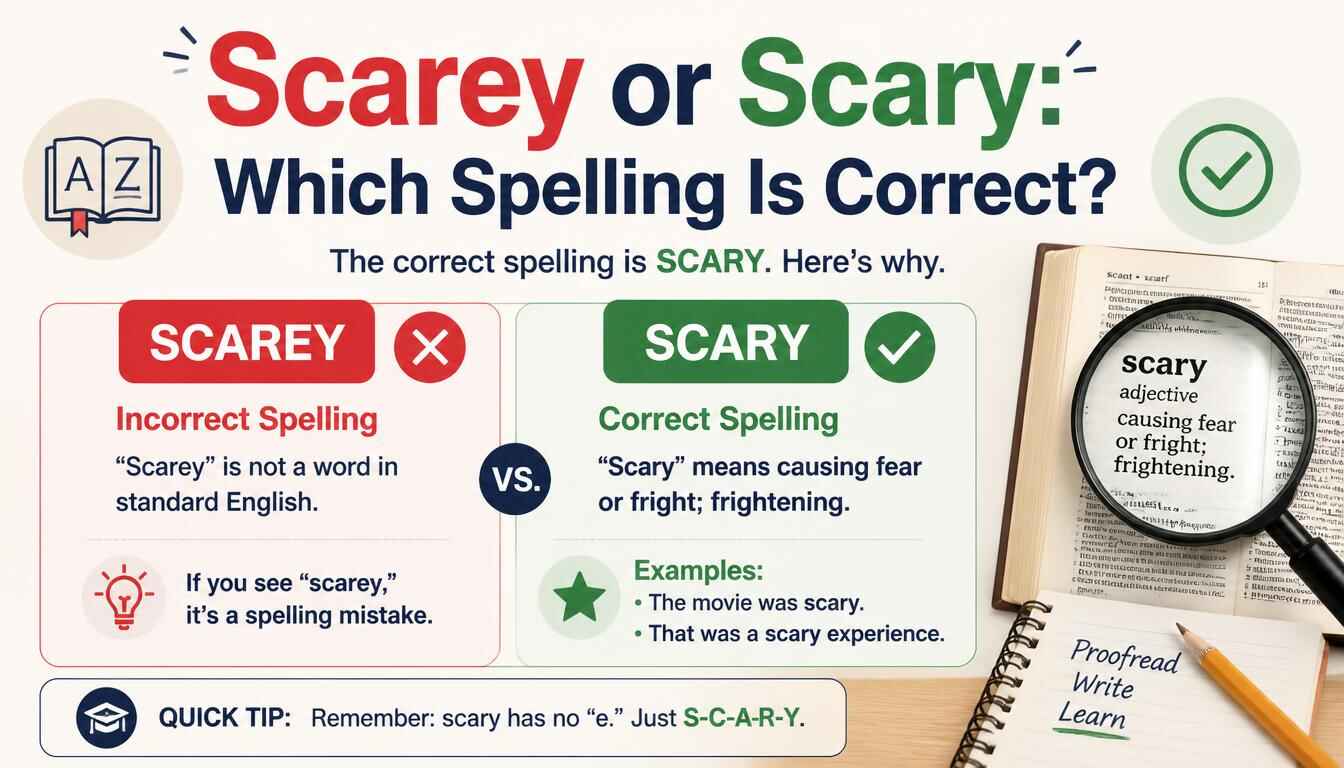
Scarey or Scary—which spelling should you use? Scary is the standard spelling in American English. It means frightening or causing fear, as in “That was a scary movie.” Although scarey is recorded as a variant spelling in some dictionaries, scary is the safest choice for school assignments, professional writing, and everyday communication in the United States.
Both spellings may look reasonable because the word scare ends in an e. However, when you turn scare into the adjective scary, the final e disappears. Understanding this small spelling change can help you avoid the same mistake in your writing.
Scarey or Scary: Quick Comparison
| Word | Meaning or usage | Recommended spelling |
|---|---|---|
| Scary | Frightening or causing fear | Standard choice in American English |
| Scarey | A variant spelling recorded in some dictionaries | Not the preferred default in US writing |
Quick answer: Use scary, not scarey, when writing standard American English. If you encounter scarey in a book, online post, or other text, remember that a recorded variant is not necessarily the most appropriate spelling for every situation.
What Does Scary Mean?
The word scary is an adjective that describes something that causes fear, nervousness, or a feeling of danger. It can refer to something mildly unsettling, such as a strange noise at night, or something genuinely frightening, such as a dangerous situation.
Scary Meaning and Definition
The meaning of scary is frightening, alarming, or likely to make someone feel afraid.
For example:
- “The scary movie kept me awake all night.”
- “It was scary to hear footsteps outside the empty house.”
- “Driving through the storm was a scary experience.”
- “The sudden loss of electricity made the room feel scary.”
In each sentence, scary describes the thing or experience that causes fear.
The word can also be used informally to describe a situation that creates anxiety or uncertainty. Someone might say, “Starting a new job can be scary,” even when there is no immediate physical danger.
How Scary Is Used in Everyday English
The word appears in several common expressions:
- Scary movie: A film intended to frighten or unsettle viewers.
- Scary story: A story designed to create fear or suspense.
- Scary situation: An event that makes someone feel unsafe or worried.
- Scary experience: Something frightening that a person has experienced.
- Scary thought: An idea that creates fear or anxiety.
The exact meaning depends on context. A scary movie may be entertaining because it creates suspense, while a scary medical result or financial situation may cause genuine concern.
How to Spell Scary Correctly
The correct standard spelling is scary.
It contains five letters:
S – C – A – R – Y
The common misspelling scarey adds an unnecessary e between the final r and y. Although that spelling may seem logical because the related word scare contains an e, the adjective is spelled scary.
Why Is Scary Spelled Without an E?
The word scary is related to the verb scare, which means to frighten someone. However, the two words have different endings.
Compare these forms:
| Base word | Correct form | Example |
|---|---|---|
| Scare | Scary | The dark forest looks scary. |
| Scare | Scared | I was scared by the noise. |
| Scare | Scaring | The sudden sound is scaring the cat. |
When scary is formed from scare, the final e is dropped before adding -y.
This is why the spelling is scary, not scarey. The same change does not apply automatically to every word ending in e, so it is helpful to learn common word forms individually.
An Easy Way to Remember the Spelling
Try connecting the word to its meaning:
- Scare is the action of frightening someone.
- Scary describes something that causes fear.
- Scared describes someone who feels fear.
Remember the phrase “a scary situation” rather than trying to add the e from scare. Repeating the correct form in a few everyday sentences can also make it easier to remember.
Is Scarey a Word?
Yes, scarey is recorded as a variant spelling in some dictionaries. However, this does not mean it is the preferred spelling in standard American English.
This distinction matters because people often assume that a word must be either completely correct or completely nonexistent. In reality, dictionaries can record variant spellings, historical forms, regional forms, and less common alternatives.
For most US readers and writers, scary remains the recommended spelling.
What Dictionaries Say About Scarey
Some dictionaries, including Collins, record scarey as a variant of scary. That evidence supports describing scarey as a recorded variant rather than claiming that it is never recognized as a word.
When checking a dictionary, pay attention to the entry’s label. A word listed as a variant may not have the same frequency, regional distribution, or editorial preference as the main spelling.
For practical writing, consider these situations:
- School assignments: Use scary.
- Professional emails and reports: Use scary when you mean frightening.
- Blog posts and articles: Use scary for standard American English.
- Direct quotations: Preserve scarey if that is how the original source spells it.
- Creative writing: A writer may deliberately use a variant for a particular voice or style.
The goal is not simply to decide whether readers can understand a spelling. It is to choose the form that best fits your audience and purpose.
READ MORE >>> BBW Meaning: What Does BBW Mean in Text and Slang?
Scarey or Scary: Oxford Dictionary Explanation
If you search for “scarey or scary Oxford dictionary,” you are probably looking for an authoritative answer about which spelling is correct.
Oxford’s dictionary entry for scary is a useful place to check the word’s meaning, pronunciation, and grammatical role. However, claims about whether Oxford lists scarey as a variant should be based on the current entry or an explicit cross-reference. Do not assume that a dictionary recognizes a variant simply because another dictionary does.
What Does Oxford Say About Scary?
In English, scary functions as an adjective. It describes something that frightens people or makes them feel afraid.
For example:
- “The film has a scary ending.”
- “She heard a scary noise in the hallway.”
- “The thought of getting lost was scary.”
When consulting Oxford or another reputable dictionary, look for the headword, definition, pronunciation, and any spelling or usage notes. These details help establish both the word’s meaning and the spelling guidance provided by that specific source.
For an additional reference, see the Oxford Learner’s Dictionaries entry for scary.
The practical takeaway: For standard American English, choose scary. If your question is specifically about Oxford’s treatment of scarey, check the current Oxford entry rather than relying on a claim copied from another website.
Scarey or Scary in US and UK English
Spelling questions often become confusing when writers assume that every unusual spelling belongs to a particular country. The distinction between scarey and scary is not as simple as saying that one is American and the other is British.
Is Scarey the British Spelling?
Scarey should not automatically be described as the British spelling of scary. A spelling variant appearing in a dictionary does not, by itself, establish that it is the preferred form throughout the United Kingdom.
In both American and British English, scary is a safe, familiar spelling. If you are writing for a British publication, check its preferred dictionary or style guide, particularly when a question concerns an uncommon variant.
Which Spelling Should You Use?
| Writing situation | Best practical choice |
|---|---|
| American English | Scary |
| British English | Scary is a safe standard choice |
| Academic writing | Scary, unless quoting a source |
| Professional content | Scary |
| Informal messages | Scary |
| A direct quotation containing scarey | Preserve the original spelling |
For US-focused websites, articles, and schoolwork, consistently using scary is the clearest option.
Scarey or Scary Examples
Examples make the spelling difference easier to recognize. In standard American writing, use scary whenever you want to describe something frightening.
Correct Examples of Scary in Sentences
- The scary movie was so suspenseful that I covered my eyes.
- Walking through the dark forest alone felt scary.
- The children told each other a scary story around the campfire.
- Hearing a strange noise downstairs was scary.
- It was a scary experience, but everyone eventually reached safety.
- The storm made the drive home scary.
- Starting a new school can feel scary at first.
- The abandoned building looked scary in the fog.
- The sudden change in the airplane’s movement was scary.
- The most scary part of the story was its unexpected ending.
These examples show that scary can describe a movie, a place, a sound, an event, or an emotional experience.
Scarey or Scary: Incorrect and Correct Examples
The following comparisons show how to correct the common spelling mistake.
| Nonstandard spelling in US writing | Preferred spelling |
|---|---|
| That was a scarey movie. | That was a scary movie. |
| She told us a scarey story. | She told us a scary story. |
| The noise was scarey. | The noise was scary. |
| It was a scarey experience. | It was a scary experience. |
| The house looked scarey at night. | The house looked scary at night. |
The meaning stays the same; only the spelling changes. In standard American English, replace scarey with scary unless you are intentionally reproducing a source’s wording.
Using Scary in Different Writing Contexts
The word scary is common in everyday conversation, but it is not always the most precise choice for formal writing.
Casual conversation
“That was scary!”
This sounds natural when reacting to a frightening experience.
School assignment
“The author creates a scary atmosphere through dark imagery and suspense.”
This sentence explains how a story produces fear.
Professional communication
“The sudden decline in sales is concerning.”
In a business report, concerning may communicate the issue more precisely than scary.
News or analytical writing
“The possibility of further losses is alarming.”
Words such as alarming, risky, and concerning can be more suitable when discussing serious situations rather than entertainment or suspense.
Scary vs. Scared vs. Scaring
Although these words share the same base, they do not mean exactly the same thing. Choosing the correct form makes a sentence clearer.
Scary: Something That Causes Fear
Scary describes a person, object, event, or situation that causes fear.
Example: “The abandoned house looks scary.”
The house creates the feeling of fear.
Scared: Someone Who Feels Fear
Scared describes a person or animal experiencing fear.
Example: “The child was scared by the thunder.”
The child feels afraid.
Scaring: The Act of Causing Fear
Scaring describes the action of frightening someone or something.
Example: “The loud noise is scaring the dog.”
The noise is causing the dog to feel afraid.
A Simple Way to Remember the Difference
Think about who or what experiences the fear:
- Scary: Causes fear.
- Scared: Feels fear.
- Scaring: Is causing fear.
Compare these sentences:
“The scary noise scared me, and it is still scaring my little brother.”
Here, scary describes the noise, scared describes how the speaker felt, and scaring describes the ongoing action.
Scary, Scarier, and Scariest: Which Forms Are Correct?
The word scary can change form when you compare different levels of fear.
| Form | Use | Example |
|---|---|---|
| Scary | Base adjective | That was a scary story. |
| Scarier | Comparative adjective | The second story was scarier than the first. |
| Scariest | Superlative adjective | That was the scariest night of my life. |
| Scarily | Adverb | The two situations were scarily similar. |
Why Is It Scarier and Scariest?
When an adjective ends in a consonant followed by y, the y generally changes to i before the comparative ending -er or superlative ending -est.
Therefore:
- Scary → Scarier
- Scary → Scariest
Forms such as scareyer and scareyest are not the standard spellings.
Remember that scarier and scariest are used for comparisons. Use scarier when comparing two things and scariest when identifying the most frightening one in a group or situation.
Common Scary Spelling Mistakes to Avoid
Even confident English writers sometimes make spelling errors when related words have different endings. The following mistakes are easy to prevent.
Adding an Unnecessary E
The most common error is writing scarey because the related verb is scare.
Incorrect for standard US usage: “The ending was scarey.”
Correct: “The ending was scary.”
Remember that the adjective drops the final e before taking -y.
Confusing Meaning With Spelling
Knowing what a word means does not guarantee that you will spell it correctly. You may understand that scary describes something frightening but still add the extra e out of habit.
When editing, check the spelling separately from the meaning.
Trusting Spellcheck Without Context
Spellcheck tools are useful, but they may recognize variants or behave differently depending on language settings. A word being accepted by software does not always mean it is the best choice for your audience.
For important writing, use a reputable dictionary and keep your language settings consistent with the intended variety of English.
Using the Wrong Related Word
Another common mistake is confusing scary with scared.
- “The movie was scary.” The movie caused fear.
- “I was scared.” The speaker experienced fear.
Checking the role each word plays in the sentence can prevent this type of error.
Frequently Asked Questions
Is Scarey a Word?
Yes, scarey is recorded as a variant spelling in some dictionaries. However, scary is the preferred standard spelling for American English.
Is Scarey or Scary Correct?
Scary is the standard choice for US writing. Use it in school assignments, professional documents, articles, and everyday communication.
How Do You Spell Scary?
The correct spelling is S-C-A-R-Y. It contains five letters and does not include an e before the final y.
What Is the Scarey or Scary Meaning?
Scary means frightening or likely to cause fear. It can describe a movie, story, noise, place, experience, or situation.
Does the Oxford Dictionary List Scarey?
To answer this accurately, consult the current Oxford entry and any explicit variant notes or cross-references. Do not assume Oxford lists scarey merely because another dictionary records it.
Is Scarey or Scary Used in the UK?
Scary is a safe standard spelling in British English as well as American English. The existence of a variant spelling does not automatically make it the preferred British form.
What Is the Difference Between Scary and Scared?
Scary describes something that causes fear, while scared describes someone who feels fear. For example, “The movie was scary, and I was scared.”
Is It Scarier or Scareyer?
The correct comparative form is scarier. The y changes to i before the comparative ending -er.
Is It Scariest or Scareyest?
The correct superlative form is scariest. Use it to describe the most frightening person, thing, or situation in a group.
Can I Use Scarey in Informal Writing?
You may encounter scarey in informal posts, quotations, or other texts. However, if you want standard American spelling, scary remains the better choice.
Final Verdict: Scarey or Scary?
When deciding between scarey or scary, choose scary for standard American English. It is the familiar spelling for describing something frightening, and it is the safest option for schoolwork, professional writing, and everyday communication.
Although scarey is recorded as a variant in some dictionaries, that does not make it the preferred spelling for every audience. If you are unsure, remember this simple rule: scare, scared, scaring, but scary.
Condense repeated spelling explanationsClarify the final e-drop rule