
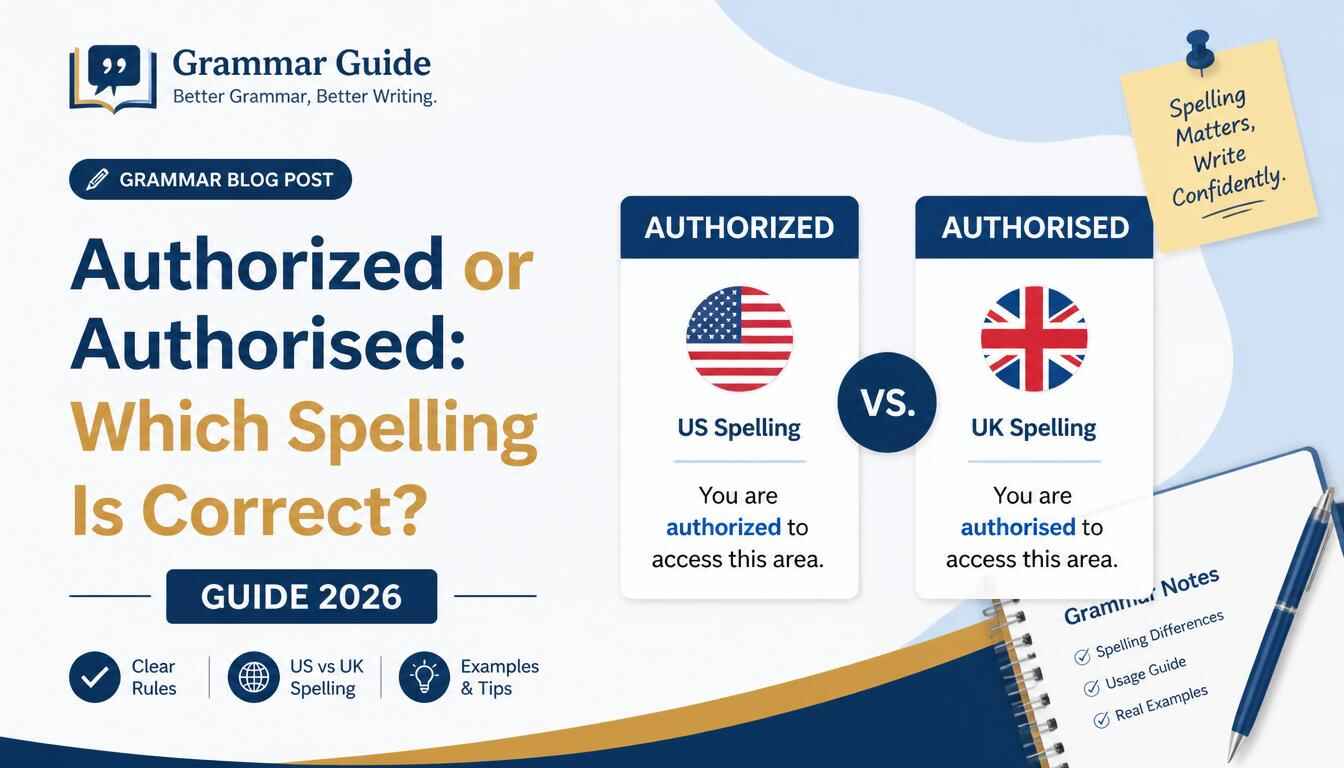
Authorized or authorised which spelling is correct? Both are correct, but they are generally used in different varieties of English. Authorized is the standard spelling in American English, while authorised is usually preferred in British English.
The two spellings have the same meaning. Both describe something or someone that has been given official permission, approval, or authority.
So, if you are writing for a US audience, use authorized. If you are following British English, authorised is usually the better choice. The important thing is to choose the spelling that matches your audience and remain consistent throughout your writing.
Quick Answer: Authorised or Authorized?
Authorized and authorised are different regional spellings of the same word.
| Spelling | Common English variety | Example |
|---|---|---|
| authorized | American English | Only authorized personnel may enter. |
| authorised | British English | Only authorised personnel may enter. |
Both mean officially permitted, approved, or given authority to do something.
The difference is mainly spelling, not meaning.
If you’re writing for readers in the United States, authorized is the natural choice. If you’re writing in British English, authorised is usually preferred.
One important detail is that British English should not be reduced to a simple “always use S” rule. British English commonly uses authorise/authorised, but -ize spellings also occur in British usage. For this particular word, however, authorised is the usual British form.
What Does Authorized Mean?
Authorized means that someone or something has been officially permitted, approved, or given the authority to do something.
For example:
Only authorized personnel can enter the restricted area.
This means that only people who have official permission can enter.
The word can describe people, organizations, actions, products, access, or other things that have received official permission or approval.
Common examples of authorized
She is an authorized representative of the company.
The store is an authorized dealer for the brand.
Only authorized users can access the database.
The payment was authorized by the bank.
The company provides service through authorized distributors.
In each example, the word relates to some form of official permission, approval, or authority.
Is Authorized a Verb or an Adjective?
Authorized can be used in more than one grammatical way.
Understanding this makes the word easier to use correctly.
Authorized as a verb
Authorized is the past tense and past participle form of authorize.
For example:
The manager authorized the payment.
Here, authorized describes an action performed by the manager.
The basic verb is:
authorize
Its common forms include:
authorize → authorized → authorizing
Authorized as an adjective
Authorized can also describe a person or thing that has official permission or approval.
For example:
Only authorized employees can enter.
Here, authorized describes the employees.
Another example:
We purchased the product from an authorized dealer.
The dealer is officially permitted or approved to sell the product.
The same grammatical distinction applies to authorised in British English.
What Does Authorised Mean?
Authorised has the same basic meaning as authorized. It is the spelling commonly preferred in British English.
For example:
Only authorised personnel may enter.
The manager authorised the payment.
We contacted an authorised representative.
If these sentences were written in standard American English, they would normally use authorized instead:
Only authorized personnel may enter.
The manager authorized the payment.
We contacted an authorized representative.
The meaning remains the same.
Authorized and authorised have the same meaning
This is one of the most important points to remember.
You do not choose between the two spellings because one means “approved” and the other means “permitted.”
They are simply regional spelling forms.
Think of the difference this way:
American English: authorized
British English: authorised
The spelling changes, but the underlying word and meaning remain the same.
Authorised or Authorized: What’s the Difference?
The main difference is regional spelling preference.
| Feature | Authorized | Authorised |
|---|---|---|
| Common usage | American English | British English |
| Meaning | Officially permitted or approved | Officially permitted or approved |
| Verb | authorize | authorise |
| Past tense | authorized | authorised |
| -ing form | authorizing | authorising |
| Noun | authorization | authorisation |
| Negative form | unauthorized | unauthorised |
This means that a US writer might say:
The employee was authorized to access the files.
A British writer might say:
The employee was authorised to access the files.
Both sentences communicate the same idea.
Why Are Authorized and Authorised Spelled Differently?
The difference comes from regional spelling conventions that developed within different varieties of English.
The -ize/-ise distinction appears in several English words. Authorize/authorise is one example.
However, the common explanation that says:
“American English uses Z and British English uses S.”
is useful as a shortcut, but it is not a complete rule.
British English can use -ize spellings in some circumstances and according to some style systems. At the same time, -ise spellings are very common in British writing.
For the word in question, the practical rule is straightforward:
Use authorized for American English and usually authorised for British English.
You do not need to treat the two forms as completely separate vocabulary words.
Does the Spelling Change the Meaning?
No.
The spelling does not create a different meaning.
Compare:
Only authorized personnel can enter.
and:
Only authorised personnel can enter.
Both mean that only personnel with official permission can enter.
Likewise:
The director authorized the purchase.
and:
The director authorised the purchase.
Both mean that the director officially gave permission for the purchase.
The difference is therefore about English variety and spelling convention, not meaning.
The Complete Authorized Word Family
If you’re learning or writing about this word, it helps to understand its related forms.
| American English | British English | Word type |
|---|---|---|
| authorize | authorise | Verb |
| authorized | authorised | Past tense / past participle / adjective |
| authorizing | authorising | Present participle |
| authorization | authorisation | Noun |
| unauthorized | unauthorised | Adjective |
Authorize / Authorise
These are the basic verb forms.
The director authorized the payment.
The director authorised the payment.
Authorized / Authorised
These can function as a past-tense or past-participle verb form and as an adjective.
The manager authorized the transaction.
The manager authorised the transaction.
Or:
an authorized employee
an authorised employee
Authorizing / Authorising
These are the -ing forms.
The committee is authorizing the new project.
The committee is authorising the new project.
Authorization / Authorisation
These are the noun forms.
The transaction requires authorization.
The transaction requires authorisation.
Unauthorized / Unauthorised
The negative form follows the same regional spelling pattern.
Unauthorized access is prohibited.
Unauthorised access is prohibited.
This is useful because once you choose an English variety, the related words generally follow the same spelling system.
READ MORE >>> Salvadoran or Salvadorian: Which Spelling Is Correct?
How Do You Spell Authorized?
If you’re asking how do you spell authorized, the answer depends on which variety of English you’re using.
In American English
Spell it:
authorized
Example:
The payment was authorized by the customer.
In British English
The usual spelling is:
authorised
Example:
The payment was authorised by the customer.
What if you’re writing for an international audience?
Choose one consistent English variety based on your main audience, organization, publication, or style guide.
For a US-focused website, authorized is the natural choice.
For a British publication, authorised is usually appropriate.
For international writing, consistency is often more useful than trying to switch spellings from sentence to sentence.
Authorized vs Approved vs Permitted
Authorized, approved, and permitted can overlap in meaning, but they are not always interchangeable.
Understanding the distinction can help you choose the most precise word.
Authorized
Authorized emphasizes official permission or authority.
The manager authorized the employee to make the purchase.
The manager gave the employee official authority to do something.
Approved
Approved generally emphasizes acceptance or agreement.
The manager approved the purchase.
This tells us that the manager accepted or agreed to it.
The two concepts can occur together, but they emphasize slightly different things.
Permitted
Permitted simply means allowed.
Visitors are permitted to enter after 9 a.m.
Authorized can sound more official because it often involves permission granted by someone or an organization with authority.
Only authorized personnel may enter.
So while these words can sometimes be close in meaning, they should not automatically be treated as exact synonyms.
Authorized vs Authoritative
Authorized and authoritative look similar, but they mean different things.
Authorized
Means officially permitted or approved.
Only authorized employees can access the records.
The employees have official permission.
Authoritative
Means reliable, knowledgeable, or showing authority.
The book is an authoritative guide to English grammar.
The book is considered trustworthy or knowledgeable.
The easiest way to remember the difference
Authorized = permission
Authoritative = reliability or authority
An authorized person has permission to do something.
An authoritative source is considered reliable or highly knowledgeable.
Do not use these words interchangeably.
Authorization vs Authentication
Another important distinction appears in technology, cybersecurity, and online accounts.
Authentication and authorization are related, but they answer different questions.
Authentication asks: “Who are you?”
Authentication is the process of verifying someone’s identity.
For example, you might authenticate yourself by entering:
- a username and password
- a verification code
- a fingerprint
- another identity credential
Authorization asks: “What are you allowed to do?”
Once a system knows who you are, it can determine what you’re allowed to access.
For example:
You successfully authenticated your account, but you are not authorized to access the administrator settings.
A simple way to remember it is:
Authentication = identity
Authorization = permission
This distinction explains why technical writing often uses both terms in the same context.
Common Phrases With Authorized and Authorised
The word frequently appears in combinations involving official permission or access.
Authorized personnel
Only authorized personnel may enter the laboratory.
Dealer
The product is available through an authorized dealer.
Representative
Please contact an authorized representative for assistance.
Authorized user
Only an authorized user can change these settings.
Authorized access
The system records every instance of authorized access.
Distributor
The company works with several authorized distributors.
Authorized signatory
Only an authorized signatory can approve the document.
Unauthorized access
The system detected an attempt at unauthorized access.
In British English, these forms would generally use authorised and unauthorised.
Authorized vs Authorised Examples
Seeing the two forms side by side makes the distinction easier to understand.
Business example
American English:
The director authorized the new contract.
British English:
The director authorised the new contract.
Workplace example
American English:
Only authorized employees can access this room.
British English:
Only authorised employees can access this room.
Banking example
American English:
The bank authorized the transaction.
British English:
The bank authorised the transaction.
Technology example
American English:
Unauthorized users cannot access the system.
British English:
Unauthorised users cannot access the system.
Retail example
American English:
We recommend buying the product from an authorized dealer.
British English:
We recommend buying the product from an authorised dealer.
The pattern stays the same in each example: the meaning remains unchanged while the spelling follows the selected variety of English.
Common Mistakes With Authorized and Authorised
Mistake 1: Thinking one spelling is universally correct
Neither spelling should be treated as universally correct for every English-speaking audience.
Authorized is standard American usage.
Authorised is usually preferred in British usage.
The correct choice depends on context.
Mistake 2: Saying British English always uses -ise
This is an oversimplification.
British English commonly uses -ise in words such as authorise, but the broader relationship between -ize and -ise is more complicated.
For this word, authorised is the usual British form, but that does not mean every British English word ending in -ize must automatically change to -ise.
Mistake 3: Assuming the words have different meanings
They do not.
authorized = authorised
The spelling is different, but the basic meaning is the same.
Mistake 4: Mixing spelling systems without a reason
Consider:
The manager authorized the transaction and requested additional authorisation.
The sentence is understandable, but it combines American and British spelling conventions.
If you’re writing in American English, a consistent version would be:
The manager authorized the transaction and requested additional authorization.
In British English:
The manager authorised the transaction and requested additional authorisation.
Consistency is especially useful in professional, academic, and business writing.
Mistake 5: Confusing authorized with authoritative
Remember:
Authorized means officially permitted.
Authoritative means reliable, knowledgeable, or carrying authority.
They are not interchangeable.
Should You Use Authorized or Authorised?
The answer depends on your audience and writing context.
Use “authorized” when writing American English
If your readers are primarily in the United States, use:
authorized
and related forms such as:
authorize authorizing authorization unauthorized
Use “authorised” when following British English
For British English, the usual forms are:
authorised authorise authorising authorisation unauthorised
Follow a house style when one exists
If you’re writing for a company, newspaper, university, publisher, or other organization with a specific style guide, follow its rules.
A style guide can determine which spelling a publication prefers even when multiple forms are accepted in English.
Keep the document consistent
Once you’ve selected your spelling system, use it consistently.
You do not need to change every word simply because your document contains readers from different countries. Choose the style appropriate to the document and maintain it.
Does Authorized Sound Different From Authorised?
The spelling difference does not create a major difference in pronunciation.
The two forms are pronounced essentially the same way in ordinary English.
So if you hear someone say authorized or authorised, the pronunciation generally will not tell you which spelling they would use when writing.
This is another reason not to think of the two forms as different vocabulary words. They are primarily different written forms associated with regional English conventions.
A Simple Rule for Choosing the Right Spelling
When you’re unsure, use this four-step method.
1. Identify your audience
Ask whether your writing is primarily for:
- American readers
- British readers
- another English-speaking audience
2. Choose the regional form
For US English:
authorized
For British English:
authorised
3. Check your style guide
If your employer, client, school, publication, or organization has a style guide, follow it.
4. Keep related forms consistent
If you’ve chosen American English, use the American forms throughout the document.
If you’ve chosen British English, use the corresponding British forms.
This is a better approach than trying to decide whether one spelling is “more correct” in every situation.
Frequently Asked Questions
How do you spell authorized?
In American English, it is spelled authorized. In British English, the usual spelling is authorised.
Is authorized American or British?
Authorized is the standard American spelling. British English usually uses authorised.
Is authorised correct?
Yes. Authorised is a standard British English spelling of authorized.
Are authorized and authorised the same?
Yes. They have the same basic meaning and grammatical functions. The main difference is the spelling convention used in different varieties of English.
Can British English use authorized?
Yes. It is too simplistic to say that authorized can never appear in British English. British English commonly prefers authorised, but -ize spellings also occur in British usage and particular style systems.
Is authorized a verb or an adjective?
It can be both.
As a verb:
The manager authorized the payment.
As an adjective:
The manager is an authorized representative.
What is the noun form of authorized?
The related noun is authorization in American English and usually authorisation in British English.
What is the difference between authorize and authorized?
Authorize is the base verb.
The manager will authorize the payment.
Authorized is its past-tense and past-participle form.
The manager authorized the payment.
It can also function as an adjective:
an authorized employee
What is the difference between authorization and authentication?
Authorization concerns permission or access rights.
Authentication concerns verifying identity.
In simple terms:
Authentication asks who you are.
Authorization asks what you are allowed to do.
Is authorized more correct than authorised?
Neither is universally more correct. Authorized is the normal choice for American English, while authorised is usually preferred in British English.
Should I use authorized or authorised in a US article?
For an article written primarily for a US audience, authorized is the appropriate choice.
Should I use authorized or authorised in a UK article?
For British English, authorised is usually the natural choice.
Conclusion
Authorized and authorised are both correct spellings of the same word. The main difference is regional usage.
Authorized is the standard form in American English, while authorised is usually preferred in British English.
Both forms mean officially permitted, approved, or given authority to do something. They can also perform the same grammatical roles.
The easiest rule is:
American English → authorized British English → authorised
Remember that the same distinction carries through the word family:
authorize → authorized → authorizing → authorization
and
authorise → authorised → authorising → authorisation