

Salvadoran or Salvadorian can both be found in English, but they are not equally common. Salvadoran is the usual and preferred choice, while Salvadorian is an established alternative form used for people or things associated with El Salvador.
So, if you’re writing an email, school assignment, article, or general English sentence and you’re unsure which one to use, Salvadoran is the safest default choice.
However, there is an important distinction that many explanations miss: calling Salvadorian simply “wrong” is too simplistic. The two forms have essentially the same reference, but they differ in how commonly and conventionally they are used.
Quick Answer: Salvadoran or Salvadorian?
Salvadoran is the standard choice for most English writing. Salvadorian is also an established English variant and can refer to the same nationality or connection with El Salvador.
For example:
She is Salvadoran.
We ordered Salvadoran food.
If you see Salvadorian in an article or other source, that does not automatically mean the writer invented a word. It is a recognized alternative, although Salvadoran is generally the more common and practical default.
The key difference is therefore usage and preference rather than a different meaning.
What Does Salvadoran Mean?
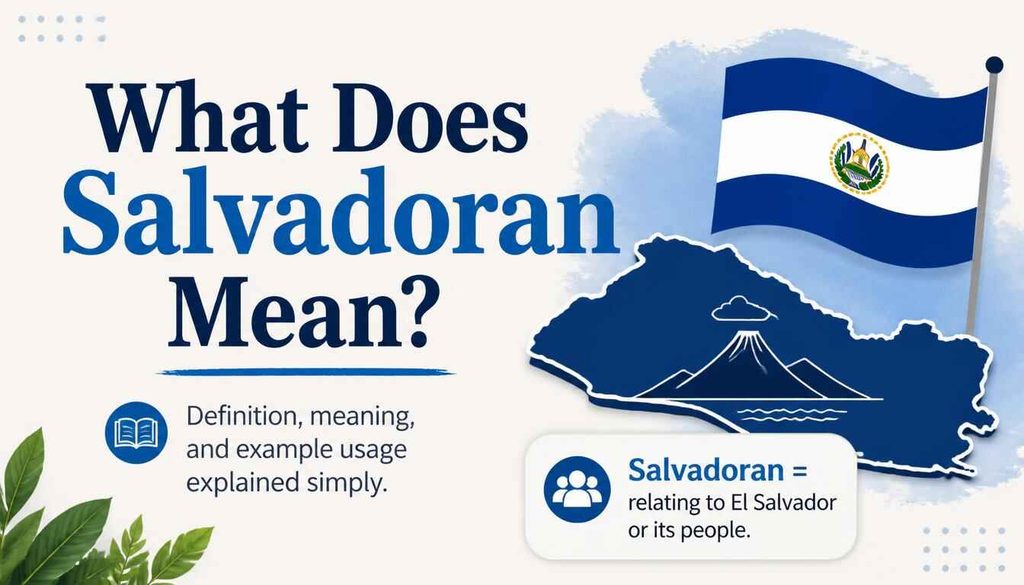
Salvadoran is an English word used as both a noun and an adjective.
It relates to El Salvador, the Central American country.
Salvadoran as a Noun
As a noun, Salvadoran refers to a person from El Salvador.
Examples:
She is a Salvadoran.
He is Salvadoran.
The group included several Salvadorans.
In these examples, Salvadoran identifies a person or group of people.
Salvadoran as an Adjective
As an adjective, Salvadoran describes something connected with El Salvador.
Examples include:
- Salvadoran food
- Salvadoran culture
- Salvadoran history
- Salvadoran music
- Salvadoran art
- Salvadoran traditions
For example:
We tried Salvadoran cuisine for the first time.
The documentary explored Salvadoran history.
The same word therefore works naturally when talking about both people and things associated with the country.
What Does Salvadorian Mean?
Salvadorian is an alternative English form associated with El Salvador.
It can be used in contexts where Salvadoran might also appear.
For example:
He is Salvadorian.
The article discusses Salvadorian culture.
The important point is that Salvadorian does not normally identify a different nationality from Salvadoran.
Both forms can refer to someone from El Salvador or something connected with the country.
Is Salvadorian a Real Word?
Yes.
This is where some explanations become unnecessarily absolute.
There is a difference between saying:
“Salvadoran is the more common form.”
and saying:
“Salvadorian is not a real English word.”
The first statement describes usage preference. The second makes a much stronger claim.
Salvadorian is an established form that readers may encounter in English. The practical issue is that Salvadoran is the more conventional default for most writers.
So if you’re wondering, “Have I completely made up this word because I’ve seen Salvadorian somewhere?” the answer is no.
Salvadoran vs. Salvadorian: What’s the Difference?
The easiest way to understand the difference is to separate meaning from usage.
| Question | Salvadoran | Salvadorian |
|---|---|---|
| Associated with El Salvador | Yes | Yes |
| Can refer to a person | Yes | Yes |
| Can describe something from El Salvador | Yes | Yes |
| Can function as a noun | Yes | Yes |
| Can function as an adjective | Yes | Yes |
| Same basic nationality reference | Yes | Yes |
| Common/default form | Yes | Less common |
| Practical choice for your own writing | Yes | Usually unnecessary |
The two words are therefore not best understood as having two completely different meanings.
The main distinction is which form is more commonly used and which one makes the best default choice when you are writing your own sentence.
That is why you can encounter Salvadorian without needing to interpret it as a different nationality.
“Correct” Does Not Always Mean “Most Common”
One of the biggest sources of confusion in English is the word correct.
When someone asks, “Is Salvadorian correct?” they may actually be asking several different questions.
1. Is the word used?
Does the form actually occur in English?
If it does, calling it completely nonexistent would be inaccurate.
2. Is the word recognized?
Is the form recorded or acknowledged by language references?
Salvadorian is recognized as an alternative form.
3. Is it common?
A word can be recognized without being equally common to another form.
Salvadoran is the more familiar and widely used choice.
4. Is it the best default for my sentence?
This is the question most writers really need answered.
If you are simply writing a sentence and have no special reason to choose the alternative, Salvadoran is the practical default.
These four questions should not be treated as if they were identical:
recognized ≠ equally common ≠ preferred default
That distinction provides a much more accurate answer than simply labeling one spelling “right” and the other “wrong.”
READ MORE >>> Fiend or Feen: Which Is Correct? Meaning, Slang & Usage
Why Does Salvadorian Look So Natural?
There is a simple reason many English speakers find Salvadorian intuitive.
English contains many nationality words ending in -ian, such as:
- Canadian
- Brazilian
- Italian
- Australian
- Egyptian
Because of these familiar patterns, a reader may naturally look at Salvador and expect:
Salvador + ian = Salvadorian
That reasoning is understandable, but English demonyms do not follow one universal formula.
Different countries have developed different conventional English forms. Some use -an, some use -ian, and others use completely different patterns.
For example:
Canada → Canadian
Brazil → Brazilian
Mexico → Mexican
The correct English form is therefore not always predictable simply from the country’s name.
In the case of El Salvador, Salvadoran is the usual English choice.
Is Salvadoran or Salvadorian an American vs. British Difference?
Not in the simple way that color and colour are different regional spellings.
It would be misleading to create a rule such as:
American English = Salvadoran British English = Salvadorian
The distinction is more complicated than that.
Both forms can be encountered in English, and Salvadorian should not automatically be classified as a specifically British spelling.
If you’re writing for a general US audience, Salvadoran is the straightforward choice. But if you encounter Salvadorian in another English-language source, that alone does not tell you that the source is using British English.
Salvadoran in Real Sentences
Seeing the word in different situations can make the distinction easier to understand.
Talking About a Person
Maria is Salvadoran.
He is a Salvadoran.
Several Salvadorans attended the event.
About Food
We ordered Salvadoran food.
She enjoys Salvadoran cuisine.
The restaurant serves traditional Salvadoran dishes.
Talking About Culture
The museum displayed Salvadoran art.
The documentary explored Salvadoran culture.
Talking About History
The students studied Salvadoran history.
These examples show why Salvadoran is useful as both a noun and an adjective.
What If You See “Salvadorian” in a Sentence?
If you encounter Salvadorian, don’t automatically assume the entire sentence is incorrect.
For example:
The book discusses Salvadorian traditions.
A reader may encounter this form because the writer chose an alternative spelling.
The practical response depends on what you’re doing.
If you’re reading someone else’s work, understanding the intended meaning is usually more important than immediately treating the word as an error.
If you’re writing your own sentence, Salvadoran is the more straightforward choice.
This distinction becomes particularly important when dealing with quotations and source material.
What Should You Use in Different Situations?
If you’re deciding which form to use yourself, this table provides a simple guide.
| Situation | Practical choice |
|---|---|
| General writing | Salvadoran |
| School assignment | Salvadoran |
| Business writing | Salvadoran |
| Website article | Salvadoran |
| Academic writing | Salvadoran, unless a required style says otherwise |
| Everyday conversation | Both may be encountered |
| Reading another person’s writing | Understand the context |
| Direct quotation | Preserve the original wording when appropriate |
| Your own article | Salvadoran |
The underlying rule is simple:
When you are choosing the wording yourself, Salvadoran is the safest default.
You do not need to use Salvadorian simply because it exists.
What If My Source Uses “Salvadorian”?
This is an important situation for writers and editors.
Suppose you are reading a source that says:
The study examines Salvadorian communities.
If you’re summarizing the source in your own words, you can normally use your preferred standard form:
The study examines Salvadoran communities.
But if you’re reproducing the exact wording as a quotation, you should generally preserve the source’s wording when accuracy requires it:
The study refers to “Salvadorian communities.”
The distinction is between your own wording and someone else’s wording.
You should not automatically rewrite every occurrence of Salvadorian simply because Salvadoran is your preferred form.
This is especially useful when writing research papers, articles, reports, or other material based on existing sources.
What About “Salvadorean”?
There is another variant you may encounter: Salvadorean.
Like Salvadorian, it can be used in English in connection with El Salvador.
You don’t need to turn this into a complicated three-way spelling rule.
For most modern general writing, the easiest choice remains:
Salvadoran
If you encounter Salvadorean or Salvadorian in an existing source, recognize that these forms may be used as variants rather than assuming they refer to completely different things.
El Salvador, Salvador, and Salvadoran
These terms can look similar, but they do not all mean the same thing.
El Salvador
El Salvador is the name of the country.
Example:
She moved to El Salvador.
Salvadoran
Salvadoran is the English demonym and adjective associated with El Salvador.
Examples:
She is Salvadoran.
They serve Salvadoran food.
Salvador
Salvador should not simply be treated as a shortened version of El Salvador in every context.
It can occur as a proper name and can refer to other places or names. For example, Salvador is also the name of a major city in Brazil.
So these terms should not be used interchangeably:
El Salvador = the country
Salvadoran = a person or something associated with the country
Salvador = a separate proper name that can refer to different entities depending on context
Common Mistakes With Salvadoran and Salvadorian
Mistake 1: Saying Salvadorian Is Completely Wrong
This is too absolute.
A more precise explanation is:
Salvadorian is an alternative form, while Salvadoran is the usual default.
That gives readers a more accurate understanding of the language.
Mistake 2: Assuming the Difference Is British vs. American
There is no simple rule that assigns Salvadoran to American English and Salvadorian to British English.
Mistake 3: Treating Them as Different Nationalities
The two forms do not normally distinguish between two different nationalities.
Mistake 4: Using “El Salvadoran” as the Standard Demonym
When referring to a person from the country, Salvadoran is the normal English choice.
For example:
She is Salvadoran.
You can say:
She is from El Salvador.
But you don’t need to create the demonym “El Salvadoran.”
Mistake 5: Changing a Quotation Unnecessarily
If a source says Salvadorian and you are directly quoting it, changing the wording can make the quotation inaccurate.
Mistake 6: Switching Forms Randomly
If you’re writing your own article, consistency matters.
If you choose Salvadoran, continue using Salvadoran unless there is a specific reason to reproduce another form.
A Simple 10-Second Decision Rule
Still unsure?
Use this quick test.
Writing your own sentence? → Use Salvadoran.
Wondering whether Salvadorian exists? → Yes, it is an established alternative form.
Reading Salvadorian in another article? → Don’t automatically assume it is a meaningless or invented word.
Quoting a source? → Preserve the original wording when appropriate.
Need one default form for general or formal English? → Choose Salvadoran.
This approach gives you the practical answer without pretending that every language variation is a simple right-or-wrong spelling mistake.
Frequently Asked Questions
Is Salvadoran or Salvadorian correct?
Salvadoran is the usual and preferred choice, while Salvadorian is an established alternative. Both can refer to people or things associated with El Salvador.
Is Salvadorian a real word?
Yes. Salvadorian is an established English form associated with El Salvador. It is less common than Salvadoran, but it is not simply a nonexistent spelling.
Is Salvadorian wrong?
Not necessarily. It is more accurate to describe Salvadorian as an alternative, less common form. If you’re choosing wording for your own general English writing, Salvadoran is the better default.
What do you call someone from El Salvador?
The usual English term is Salvadoran.
For example:
He is Salvadoran.
What is the difference between Salvadoran and Salvadorian?
The main difference is usage and frequency rather than meaning. Both forms can refer to people or things associated with El Salvador, but Salvadoran is the more common and conventional choice.
Is Salvadoran American or British English?
Salvadoran is not exclusively an American spelling. The difference between Salvadoran and Salvadorian should not be treated as a simple American-versus-British spelling distinction.
Is Salvadorean correct?
Salvadorean is another English variant associated with El Salvador. However, Salvadoran is the most straightforward default for general writing.
Should I say El Salvadoran or Salvadoran?
Use Salvadoran when referring to a person or something associated with the country.
For example:
She is Salvadoran.
Use El Salvador when referring to the country:
She is from El Salvador.
Is Salvadoran a noun or adjective?
It can be both.
As a noun:
He is a Salvadoran.
As an adjective:
He enjoys Salvadoran cuisine.
Which spelling should I use in formal writing?
If you’re choosing the wording yourself, Salvadoran is the straightforward default. If you are following a specific publication’s style or reproducing a quotation, follow the relevant source or style requirements.
Conclusion
So, Salvadoran or Salvadorian?
For most general English writing, choose Salvadoran. It is the usual and practical default for the demonym and adjective associated with El Salvador.
Salvadorian is an established alternative, so it is too simplistic to say that every occurrence of it is simply a spelling error.
The easiest way to remember the distinction is:
Salvadoran = the usual default choice. Salvadorian = an alternative form you may encounter.
The most useful lesson is that “recognized,” “common,” and “preferred” are not always the same thing. Once you understand that distinction, the Salvadoran vs. Salvadorian question becomes much easier to answer accurately and confidently.