

Fiend or feen can be confusing because the two spellings sound similar, but they are not simply interchangeable versions of the same word. Fiend is the standard English spelling used for several meanings, including an evil or cruel person and someone who is extremely interested in something. Feen has more specific slang and dialect uses.
If you are writing ordinary English and are unsure which spelling to choose, fiend is the standard choice. If you encounter feen in slang or a regional context, however, it should not automatically be treated as a spelling mistake.
Quick Answer: Should You Use Fiend or Feen?
Use fiend when you mean the standard English word. For example, “She is a chocolate fiend” means she really likes chocolate. Fiend can also describe an evil or cruel person. Feen appears in documented slang use associated with strongly desiring something, while feen is also an Irish-dialect noun meaning “man.”
Fiend vs. Feen at a Glance
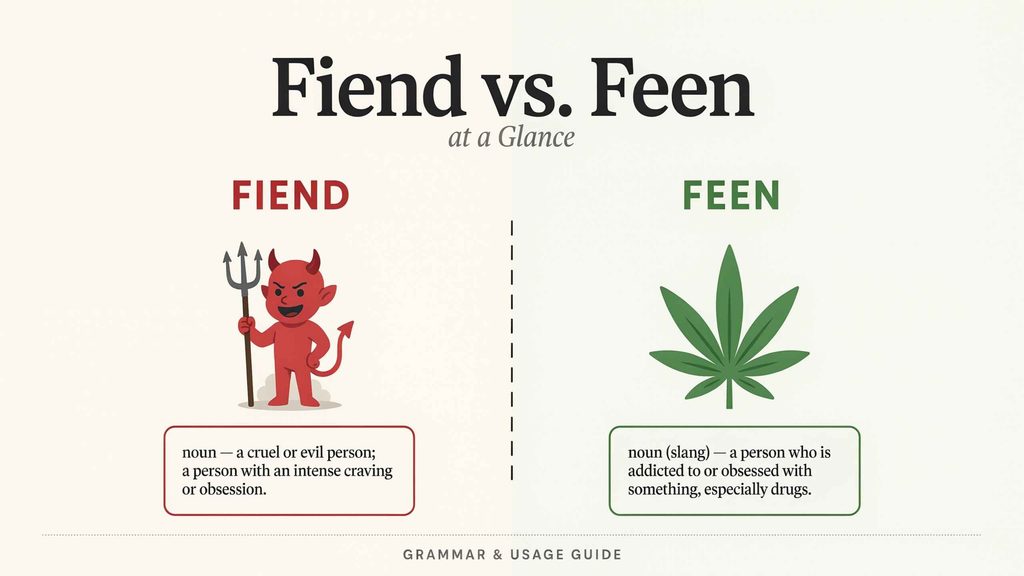
| Word | Main use | Standard English? | Example |
|---|---|---|---|
| fiend | An evil/cruel person or someone extremely interested in something | Yes | “She is a chocolate fiend.” |
| feen | Slang form associated with strongly desiring something | Context-specific | “I’m feening for pizza.” |
| feen | Irish-dialect noun meaning “man” | Regional/dialect use | Depends on the context |
The key distinction is context. Dictionary records feen as a slang form associated with the verb fiend meaning “to desire greatly.” Separately, Collins records feen as an Irish-dialect informal noun meaning “man.”
So, if you simply need the standard English spelling, fiend is the answer.
What Does “Fiend” Mean?
The word fiend has several meanings. It is not limited to the idea of an evil person.
Fiend Can Mean an Evil or Cruel Person
The traditional meaning of fiend refers to an evil, cruel, or wicked person. It can also refer to an evil spirit or demon.
For example:
The villain in the story was portrayed as a cruel fiend.
Here, fiend has a clearly negative meaning.
Cambridge defines fiend as an evil and cruel person, while Dictionary includes meanings involving the devil, an evil spirit, and a cruel or wicked person.
Fiend Can Mean Someone Who Really Likes Something
In another common informal use, fiend describes someone who likes something very much or is extremely interested in it.
For example:
My brother is a coffee fiend.
This does not mean that he is cruel or evil. It means that he really likes coffee or is extremely enthusiastic about it.
The same pattern can describe different interests:
- a chocolate fiend
- a fitness fiend
- a movie fiend
- a sports fiend
- a gaming fiend
Cambridge specifically gives this enthusiastic sense of fiend, including examples such as a chocolate fiend.
Fiend Can Have an Addiction-Related Meaning
Fiend also has an informal use for someone who is extremely addicted to a harmful habit or substance.
For example:
The book described him as a drug fiend.
This usage can sound harsh or stigmatizing, so it should be understood in context rather than treated as a neutral everyday description.
Dictionary.com lists an informal sense involving someone extremely addicted to a harmful habit.
Fiend Can Describe Someone Highly Skilled
There is another less obvious meaning:
She’s a fiend at languages.
In this context, fiend describes someone who is highly skilled or gifted at something. Dictionary includes this sense in its entry for fiend.
This is why you should not assume that fiend always has a negative meaning. The words around it determine how the reader should understand it.
What Does “Feen” Mean?
The answer to “Is feen a real word?” needs some explanation because dictionaries document more than one use.
“Feen” as Slang
Dictionary identifies feen as a slang form associated with fiend in the verb sense of desiring something greatly. Its entry gives examples using fiending to express strong desire.
For example:
I’m feening for some pizza.
The speaker is expressing a strong desire for pizza.
Another example is:
I’ve been feening for a vacation.
Here, feening means strongly wanting a vacation.
This is why you may encounter feen or feening in informal language even though fiend is the standard spelling of the common noun.
“Feen” as an Irish-Dialect Word
There is also a separate use of feen that has nothing to do with the slang sense above.
Collins lists feen as an Irish-dialect informal noun meaning “man.”
This distinction matters because it would be inaccurate to say:
“Feen always means a person who strongly wants something.”
That describes only one documented context.
A better explanation is:
Feen has different documented uses, so its meaning depends on the context in which it appears.
Is “Feen” Just a Misspelling of “Fiend”?
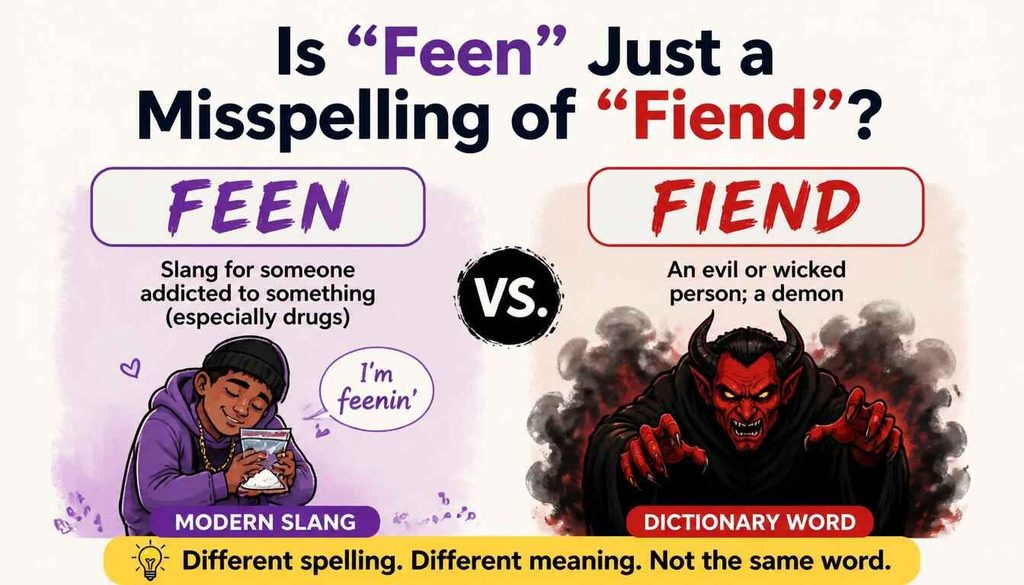
Not always.
If someone writes feen when they intend the standard English noun fiend, it can certainly be a spelling mistake. But that does not mean every occurrence of feen is incorrect.
There are documented contexts in which feen is intentional:
- It can appear as a slang form associated with fiend meaning to desire greatly.
- It is also recorded as an Irish-dialect noun meaning “man.”
Therefore, the better rule is:
If you mean the standard English word, use “fiend.” If you encounter “feen,” check the context before deciding that it is wrong.
This is more accurate than simply labeling feen as a misspelling.
Are Fiend and Feen Pronounced the Same?
The words can sound very similar, which helps explain why people confuse their spellings.
How Do You Pronounce “Fiend”?
Cambridge gives the pronunciation of fiend as /fiːnd/ in both UK and US English. The pronunciation contains the long ee sound followed by the n and d sounds.
You can think of the sound as:
fiend → /fiːnd/
The vowel is the same general long ee sound heard in words such as sheep.
Why Does “Fiend” Sound Like “Feen”?
The spelling fiend contains several letters that do not correspond to separate sounds in an obvious one-to-one way.
Someone who hears the word without seeing it written may focus on the “ee” sound and produce a phonetic spelling such as feen.
That can lead to the common question:
“Is it fiend or feen?”
The important point is that sound alone does not determine the spelling. You also need to consider the intended meaning and context.
Fiend, Feen, Fiending, and Feening
The confusion becomes even greater when related forms appear.
Fiend vs. Fiending
Fiend is commonly used as a noun:
She’s a coffee fiend.
But fiend also has a slang verb use meaning to desire something greatly. The related form is fiending. Dictionary documents this verb use and gives examples involving fiending after or toward something desired.
For example:
I’m fiending for some coffee.
Here, fiending expresses strong desire.
Feen vs. Feening
Feen can appear as the slang form associated with that desire-related use:
I’m feening for some pizza.
The related form feening is also found in informal slang.
However, it is better not to treat fiending and feening as universally interchangeable spellings in every type of English. Their use depends on the context and audience.
If your goal is ordinary standard English, fiend is the established spelling to start from.
What Does “Fiend For” Mean?
Another useful expression is “fiend for.”
Cambridge defines fiend for something as describing someone who likes something very much or is very interested in it.
For example:
She’s a fiend for good books.
This means she is extremely interested in or fond of good books.
You could also say:
He’s a fiend for coffee.
The phrase makes it clear what the person is especially enthusiastic about.
“Fiend” vs. “Fiend For”
Compare these sentences:
He’s a fiend.
and:
He’s a fiend for coffee.
The first sentence is ambiguous because fiend has several meanings.
The second gives the reader additional information and clearly expresses strong enthusiasm for coffee.
Cambridge provides examples of this construction with subjects including bacon, color, punctuality, and conversation.
When Should You Use Fiend or Feen? The Context Test
Instead of memorizing a long list of rules, use this simple context test.
1. Are You Using Standard English?
If you mean the ordinary English word, use:
FIEND
Examples:
She’s a chocolate fiend.
The villain was a cruel fiend.
He’s a fiend for old movies.
These are established uses of fiend.
2. Are You Intentionally Using Slang?
If you’re reproducing casual slang about strongly wanting something, feen or feening may appear.
For example:
I’m feening for pizza.
This is a slang context rather than the ordinary standard-English noun.
3. Is It a Regional or Dialect Context?
If feen appears in an Irish-dialect context, it may have the separate meaning “man.”
4. Are You Simply Unsure?
If you need the standard English word and aren’t deliberately reproducing slang or dialect, choose:
Fiend
That’s the most practical default.
Fiend or Feen in Different Writing Situations
| Situation | Recommended form | Why |
|---|---|---|
| Formal writing | fiend | Standard English |
| Academic writing | fiend | Clear and conventional |
| Professional writing | fiend | Usually the clearest choice |
| General website content | fiend | Standard form is easiest to understand |
| Casual dialogue | Context-dependent | Slang may be intentional |
| Social media language | Context-dependent | Informal spellings may be intentional |
| Quoting slang | Preserve the original wording | The spelling may be part of the expression |
| Irish-dialect discussion | feen may be appropriate | It has a documented regional meaning |
One important distinction is that standard English does not mean every other form is automatically wrong. Slang, dialect, quoted speech, and creative writing can intentionally use forms that would not be the default in formal prose.
Fiend, Feen, Fein, Fien, or Feind?
People searching for fiend or feen may also encounter spellings such as fein, fien, or feind.
If you mean the standard English word for an evil or cruel person, or someone extremely interested in something, the spelling is:
fiend
The other forms should not be substituted simply because they look or sound similar.
The important difference is that feen has documented uses, while an arbitrary spelling variation does not automatically become an accepted alternative spelling.
So don’t confuse a documented context-specific form with an ordinary spelling mistake.
Common Misconceptions About Fiend and Feen
“Feen Is Always Wrong”
Not necessarily.
Dictionaries document feen in slang and dialect contexts.
“Fiend Only Means an Evil Person”
No.
Fiend can also describe someone who is extremely interested in something.
“Fiend Is Always Negative”
Not necessarily.
Compare:
The villain was a fiend.
with:
She’s a chocolate fiend.
The first describes a cruel person. The second is an informal expression for someone who really likes chocolate.
“Fiend and Feen Are Always Interchangeable”
No.
They overlap in a specific slang context, but fiend is the standard English form for the common word, while feen also has other context-specific uses.
“If I Hear ‘Feen,’ I Should Always Spell It That Way”
No.
Pronunciation alone cannot tell you which written form is intended. Consider the meaning, sentence, and context.
Fiend or Feen Examples in Real Sentences
Seeing the words in different sentences makes the distinction easier to understand.
Examples With “Fiend”
Evil or cruel person:
The story’s villain is portrayed as a ruthless fiend.
Here, fiend refers to a cruel person.
Strong enthusiasm:
My sister is a chocolate fiend.
Here, fiend means someone who really loves chocolate.
Strong interest:
He’s a fitness fiend.
The sentence emphasizes his extreme interest in fitness.
Skill:
She’s a fiend at solving difficult puzzles.
Here, fiend describes someone highly skilled at something, a sense recorded by Dictionary
Fiend for:
He’s a fiend for old movies.
This means he is extremely interested in old movies.
Examples With “Feen”
Slang desire:
I’m feening for pizza.
The speaker is expressing a strong desire for pizza.
Another slang example:
She’s been feening for a vacation all month.
Again, feening expresses strong desire in informal slang.
Dialectal use:
In an Irish-dialect context, feen can mean “man.” This is a separate dictionary meaning and should not be confused with the slang use above.
What Does the Word Mean in a Sentence?
Sometimes the person searching for fiend or feen isn’t actually trying to choose a spelling. They have already seen one of the words and want to know what it means.
Context can usually answer that question.
“He’s a chocolate fiend.”
Meaning: He really likes chocolate.
“The villain was a fiend.”
Meaning: The villain was cruel or evil.
“I’m feening for coffee.”
Meaning: I’m strongly wanting or craving coffee. This reflects the documented slang use associated with fiend as a verb meaning to desire greatly.
“She’s a fiend for punctuality.”
Meaning: She is extremely interested in or particular about punctuality. Cambridge uses this construction to illustrate the enthusiastic sense of fiend.
The surrounding words therefore matter just as much as the spelling.
Fiend vs. Feen: Detailed Comparison
| Feature | Fiend | Feen |
|---|---|---|
| Standard English word | Yes | Not as the ordinary spelling of fiend |
| Evil/cruel person | Yes | No |
| Very enthusiastic person | Yes | Not the standard noun for this meaning |
| Informal addiction-related sense | Yes | Not the main standard noun |
| Desire-related slang use | Yes, as a verb | Yes, documented as a slang form |
| Related form | fiending | feening in informal usage |
| “Fiend for” construction | Yes | Not the standard equivalent |
| Irish-dialect meaning “man” | No | Yes |
| Formal writing default | Yes | Generally no, unless context specifically requires it |
| Automatically interchangeable? | No | No |
The main takeaway is simple: fiend and feen overlap in a particular slang context, but they are not two universal spellings of the same word.
Which One Should You Use?
If you’re deciding what to write in ordinary English, the answer is straightforward.
Use fiend when:
- you mean the standard English word
- you’re writing an article or essay
- you’re writing professionally
- you’re describing an evil or cruel person
- you’re describing someone extremely interested in something
- you’re using “fiend for”
- you’re unsure and don’t specifically need slang
Use feen when:
- you’re intentionally using a documented slang expression
- you’re discussing or reproducing informal language
- you’re dealing with the specific Irish-dialect meaning
- the context clearly calls for that form
The simplest rule
Use “fiend” as your default standard-English spelling. Treat “feen” as a context-specific form rather than automatically calling it wrong.
That distinction gives you a more accurate answer than simply saying “fiend is correct and feen is wrong.”
Frequently Asked Questions
Is fiend or feen correct?
Fiend is the standard spelling for the common English word. Feen also has documented uses, including a slang form associated with strongly desiring something and an Irish-dialect noun meaning “man.”
Is “feen” a real word?
Yes. Dictionaries document feen in more than one context. Dictionary.com records a slang use associated with fiend, while Collins records an Irish-dialect noun meaning “man.”
What does “feen” mean in slang?
In slang, feen is documented as a form associated with fiend meaning to desire greatly. The related form feening can express strong desire for something.
What does “fiend” mean in slang?
Depending on context, fiend can describe someone who is extremely interested in something, someone strongly addicted to a habit, or it can be used as a slang verb meaning to desire greatly.
Is “fiending” or “feening” correct?
Fiending is an established form associated with the slang verb fiend. Feening also appears in informal slang usage. Which form is appropriate depends on the context and audience.
How do you pronounce “fiend”?
Fiend is pronounced /fiːnd/ in both UK and US English according to Cambridge.
What does “fiend for” mean?
Fiend for describes someone who likes something very much or is very interested in it.
For example:
He’s a fiend for coffee.
Cambridge lists fiend for something as a collocation with this meaning.
Is “fiend” always a negative word?
No. Although fiend can describe an evil or cruel person, it can also be used informally for someone who is extremely enthusiastic about something, such as a “chocolate fiend.”
Is “feen” just a misspelling of “fiend”?
No. It can be a mistaken spelling when someone intends the standard word fiend, but dictionaries also document legitimate slang and dialect uses of feen.
Is “feen” used in Irish English?
Collins records feen as an Irish-dialect informal noun meaning “man.” This is a separate meaning from the slang use associated with fiend.
Conclusion: Fiend or Feen?
The answer to fiend or feen depends on context, but fiend is the standard spelling to use in ordinary English.
Fiend can refer to an evil or cruel person, but it can also describe someone who is extremely interested in something, such as a chocolate or coffee fiend. It also has documented informal and slang uses.
Feen is more context-specific. It appears as a documented slang form associated with fiend in the sense of strongly desiring something, and it is also recorded as an Irish-dialect noun meaning “man.”
So, if you’re simply choosing which spelling to use, remember:
Standard English → fiend Documented slang or specific dialect → feen may be appropriate
The most useful rule is not that feen is always wrong. It’s that context tells you whether “feen” is intentional—and when in doubt, “fiend” is the standard choice.