
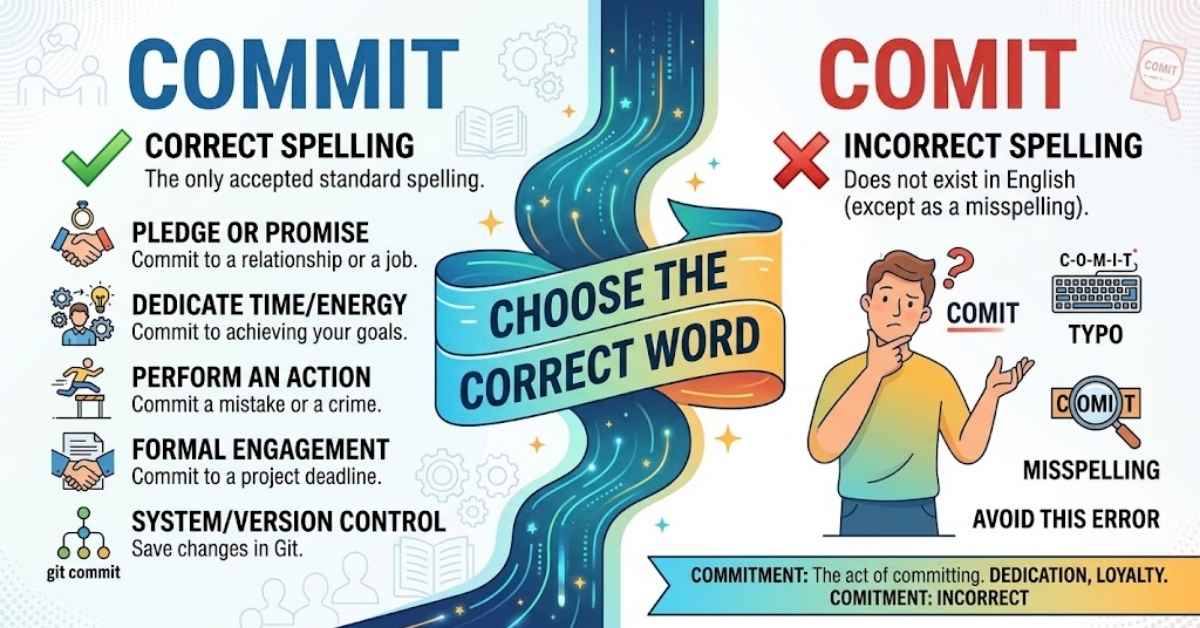
Comit or commit? The correct spelling is commit, with two m’s. Comit is not the standard spelling of the English verb. If you’re writing an email, essay, résumé, business document, or code command, use commit.
The confusion is easy to understand because the two spellings look almost identical, and you hear only one m sound when you pronounce the word. But once you separate the spelling of commit from the spelling of its related forms, the pattern becomes much easier to remember.
Comit or Commit: The Quick Answer
| Spelling | Status | Example |
|---|---|---|
| commit | Correct | I will commit to the plan. |
| comit | Incorrect in standard English | I will comit to the plan. ❌ |
So, when someone asks “is it comit or commit?”, the answer is straightforward:
It is commit.
The word is pronounced /kəˈmɪt/ in American English, with the stress on the second syllable. Cambridge and Oxford both list commit as the standard English verb and provide its grammatical forms.
Why Commit Is the Correct Spelling
The most obvious difference between comit vs commit is the second m.
Think of the word as:
co + m + m + it
not:
co + m + it
The standard English word is commit, and dictionaries such as Cambridge and Oxford list it with the double m.
Correct examples
- I commit to finishing the project.
- She decided to commit more time to her studies.
- They commit their resources to the new program.
- He did not commit the offense.
- The developer will commit the changes.
Incorrect examples
- I comit to finishing the project. ❌
- She decided to comit more time to her studies. ❌
- The developer will comit the changes. ❌
The mistake is small, but it changes the spelling of the word.
Why Does Commit Have Two M’s?
This is where many spelling articles oversimplify the explanation.
The double m in commit is connected to the word’s history. Commit entered English through Old French from Latin committere. The Latin word was formed from com-, meaning roughly “together” or “with,” and mittere, meaning “to send” or “let go.”
So the historical structure helps explain why the spelling contains mm.
Importantly, this is not the same spelling rule that explains the double t in committed.
That’s a distinction worth remembering:
The double M belongs to the spelling of commit itself. The double T in committed and committing comes from English inflectional spelling.
That is a more accurate explanation than simply telling learners that one generic “double-letter rule” creates every letter in the word.
Why People Type “Comit” Instead of “Commit”
The error is particularly easy to make because pronunciation does not expose the spelling.
When you say commit, you do not pronounce the two m’s separately. The listener hears one /m/ sound.
That means your ear cannot tell you whether the written word contains:
- one m, or
- two m’s.
Fast typing can make the problem worse. If your fingers move quickly, one of two identical letters can disappear without changing the way the word sounds.
That is why comit can look surprisingly convincing even though it is not the standard spelling.
Comit vs Commit Meaning
The difference in comit vs commit meaning is actually simpler than it first appears.
Commit has several meanings. Comit, when used as an attempted spelling of the English verb, does not provide a different meaning; it is simply the wrong spelling.
Depending on context, commit can mean:
- To promise or dedicate yourself to something
- To carry out an act
- To dedicate money, time, or resources
- To place something into memory or writing
- To send or place someone somewhere officially
- To record changes in software
Cambridge and Oxford document these different senses.
What Does Commit Mean?
Commit meaning: promise or dedicate
When you commit to something, you make a firm decision or promise to support it.
Examples:
I commit to exercising three times a week.
The company committed to improving customer service.
She couldn’t commit to a specific date.
Cambridge defines this sense in terms of promising to give yourself, your time, money, or other support to something.
Commit meaning: carry out an action
The verb can also mean to perform or carry out something, particularly an act considered wrong or illegal.
Examples include:
- commit a crime
- commit fraud
- commit an offense
- commit an error
- commit a serious mistake
Oxford and Cambridge both document this use.
For example:
The investigation found that the company had committed a serious error.
Commit meaning: dedicate resources
You can commit money, time, staff, energy, or other resources to a project.
For example:
The company committed $2 million to the expansion.
She committed several hours to studying each week.
This sense is particularly common in business writing. Cambridge’s Business English entry specifically describes committing money or resources to a purpose.
Commit something to memory
Another established expression is:
commit something to memory
It means to learn something well enough to remember it.
For example:
I committed the instructions to memory.
You can also commit something to paper or commit something to writing, meaning to put it into written form. Cambridge and Oxford both document these constructions.
Why Are Committed and Committing Spelled With Double T?
This is one of the most useful follow-up lessons.
The base form is:
commit
When certain vowel-initial endings are added, the final t is doubled:
- commit → committed
- commit → committing
So:
committed ✅ commited ❌
and:
committing ✅ commiting ❌
Oxford lists the forms committed and committing in the verb paradigm for commit.
The key distinction
Do not confuse these:
commit → double m, single t
committed → double m, double t
committing → double m, double t
commitment → double m, single t
That last one causes another extremely common spelling mistake.
Commit vs Commitment
The noun is:
commitment ✅
Not:
comitment ❌ committment ❌
The word commitment retains the double m, but it has only one t before -ment.
| Word | Correct spelling |
|---|---|
| Base verb | commit |
| Third-person singular | commits |
| Past tense | committed |
| -ing form | committing |
| Noun | commitment |
The distinction becomes much easier when you stop treating all suffixes as though they behave identically.
The historical noun commitment developed from commit plus -ment.
Commit or Comit in Real Sentences
Here are practical examples you can use as a reference.
Commitment to a goal
I commit to completing the course this year.
Workplace
Our team committed additional resources to the project.
Business
The company has committed to improving response times.
Personal relationship
He isn’t ready to commit to a long-term relationship.
Legal context
The defendant was accused of committing fraud.
Mistake or error
The analyst committed an error in the calculation.
Memory
She committed the instructions to memory.
Writing
The researchers committed their findings to paper.
In every example, the spelling begins with comm-, not com-.
Commit in American English
For U.S. readers, the pronunciation is:
/kəˈmɪt/
The stress falls on the second syllable. Cambridge’s American Dictionary gives this pronunciation, and Oxford’s American English dictionary also lists /kəˈmɪt/.
The spelling is the same in American and British English:
commit ✅
There is no American/British spelling difference such as the one seen with words like traveled/travelled.
Commit in Business and Professional Writing
In professional writing, commit often communicates a stronger obligation than words such as hope, plan, or intend.
Compare:
We hope to finish the project Friday.
with:
We commit to finishing the project Friday.
The second sentence communicates a stronger promise.
That makes commit useful in:
- project planning
- business agreements
- company announcements
- customer-service commitments
- financial planning
- workplace goals
- deadlines
Because the word expresses commitment itself, spelling it incorrectly can be particularly distracting in a sentence that is supposed to communicate reliability.
Commit in Relationships
In everyday conversation, commit is also frequently used when discussing relationships.
For example:
She isn’t ready to commit.
He wants to commit to the relationship.
They decided to commit to building a life together.
Here, commit means making a serious decision to remain dedicated to a person or relationship.
The related noun is commitment:
Their relationship requires mutual commitment.
Notice the spelling:
commit commitment
Both retain the double m.
Commit in Law
Legal English uses commit in several ways.
The most familiar is:
commit a crime
or:
commit fraud
In these constructions, commit means carry out or perform an act.
There is also a more formal meaning involving officially sending or placing someone in custody or an institution. Cambridge and Oxford both record this sense.
So the meaning of commit changes according to its object and context.
The spelling does not.
Commit in Programming and Git
There is an important modern technical meaning of commit.
In software development, particularly with Git, a commit records a set of changes in a repository.
You can use commit as a verb:
I need to commit these changes.
And as a noun:
I made a commit before opening the pull request.
A typical Git command is:
git commit
Not:
git comit
A spelling error in ordinary prose may simply look like a typo. In a command-line environment, however, the difference can make the command fail.
This is why the comit vs commit question is relevant to both writers and developers.
Commit vs push
These terms should not be confused.
A commit records changes in your local Git history.
A push sends commits to a remote repository.
So you might:
- modify your files;
- stage the changes;
- commit them;
- push the commit to a remote repository.
The spelling is always commit.
Is Comit a Word?
For the ordinary English verb meaning “to dedicate,” “to promise,” “to carry out,” or “to record changes,” comit is not the standard spelling.
That is the important answer for anyone asking “is it comit or commit?”
There can be specialized uses of letter strings in names, labels, acronyms, or other contexts, so saying that the sequence comit can never appear anywhere would be unnecessarily broad.
But if you are trying to write the English verb, use:
commit.
LEARN MORE: Hilight or Highlight
Common Commit Spelling Mistakes
The biggest benefit of learning commit is that you can prevent several related errors at the same time.
| Incorrect | Correct |
|---|---|
| comit | commit |
| commited | committed |
| comited | committed |
| comiting | committing |
| comitment | commitment |
| committment | commitment |
Why these mistakes happen
There are two different letter patterns to remember:
Double M
- commit
- committed
- committing
- commitment
Double T
- committed
- committing
But not:
- commitment
This is why learning the entire word family is more useful than memorizing only one spelling.
A Simple Memory Trick for Commit
Use this:
Commit has two M’s.
Think:
co-MM-it
Then remember:
committed and committing add the extra t.
And:
commitment goes back to one t before -ment.
A quick mental check before sending your sentence:
Does “commit” have two m’s? Yes.
If you typed comit, put the second m back.
Frequently Asked Questions
Is it comit or commit?
It is commit. The standard English verb is spelled with two m’s.
What is the meaning of commit?
Commit can mean to promise or dedicate yourself to something, carry out an action, allocate resources, place something into memory or writing, or formally place someone somewhere, depending on context.
What is the comit vs commit meaning?
Commit has the English meanings; comit is normally a misspelling of that word.
Is comit a word?
Not as the standard spelling of the English verb commit. If you mean the ordinary verb, write commit.
Why does commit have two m’s?
Its spelling is historically connected to Latin committere, from com- + mittere.
Is it committed or commited?
It is committed, with two m’s and two t’s.
Is it committing or commiting?
It is committing, with two m’s and two t’s.
Is it commitment or committment?
It is commitment, with two m’s but only one t.
What does commit to mean?
Commit to means to promise, dedicate, or bind yourself to something.
For example:
She committed to completing the course.
Oxford and Cambridge both document this construction.
Is commit a noun or a verb?
In general English, commit is primarily a verb. In software, particularly Git, commit is also commonly used as a noun for a recorded set of changes.
How do you pronounce commit?
In American English, commit is pronounced /kəˈmɪt/, with stress on the second syllable.
Is commit spelled the same in American and British English?
Yes. Commit has the same spelling in American and British English.
Is commit used in Git?
Yes. Git commit records a set of changes in a repository. The spelling is commit, not comit.
What is the easiest way to remember commit?
Remember:
commit = two M’s
Then learn the related forms separately:
committed, committing, commitment.
Final Answer: Commit or Comit?
If you’re deciding between comit or commit, choose commit.
Commit is the standard English spelling, and it can mean to promise or dedicate yourself to something, carry out an act, allocate resources, place something into memory or writing, or record changes in software.
The easiest rule is:
Commit has two M’s.
Then watch the related forms:
- commit ✅
- commits ✅
- committed ✅
- committing ✅
- commitment ✅
So if you’re asking “is it comit or commit?”, write commit.