
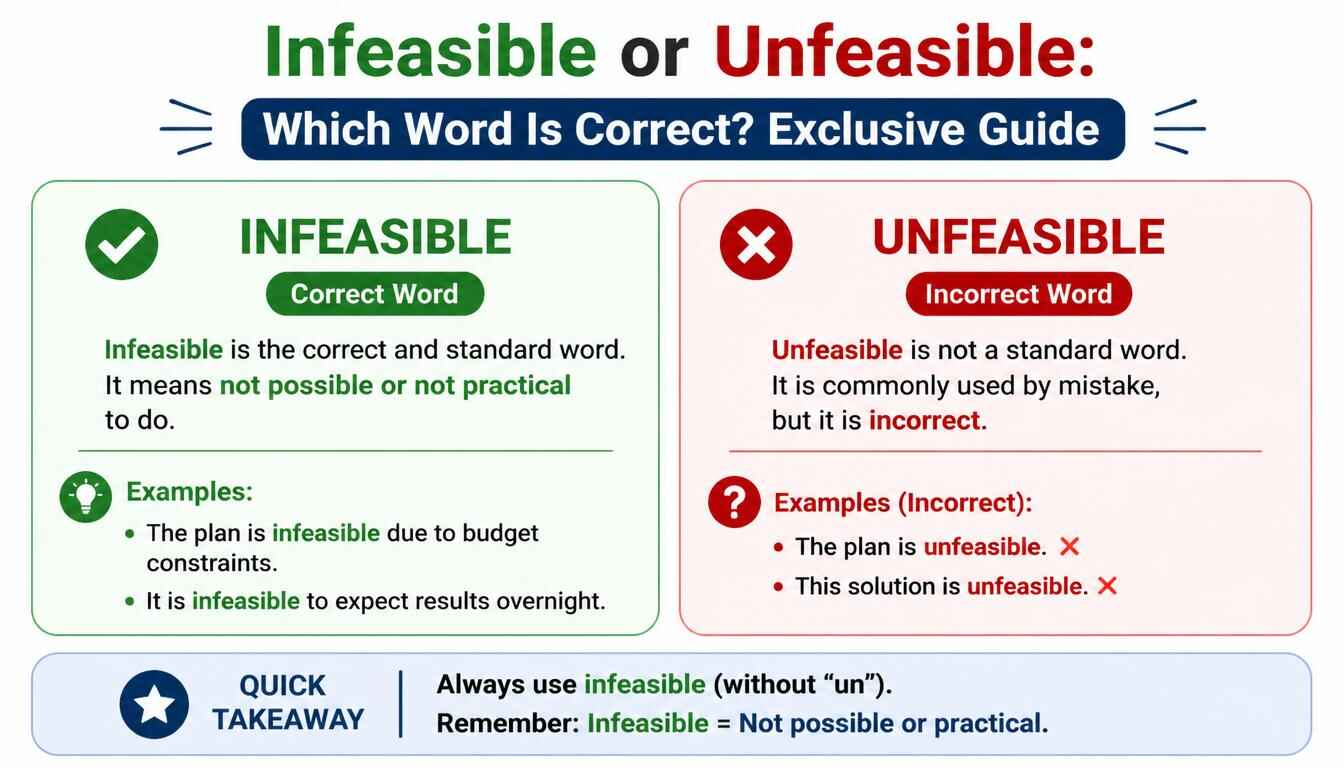
Infeasible or unfeasible which word should you use? Both are correct English words, and both mean that something is not feasible, practical, or achievable under the circumstances. They are generally interchangeable, so neither is automatically wrong. However, infeasible is a useful default for American professional and technical writing, while unfeasible is also acceptable. If you want the clearest wording for a general audience, you can simply write “not feasible.”
Infeasible or Unfeasible: The Quick Answer
Infeasible and unfeasible both describe plans, ideas, tasks, or solutions that cannot reasonably be carried out in a particular situation. For example, “Completing the project in one day is infeasible” and “Completing the project in one day is unfeasible” communicate essentially the same idea. In American English, infeasible is a strong default for formal writing, but unfeasible is not incorrect.
Infeasible vs. Unfeasible: What’s the Difference?
The main difference is a matter of usage and word preference rather than a strict difference in meaning. Both words express the idea that something is not feasible, although writers may favor one form over the other.
| Feature | Infeasible | Unfeasible |
|---|---|---|
| Correct English word? | Yes | Yes |
| Basic meaning | Not feasible or practical | Not feasible or practical |
| Typical use | Formal, professional, and technical writing | General and formal writing |
| Suitable for American English? | Yes | Yes |
| Interchangeable? | Generally, yes | Generally, yes |
| Clear alternative | Not feasible | Not feasible |
Are Both Words Correct?
Yes. Both “infeasible” and “unfeasible” are recognized English words. They are formed by adding a negative prefix to feasible, which means possible or practical to accomplish.
Consider these examples:
- Infeasible: The proposed schedule is infeasible because the team needs more time.
- Unfeasible: The proposed schedule is unfeasible because the team needs more time.
Both sentences communicate that the schedule cannot reasonably be followed under the circumstances.
You do not need to correct unfeasible automatically when editing a sentence. Instead, consider your audience, your preferred writing style, and whether the word fits the context.
Do Infeasible and Unfeasible Mean the Same Thing?
For most everyday, professional, and academic purposes, the two words have the same basic meaning. They describe something that cannot reasonably be accomplished, implemented, or carried out.
For example:
- The plan is infeasible without additional funding.
- The plan is unfeasible without additional funding.
Both sentences suggest that the plan cannot reasonably proceed with the available resources.
Some writers may prefer infeasible in technical or business documents, while others may use unfeasible. However, it is best not to treat them as having a strict, universal distinction in meaning. The surrounding context determines what makes a plan infeasible or unfeasible.
Which Word Is More Common in American English?
Infeasible is a useful default in American English, particularly in professional, academic, business, and technical writing. It is a familiar choice when discussing project constraints, budgets, schedules, research methods, and proposed solutions.
That does not mean unfeasible is wrong in the United States. Both forms are acceptable, and their relative frequency can vary by context and source. Without a specific, comparable corpus analysis, it would be misleading to give an exact percentage or claim a precise frequency difference.
If consistency matters in your document, choose one form and use it consistently. For many American readers, infeasible is a straightforward choice.
Which Word Is Better for Formal Writing?
For formal writing, infeasible is often the safer default. It fits naturally into reports, proposals, academic discussions, project assessments, and technical explanations.
For example:
- Formal: The proposed research method is infeasible because the required data are unavailable.
- Also acceptable: The proposed research method is unfeasible because the required data are unavailable.
- Plain English: The proposed research method is not feasible because the required data are unavailable.
The first option is concise and professional. The third may be easier to understand for readers who prefer familiar, everyday wording.
Infeasible or Unfeasible Meaning
To understand the difference between infeasible and unfeasible, start with the word feasible.
Feasible means possible or practical to accomplish, given the available time, money, resources, skills, and other conditions. Adding a negative prefix changes the meaning to indicate that something is not feasible.
What Does Infeasible Mean?
Infeasible means not practical or possible to carry out under the circumstances.
It often describes a plan that faces significant obstacles, such as a limited budget, an unrealistic deadline, unavailable equipment, or insufficient staff.
Examples:
- Building the entire facility in two weeks is infeasible.
- The project became infeasible after its funding was reduced.
- The proposed solution is infeasible with the current technology.
- Completing all the assignments tonight is infeasible for one student.
In each example, the task may be imaginable, but the existing conditions make it impractical or impossible to carry out as planned.
What Does Unfeasible Mean?
Unfeasible also means not feasible, practical, or reasonably achievable.
Examples:
- The original deadline is unfeasible because several stages remain unfinished.
- The team rejected the unfeasible proposal.
- It would be unfeasible to serve every customer with the staff currently available.
- The plan sounds attractive, but it is unfeasible within our budget.
These sentences could generally use infeasible without changing their central meaning.
What Does Feasible Mean?
Feasible is the positive form. It describes something that can reasonably be done or achieved.
For example:
- The revised budget makes the project feasible.
- A six-month timeline is feasible with additional staff.
- We need to find a feasible way to reduce costs.
- The engineer confirmed that the proposed design is feasible.
Understanding feasible makes the negative forms easier to use. If a plan is feasible, it can reasonably be carried out. If it is infeasible or unfeasible, it cannot reasonably be carried out under the current conditions.
Why Do Both Infeasible and Unfeasible Exist?
English uses several prefixes to create negative words. Both in- and un- can express negation, although English does not allow every prefix to attach naturally to every word.
In this case, both infeasible and unfeasible are established forms. Their existence does not mean that one must have a completely different meaning from the other.
Related words include:
- Feasible: Practical or possible to accomplish.
- Feasibility: The quality or condition of being practical or possible.
- Infeasibility: The condition of being infeasible.
- Infeasible: Not feasible.
- Unfeasible: Also meaning not feasible.
For example, a company might conduct a feasibility study to determine whether a project can be completed with the available budget, technology, and staff. If the study identifies major obstacles that cannot reasonably be resolved, the project may be considered infeasible.
Infeasible or Unfeasible in a Sentence
The best way to understand these words is to see how they work in natural sentences. Both can describe plans, deadlines, budgets, technical requirements, and everyday tasks.
Infeasible in a Sentence: Examples
Here are ten examples of infeasible in context:
- Completing the entire project by tomorrow is infeasible.
- The company decided that the expansion plan was infeasible without additional funding.
- Our original schedule became infeasible after the supplier delayed delivery.
- The engineer found the proposed design infeasible with the available materials.
- Running the experiment without reliable data would be infeasible.
- The team developed a more feasible alternative after reviewing the budget.
- The construction plan is infeasible because the site is too small.
- It would be infeasible to hire and train an entire team in two days.
- The researchers concluded that the original method was infeasible under the study’s conditions.
- Traveling to all five destinations in a single afternoon is infeasible.
These examples show how infeasible works in business, education, research, construction, and everyday planning.
Unfeasible in a Sentence: Examples
Here are ten examples of unfeasible used naturally:
- The proposed deadline is unfeasible given the amount of work remaining.
- The manager rejected the unfeasible budget proposal.
- It would be unfeasible to complete the repairs without the necessary equipment.
- The original plan became unfeasible after the project lost its funding.
- The team searched for an alternative to the unfeasible design.
- Hiring enough workers by the end of the day would be unfeasible.
- The schedule is unfeasible because several tasks depend on the same equipment.
- The company needs a practical alternative to its unfeasible expansion strategy.
- The proposed experiment was considered unfeasible with the resources available.
- It is unfeasible to finish every assignment in an hour.
In these examples, infeasible could generally replace unfeasible. The choice mainly reflects style and preference.
When Should You Use “Not Feasible” Instead?
Although infeasible and unfeasible are correct, “not feasible” is often the clearest option for a broad audience. It uses familiar words and makes the meaning immediately accessible.
Compare these sentences:
| More formal or concise | Plain-English alternative |
|---|---|
| The deadline is infeasible. | The deadline is not feasible. |
| The proposed method is unfeasible. | The proposed method is not practical. |
| The plan is infeasible within this budget. | We cannot reasonably carry out the plan within this budget. |
| The schedule is unfeasible. | We do not have enough time to follow the schedule. |
The best choice depends on what you want to communicate. Use infeasible when it fits the tone of your writing, but do not hesitate to use a clearer phrase when readers may find the technical wording unfamiliar.
Examples in Work, Budgets, School, and Technology
At work:\ “The requested delivery date is infeasible because the product has not completed testing.”
With a limited budget:\ “Hiring five additional employees is infeasible under the current budget.”
At school:\ “Finishing a semester-long research project in one evening is unfeasible.”
In technology:\ “The proposed feature is infeasible with the current system architecture.”
In everyday planning:\ “Visiting six cities in one day is not feasible because of the travel time.”
Notice that the final example uses not feasible. It expresses the same basic idea without requiring a formal adjective.
Before-and-After Sentence Improvements
Sometimes the issue is not whether infeasible or unfeasible is correct. The real issue is whether the sentence explains why something cannot be done.
Before: The plan is infeasible.
After: The plan is infeasible because the available budget cannot cover the required materials and labor.
The improved sentence gives readers a reason instead of simply labeling the plan.
Before: The deadline is unfeasible.
After: The deadline is not feasible because the team needs at least three additional days to complete testing.
The second version makes the obstacle clear and offers more useful information.
Before: The proposed solution is infeasible.
After: The proposed solution is infeasible with the current software, but it may work after the system is upgraded.
This final example shows that something infeasible under current conditions may become feasible when those conditions change.
READ MORE >>> Lovey or Lovie: What’s the Difference, Which Is Correct, & When to Use
Infeasible or Unfeasible Examples: Which Sounds Better?
Both words can fit the same sentence, but some contexts favor a particular style.
In Professional Emails
In professional emails, infeasible is a concise option for explaining why a request cannot be completed as proposed.
For example:
“After reviewing the requested timeline, we found that completing the project by Friday is infeasible with our current staffing levels.”
You could also write:
“After reviewing the requested timeline, we found that completing the project by Friday is not feasible with our current staffing levels.”
The second version is direct and accessible. Both are appropriate; choose the one that best matches your audience and workplace style.
In Business and Project Planning
Business writing frequently discusses the feasibility of schedules, budgets, and proposed strategies.
Examples:
- The expansion plan is infeasible without additional capital.
- The launch date is unfeasible because product testing is incomplete.
- The proposed budget is not feasible given current operating costs.
When assessing a project, it is useful to explain the specific constraint. A project may be infeasible because of insufficient funding, limited resources, regulatory requirements, or an unrealistic schedule. Identifying the reason helps decision-makers determine whether the plan should be revised or abandoned.
In Academic and Technical Writing
In academic and technical contexts, infeasible is a useful choice when discussing research methods, engineering designs, mathematical problems, or computational limits.
Examples:
- The proposed sampling method was infeasible because the required participants could not be recruited.
- The algorithm becomes computationally infeasible as the input size increases.
- The experiment was unfeasible under the available laboratory conditions.
In technical writing, be specific about the type of limitation. For instance, a computation may be theoretically possible but take too much time or require too many resources to be practical. Calling it computationally infeasible can communicate that distinction more accurately than simply calling it impossible.
In Everyday Conversation
In casual conversation, you may find that not possible, too difficult, or not practical sounds more natural.
For example:
- Formal: “It is infeasible to complete the trip in two hours.”
- Everyday: “We can’t realistically make the trip in two hours.”
- Formal: “The plan is unfeasible without more money.”
- Everyday: “The plan won’t work unless we get more money.”
You do not need to avoid infeasible in conversation. However, simpler wording can make your meaning clearer when you are speaking to people who are unfamiliar with the term.
Infeasible or Unfeasible Synonyms
Several words can replace infeasible or unfeasible, but they do not all mean exactly the same thing. The right synonym depends on whether you mean something is impossible, impractical, difficult to implement, or unlikely to succeed.
| Synonym or phrase | Meaning | Example |
|---|---|---|
| Not feasible | Not practical or possible under the circumstances | The schedule is not feasible. |
| Impractical | Not sensible or convenient to carry out | The proposed arrangement is impractical for a small team. |
| Impossible | Cannot happen or be done | It is impossible to enter the locked room without a key. |
| Unworkable | Cannot function effectively as planned | The proposed system is unworkable without reliable internet access. |
| Unachievable | Cannot reasonably be attained | The target is unachievable within the available time. |
| Unrealistic | Does not reflect likely conditions or reasonable expectations | The deadline is unrealistic for a project of this size. |
Infeasible vs. Impractical
Infeasible emphasizes that something cannot reasonably be carried out under the existing conditions. Impractical emphasizes that an idea may be possible in theory but is not sensible or convenient in practice.
For example:
- “Building the bridge without the necessary permits is infeasible.”
- “Using a separate vehicle for every employee is impractical.”
The first sentence suggests a serious barrier to carrying out the project. The second suggests that an option may be possible but inefficient or inconvenient.
Infeasible vs. Impossible
Impossible is often stronger than infeasible. It suggests that something cannot happen or be done, while infeasible often focuses on practical limitations.
For example:
- “It is impossible to complete a triangle with four sides under the standard definition of a triangle.”
- “It is infeasible to finish the renovation this week with the current crew.”
The renovation may be possible with more workers, more time, or additional resources. Therefore, infeasible does not always mean that something can never be done.
Infeasible vs. Unworkable
Unworkable usually describes a plan, arrangement, or system that will not function effectively.
For example:
“The proposed payment process is unworkable because it requires customers to submit the same information several times.”
You could use infeasible if the process cannot reasonably be implemented, but unworkable highlights the problems with how it operates.
Infeasible vs. Unachievable
Unachievable focuses on whether a goal or result can be attained. Infeasible is broader and often concerns whether a plan, method, or project can be carried out.
For example:
- “The sales target is unachievable without a larger customer base.”
- “The proposed sales strategy is infeasible with the current budget.”
The terms overlap, but they emphasize different aspects of the problem.
Which Word Should You Use in American English?
For American English, infeasible is a reliable default, especially in formal, academic, business, and technical writing. However, you can also use unfeasible without automatically making a grammatical error.
Use the following guidelines to make your decision.
Choose Infeasible for Formal or Technical Writing
Use infeasible when writing reports, research papers, technical assessments, project proposals, or business documents.
Examples:
- The proposed implementation is infeasible without additional infrastructure.
- The original research design was infeasible because the required data could not be obtained.
- The project is infeasible under the current financial constraints.
This choice creates a concise and professional tone.
Choose “Not Feasible” for Maximum Clarity
If your goal is to communicate with a general audience, not feasible may be the better option.
For example:
Instead of “The proposed schedule is infeasible,” write, “The proposed schedule is not feasible because we need more time.”
The second version states the problem in familiar language and explains the reason.
Can You Use Unfeasible in American English?
Yes. Unfeasible is an acceptable English word, including in American writing. It is not automatically a spelling mistake, and you do not need to replace every occurrence with infeasible.
If your organization has a style guide, follow its preferred terminology. Otherwise, choose the word that sounds natural in context and use it consistently throughout the document.
A Simple Three-Step Decision Test
If you are unsure which form to use, follow these steps:
- Check the meaning. Are you describing something that cannot reasonably be carried out? Both words can work.
- Consider the audience. For formal American writing, infeasible is a useful default. For plain English, not feasible is often clearer.
- Check consistency. If you have already chosen one form for a document, avoid switching between the two without a reason.
You do not need a complicated rule to decide. In most situations, the distinction is about writing preference rather than correctness.
Infeasible or Unfeasible Quiz
Test your understanding of infeasible and unfeasible with these five questions. Choose the best answer for each one before checking the explanations.
Question 1: Which sentence uses a correct word?
A. The project is infeasible without additional funding.
B. The project is unfeasible without additional funding.
C. Both A and B.
Answer: C. Both infeasible and unfeasible are correct and can express the same meaning in this sentence.
Question 2: Which word is a useful default for formal American business writing?
A. Infeasible
B. Unfeasible
C. Neither word is correct.
Answer: A. Infeasible is a useful default for formal American writing. However, unfeasible is also acceptable, so it is not automatically incorrect.
Question 3: Which phrase is often clearest for a general audience?
A. Not feasible
B. Infeasibility
C. Computationally infeasible
Answer: A. Not feasible uses familiar words and communicates the meaning directly. The other options can be appropriate in more specialized contexts.
Question 4: Do infeasible and unfeasible always have completely different meanings?
A. Yes, infeasible always means impossible.
B. Yes, unfeasible always means merely inconvenient.
C. No, their basic meanings generally overlap.
Answer: C. Both words mean not feasible or practical under the circumstances. Avoid relying on a strict distinction that does not apply universally.
Question 5: Improve this sentence for a general audience: “The deadline is infeasible.”
A. The deadline is not feasible because the team needs more time.
B. The deadline is feasibility.
C. The deadline is impossible in every situation.
Answer: A. This version uses plain English and explains the reason. It is more informative without claiming that the deadline could never be met under any circumstances.
Frequently Asked Questions
Is unfeasible a real word?
Yes. Unfeasible is a recognized English word meaning not feasible, practical, or reasonably achievable. It is not automatically a spelling mistake.
Is infeasible more common than unfeasible?
Infeasible is a useful and familiar choice in formal American writing, including business and technical contexts. The exact frequency difference depends on the corpus, time period, and type of writing being examined. Avoid treating an unverified percentage or general impression as definitive statistical evidence.
Are infeasible and unfeasible interchangeable?
Yes, they are generally interchangeable when describing something that cannot reasonably be carried out. For most sentences, replacing one with the other does not change the central meaning.
Is unfeasible incorrect in American English?
No. Unfeasible is not inherently incorrect in American English. Writers may prefer infeasible for style or consistency, but the alternative is an accepted word.
What is the opposite of infeasible?
The most direct opposite of infeasible is feasible. Depending on the context, related positive terms include practical, workable, achievable, and viable.
For example, “The original plan was infeasible, but the revised plan is feasible.”
Does infeasible mean impossible?
Not always. Infeasible usually means that something cannot reasonably be carried out under the current conditions. It may become feasible if the budget, timeline, equipment, staffing, or other constraints change. Impossible can express a stronger claim, depending on the context.
Is “not feasible” better than “infeasible”?
Neither is always better. Infeasible is concise and suits formal or technical writing. Not feasible is often easier for general readers to understand. Choose the wording that communicates your meaning most clearly.
Is there a difference between infeasibility and unfeasibility?
Infeasibility is the noun related to infeasible and refers to the condition of being infeasible. Unfeasibility is also formed from unfeasible, but infeasibility is generally the more familiar choice in formal writing. When in doubt, use infeasibility or the simpler phrase lack of feasibility.
Final Verdict: Infeasible or Unfeasible?
Both “infeasible” and “unfeasible” are correct. They generally mean that something is not practical or reasonably achievable under the circumstances, and they can be used interchangeably in most contexts.
For American professional, academic, and technical writing, infeasible is a sensible default. If you are writing for a general audience, not feasible may be even clearer. Use unfeasible when it fits your style, and do not mark it as wrong simply because you prefer the alternative.
The most important point is to explain why a plan, deadline, or proposal cannot reasonably work. Clear reasoning matters more than choosing between two words with substantially overlapping meanings.
Condense repetitive explanationsClarify the American English recommendation