
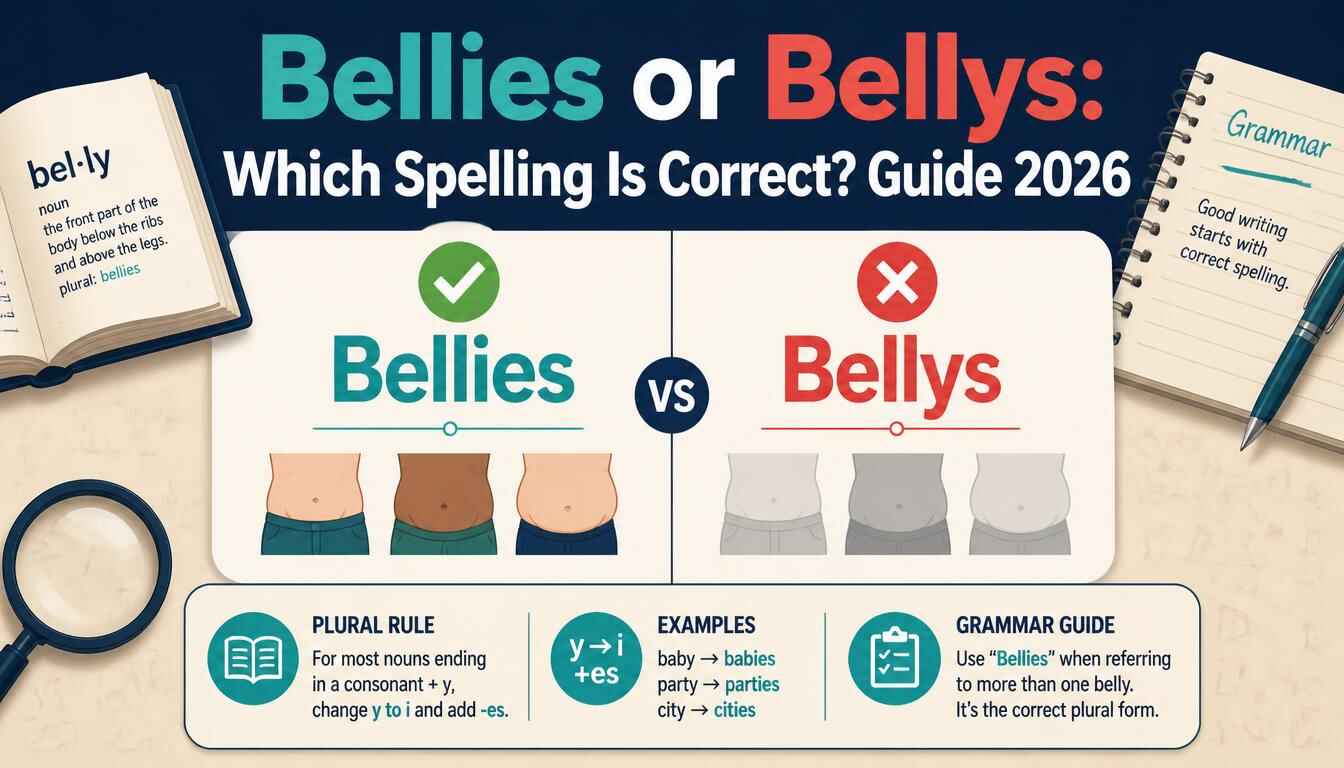
Bellies or bellys which spelling is correct? Bellies is the correct standard English plural of belly, while bellys is generally considered a misspelling. The reason is a simple spelling rule: when a noun ends in a consonant followed by y, the y usually changes to i before adding -es. That is why we write belly → bellies, just as we write baby → babies and city → cities. Below, you’ll learn the meaning, grammar rules, sentence examples, and differences between bellies, belly’s, and bellies’.
Bellies or Bellys: The Quick Answer
Bellies is the correct spelling when you want to refer to more than one belly. Bellys is not the standard plural form in ordinary English writing.
The word belly refers to the front part of a person’s or animal’s body, particularly the area around the abdomen. When you are talking about two or more people or animals, you use bellies.
| Word | Meaning and use | Example |
|---|---|---|
| Belly | Singular noun; one belly | The baby has a round belly. |
| Bellies | Plural noun; more than one belly | The babies have round bellies. |
| Bellys | Nonstandard spelling for the ordinary plural | Write bellies, not bellys. |
| Belly’s | Singular possessive or contraction of “belly is” | The baby’s belly is soft. |
| Bellies’ | Plural possessive | The animals’ bellies were muddy. |
The key is to understand what your sentence means. If you simply need the plural of belly, choose bellies. If you need to show possession, check whether the noun is singular or plural before adding an apostrophe.
Why Is Bellies the Correct Plural of Belly?
The spelling bellies follows a common English pluralization rule. Many nouns ending in a consonant followed by y change the y to i and add -es to form the plural.
The rule works like this:
Belly → Bellies
The word belly ends in l, a consonant, followed by y. To make it plural, replace the y with i and add -es. The result is bellies, not bellys.
The Consonant + Y Rule
When a noun ends in a consonant + y, change the final y to i and add -es.
Here are some familiar examples:
| Singular | Plural |
|---|---|
| Belly | Bellies |
| Baby | Babies |
| City | Cities |
| Family | Families |
| Party | Parties |
| Story | Stories |
| Lady | Ladies |
| Puppy | Puppies |
These examples follow the same spelling pattern. For instance, you would write, “The family went on vacation,” but “Several families went on vacation.”
The same principle applies to belly. Whether you are describing babies, animals, or people, the standard plural spelling remains bellies.
When Does a Word Ending in Y Just Take -S?
Not every word ending in y changes to ies. When a noun ends in a vowel + y, it usually forms its plural by adding -s without changing the y.
| Singular | Plural |
|---|---|
| Boy | Boys |
| Toy | Toys |
| Key | Keys |
| Day | Days |
| Valley | Valleys |
Compare belly with boy. In belly, the letter before y is the consonant l, so the plural is bellies. In boy, the letter before y is the vowel o, so the plural is boys.
This distinction is useful beyond this one word. Once you understand the difference between consonant + y and vowel + y, you can spell many English plurals more confidently.
Bellies or Bellys Meaning in English
To understand bellies or bellys meaning in English, start with the singular noun belly.
A belly is the front part of the body, especially the area around the abdomen. The word is common in everyday conversation and can describe the body of a person or an animal.
Bellies is simply the plural of belly. It refers to the abdominal areas of two or more people or animals.
Consider these examples:
- “The baby has a full belly after feeding.”
- “The puppies have round bellies.”
- “The children lay on their bellies while drawing.”
- “The seals rested on their bellies near the water.”
In each sentence, belly or bellies refers to the body area. The singular or plural form depends on how many people or animals are being discussed.
The words stomach and abdomen can sometimes be used in similar contexts, but they are not always interchangeable. Belly is often more conversational, while abdomen is more formal or anatomical.
Bellys does not have a separate standard meaning as the ordinary plural of belly. In everyday writing, use bellies instead. An unusual spelling might appear in a brand name, surname, or deliberately stylized text, but that does not make bellys the standard plural.
Bellies or Bellys Examples in Sentences
Seeing the word in context makes the spelling rule easier to remember. These bellies or bellys examples show how bellies works in ordinary English sentences.
Everyday Examples With Bellies
- The children lay on their bellies while watching the ants.
- The puppies had round bellies after their meal.
- The babies rested comfortably on their bellies during supervised tummy time.
- The kittens rolled onto their bellies while playing.
- The dancers stretched while lying on their bellies.
- The cartoon characters rubbed their bellies after eating.
- The veterinarians examined the animals’ bellies.
- The hikers noticed that their backpacks pressed against their bellies.
Each sentence uses bellies because it refers to more than one belly or to multiple animals or people.
Incorrect vs. Correct Spelling
Here are examples of how to correct the most common spelling mistake.
| Incorrect | Correct |
|---|---|
| The babies slept on their bellys. | The babies slept on their bellies. |
| The puppies had round bellys. | The puppies had round bellies. |
| Several children rested on their bellys. | Several children rested on their bellies. |
| The animals’ bellys were muddy. | The animals’ bellies were muddy. |
The correction is straightforward: replace bellys with bellies. If the sentence also expresses possession, check the apostrophe separately.
How to Choose the Right Form in Your Sentence
Before writing belly or bellies, ask yourself whether you mean one or more than one.
- One: “The dog has a small belly.”
- More than one: “The dogs have small bellies.”
- One person’s belly: “The baby’s belly was warm.”
- Multiple animals’ bellies: “The dogs’ bellies were covered in mud.”
This quick check can help you avoid spelling and punctuation errors in emails, school assignments, articles, captions, and everyday messages.
Bellies for Women: Meaning and Examples
The phrase bellies for women may appear in searches about body shape, clothing, pregnancy, fitness, or everyday language. Grammatically, bellies can refer to the abdominal areas of multiple women. The phrase does not create a special plural spelling or a separate grammatical rule.
Here are a few natural examples:
- “The article discussed how women’s bellies can change during pregnancy.”
- “The clothing guide explained how different waistbands fit around women’s bellies.”
- “The exercise instructor discussed ways to strengthen the muscles around the abdomen.”
- “The photographer chose comfortable poses that suited the women’s bodies.”
When referring to something belonging to women, write women’s bellies. The apostrophe comes after women because women is already the plural form of woman.
It is also important to remember that bodies vary naturally. A person’s belly can look different because of body structure, posture, digestion, pregnancy, or other factors. The word itself is neutral; the surrounding sentence determines whether the description sounds respectful and appropriate.
If you are writing about health or pregnancy, use precise wording and avoid treating every person’s experience as the same.
Bellies, Belly’s, or Bellies’: Which Form Do You Need?
The difference between bellies, belly’s, and bellies’ is a common source of confusion. The words look similar, but the apostrophe changes the grammatical meaning.
Bellies vs. Belly’s
Bellies is the ordinary plural of belly. Belly’s usually shows possession by one belly, although it can also represent the contraction belly is in a suitable sentence.
Examples:
- Plural: “The babies have round bellies.”
- Singular possessive: “The baby’s belly was covered by a soft blanket.”
- Contraction: “The belly’s getting bigger.” This means “The belly is getting bigger” and is informal.
Notice that in “the baby’s belly,” the possessive apostrophe belongs to baby, not belly. If you want to express possession by the noun belly itself, you could write, “The belly’s shape was unusual.”
Do not add an apostrophe merely to make a noun plural. For ordinary plural usage, write bellies, not belly’s.
Bellies vs. Bellies’
Bellies’ is the plural possessive form. It shows that something belongs to or is associated with multiple bellies.
For example:
- “The animals’ bellies were muddy.”
- “The children’s bellies were full after lunch.”
- “The costumes were designed to fit around the dancers’ bellies.”
In these examples, the possessive relationship is expressed by the words animals’, children’s, and dancers’—not by bellies’.
To see the difference more clearly, compare these sentences:
| Form | Example | Explanation |
|---|---|---|
| Bellies | The babies have round bellies. | Ordinary plural |
| Belly’s | The belly’s shape changed. | Singular possessive |
| Bellies’ | The bellies’ shapes were different. | Plural possessive |
The last example is grammatically possible, but it may sound awkward in ordinary writing. A more natural sentence might be, “The shapes of the bellies were different.”
A Simple Apostrophe Check
When you are unsure which form to use, follow these steps:
- Check the number. Are you talking about one belly or several?
- Check the meaning. Are you simply naming the body part, or showing possession?
- Add punctuation only when needed. A regular plural does not require an apostrophe.
For example, “The babies’ bellies were warm” uses an apostrophe in babies’ because the bellies belong to the babies. The word bellies itself remains an ordinary plural noun.
READ MORE >>> Natzi or Nazi: Correct Spelling, Meaning, Pronunciation “2026”
Common Mistakes When Writing Bellies
Even though the rule is simple, several mistakes can appear in everyday writing.
1. Writing “bellys” instead of “bellies.”\ The standard plural changes the final y to i and adds -es.
2. Using “belly’s” as a plural.\ An apostrophe does not usually make a noun plural. Use bellies when referring to more than one.
3. Confusing singular and plural possession.\ Use belly’s for singular possession and bellies’ for plural possession when the sentence genuinely needs those forms.
4. Applying the wrong Y-ending rule.\ Remember that belly → bellies, but boy → boys. The letter before the final y determines which common plural pattern applies.
5. Relying entirely on autocorrect.\ Spell-checking tools can help identify errors, but they may not explain why a form is wrong. Understanding the rule makes it easier to edit sentences accurately.
A Quick Proofreading Checklist
Before publishing or submitting your writing, ask:
- Am I referring to one belly or more than one?
- Have I used bellies as the plural?
- Does the sentence actually need an apostrophe?
- If it expresses possession, is the owner singular or plural?
- Does the sentence sound natural when read aloud?
These small checks can prevent unnecessary grammar mistakes without slowing down your writing.
Frequently Asked Questions About Bellies or Bellys
Is it bellies or bellys?
Bellies is correct in standard English when referring to more than one belly. Bellys is generally a misspelling of the plural. The spelling changes because belly ends in a consonant followed by y.
What is the belly plural?
The plural of belly is bellies. Change the final y to i and add -es. For example, “The baby has a round belly” becomes “The babies have round bellies.”
Is “bellys” ever correct in English?
Bellys is not the standard plural of belly. However, it could appear intentionally in a business name, surname, username, or stylized expression. In ordinary grammar and edited writing, use bellies.
Why does belly become bellies?
The word follows the common consonant + y plural rule. Because the letter before y is the consonant l, the final y changes to i before adding -es. This is the same pattern used in baby → babies and city → cities.
What is the difference between belly’s and bellies’?
Belly’s can show possession by one belly or serve as a contraction of “belly is.” Bellies’ is the plural possessive form. For example, “The belly’s shape changed” refers to one belly, while “The bellies’ shapes differed” refers to several.
Can I use “bellies for women”?
Yes. The word bellies can refer to the abdominal areas of multiple women. The phrase may fit discussions about clothing, pregnancy, body shape, or exercise, depending on the context. When expressing possession, women’s bellies is a natural grammatical construction.
Is “bellies” a noun?
Yes. Bellies is the plural form of the noun belly. It names the abdominal areas of multiple people or animals. In a sentence such as “The puppies have round bellies,” the word bellies functions as a plural noun.
Remember: Belly Becomes Bellies
When choosing between bellies or bellys, remember that bellies is the standard spelling. The rule is simple: a noun ending in a consonant followed by y usually changes the y to i and adds -es to form its plural.
Use belly for one, bellies for more than one, and apostrophes only when the sentence calls for possession or a contraction. Once you recognize this pattern, you can apply the same rule to words such as babies, cities, families, and parties with greater confidence.
Remove the unnecessary women’s sectionMerge repetitive spelling-rule sections