
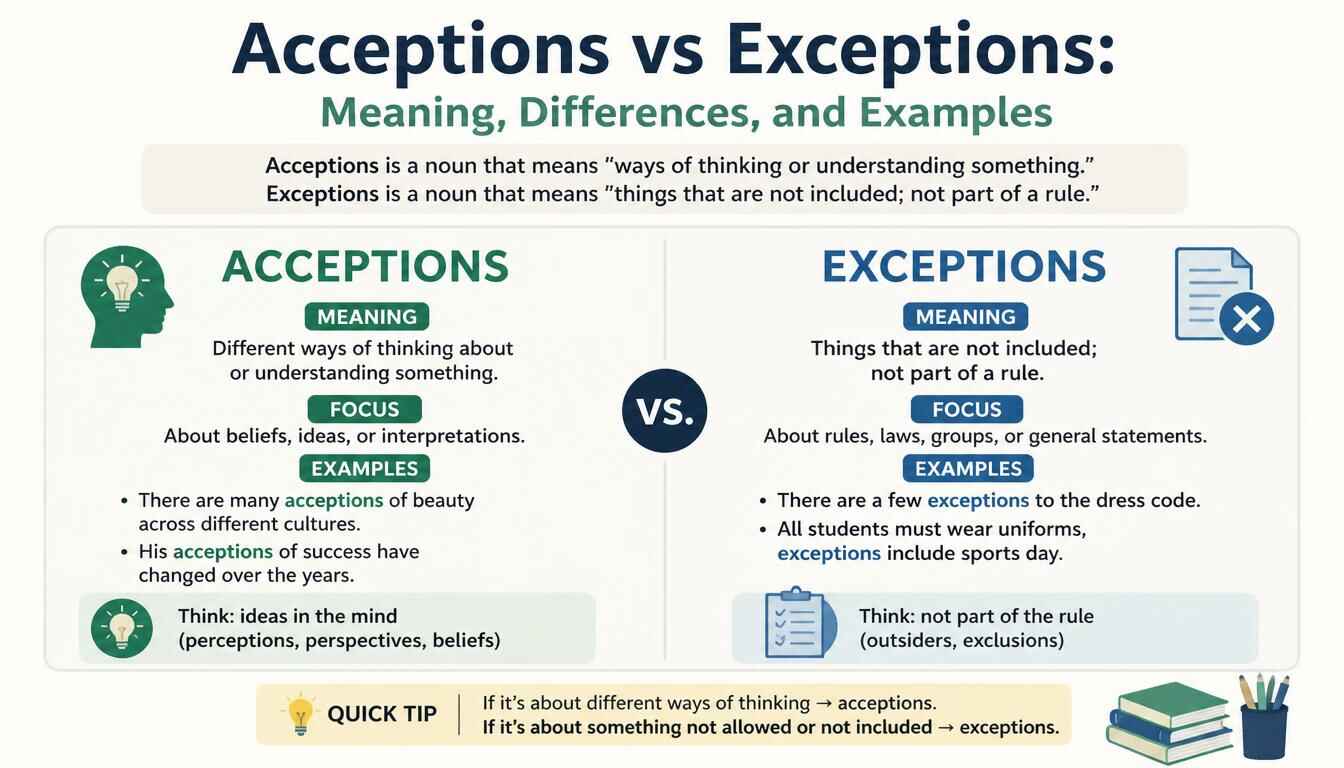
Acceptions vs. exceptions is a confusing word comparison because the two words look similar but have different meanings. Acceptions is the plural of acception, a rare English noun associated with a particular meaning or sense of a word. Exceptions is the plural of exception, meaning cases that fall outside a rule, condition, or general pattern.
For everyday writing, use exceptions when discussing rules or special cases. When discussing the meaning of a word, meanings or senses will usually be clearer than acceptions. If you mean agreeing to or approving something, use acceptance.
Acceptions vs. Exceptions: What Is the Difference?
The main difference is what each word describes: acceptions concerns meanings, while exceptions concerns cases that do not follow a rule or general pattern.
| Word | Meaning | Typical use |
|---|---|---|
| Acceptions | Particular meanings or senses of a word | Specialized or historical language discussions |
| Exceptions | Cases excluded from a rule or general pattern | Everyday, academic, and professional writing |
| Acceptance | The act of accepting, agreeing to, or approving something | Offers, invitations, proposals, and decisions |
Consider these examples:
- Acceptions: The researcher examined different acceptions of a term in historical texts.
- Exceptions: The school allows exceptions to its attendance policy.
- Acceptance: Her acceptance of the job offer arrived by email.
These words are not interchangeable. The first concerns the meaning of a word, the second describes cases outside a rule, and the third describes accepting or agreeing to something.
What Does “Acceptions” Mean?
Acceptions is the plural form of acception. The noun has historical and specialized uses associated with the meaning or accepted sense of a word. It is uncommon in contemporary general English.
Acception: Definition and Usage
An acception can refer to a particular meaning or sense in which a word is understood. Its precise meaning can depend on the historical or specialized context in which it appears.
For example:
The scholar compared different acceptions of the term in historical texts.
Here, acceptions refers to particular senses of a word. It does not mean exceptions to a rule.
For a general audience, the sentence would usually be clearer as:
The scholar compared different meanings of the term in historical texts.
Both versions communicate the intended idea, but meanings is more familiar to most readers.
Acceptions in a Sentence
These illustrative examples show how the word may be used in discussions of language:
- The researcher examined several acceptions of the term in older documents.
- One historical acception of the word differs from its modern sense.
- The study compared two acceptions of a technical expression.
These are examples created to demonstrate usage, not quotations from historical sources.
Notice that each sentence concerns how a word is understood. If you are writing for a general audience, meanings or senses will usually be more natural.
When Is “Acceptions” Appropriate?
The word may be suitable in specialized discussions of historical vocabulary, terminology, or the different senses assigned to a word.
However, it is rarely necessary in everyday messages, school assignments, business emails, or general explanations.
Compare:
- Specialized: The article examines the acceptions of the term in older texts.
- More accessible: The article examines the meanings of the term in older texts.
The second version is easier for most readers to understand. When both alternatives communicate the intended idea, prefer the wording that makes the sentence clearest.
What Does “Exceptions” Mean?
Exceptions is the plural form of exception. An exception is a person, thing, or situation that is excluded from a rule or differs from a general statement or usual pattern.
It is a common word in everyday English, especially when discussing policies, requirements, schedules, and special circumstances.
Exceptions to Rules and Policies
An exception occurs when a rule does not apply to a particular case or a special case is allowed under the usual practice.
Examples:
- There are no exceptions to the safety requirements.
- The teacher allowed one exception to the assignment deadline.
- The company made two exceptions to its standard refund policy.
An exception does not automatically mean that someone has broken a rule. It may be a permitted special case.
For example, a store might normally refuse returns after 30 days but allow an exception for a defective product. The case differs from the usual policy without necessarily violating it.
Exceptions to General Patterns
An exception can also describe something that differs from what is usual or expected, even when no formal rule exists.
Examples:
- Most students submitted their assignments on time, with a few exceptions.
- The restaurant is open every weekday, with Monday as an exception.
- The results followed the expected pattern, apart from two exceptions.
The key idea is that an exception does not fit the broader pattern. That pattern might come from a written policy, a routine, an observation, or a general expectation.
Common Expressions With “Exception”
Several everyday expressions use this word:
- An exception to the rule: a case that does not follow the usual rule.
- With the exception of: excluding a particular person or thing.
- Make an exception: allow a special case.
- Without exception: applying to everyone or everything in the relevant group.
- Take exception to: object to something or find it offensive.
For example, “She took exception to the remark” means she objected to the remark. This expression is useful to know because exception can describe an objection as well as a case outside a rule.
READ MORE >>> Ingrained or Engrained: Which Spelling Is Correct? Guide 2026
Acceptions vs. Exceptions in Sentences
The difference becomes easier to understand when the words appear in context.
Examples of “Acceptions”
- The researcher compared several acceptions of the term in historical documents.
- The older acception differs from the word’s current meaning.
- The linguistic discussion considers two acceptions of a technical expression.
In each example, the word refers to a meaning or sense. In general writing, meanings or senses would usually be more accessible.
Examples of “Exceptions”
- There are three exceptions to the company’s attendance policy.
- Everyone completed the form, with two exceptions.
- The rules apply to all applicants without exceptions.
- The store usually closes at 8 p.m., but holidays are exceptions to its normal schedule.
These examples describe cases excluded from a rule or departures from what is usual.
Incorrect vs. Correct Word Choice
The right word depends on the intended meaning.
| Wording that does not fit the intended meaning | Better wording | Why |
|---|---|---|
| There are two acceptions to the policy. | There are two exceptions to the policy. | The sentence concerns cases outside a rule. |
| The word has several exceptions. (when referring to definitions) | The word has several meanings. | The sentence concerns the meaning of a word. |
| She sent her acception of the offer. | She sent her acceptance of the offer. | The intended meaning is agreement or approval. |
| The policy has several acceptions. (when referring to special cases) | The policy has several exceptions. | The sentence concerns cases excluded from a policy. |
These examples illustrate incorrect word choices for specific intended meanings. They do not mean that every occurrence of the rare word acception is automatically a spelling mistake.
Is “Acception” a Real Word or a Misspelling?
Acception is a documented English word with historical and specialized uses. Some dictionary references record meanings related to the accepted sense of a word, while historical usage can also connect it with acceptance or reception.
However, a word can be valid without being the best choice for a particular sentence. Acception is uncommon in contemporary general writing, and many readers may not recognize it.
If you encounter it in a historical text or a specialized discussion of language, it may be intentional. If it appears in a sentence about a rule, the intended word may be exception. If the sentence concerns agreeing to something, acceptance may be more appropriate.
Why Is “Acception” Uncommon in Everyday Writing?
Most writers can communicate the intended idea with more familiar words:
- Meaning: what a word, phrase, or statement expresses.
- Sense: a particular meaning of a word.
- Interpretation: the way someone understands or explains something.
- Acceptance: agreeing to, receiving, or approving something.
- Exception: a case excluded from a rule or general pattern.
These words are not interchangeable in every situation, but they cover many contexts in which the intended meaning can be expressed more clearly than with acception.
How to Decide Whether to Use “Acception”
Ask yourself three questions:
- Am I discussing a particular meaning of a word?
- Does the context specifically call for this rare or historical term?
- Would meaning or sense communicate the idea more clearly?
If the sentence concerns a case outside a rule, use exception. If it concerns agreement or approval, use acceptance.
Make an Acception: Meaning
“Make an acception” is not a standard expression in modern English. If you mean to allow something that does not follow a general rule, the correct phrase is “make an exception.”
An acception is a rare noun historically associated with the meaning or interpretation of a word. However, it is not normally used to describe making a special allowance or giving someone permission to break a rule.
Examples:
- Incorrect: I will make an acception for you.
- Correct: I will make an exception for you.
- Correct: The teacher made an exception and allowed the student to submit the assignment late.
Use “make an exception” when you decide not to apply a rule in a particular situation.
I’ll Make an Acception or Exception?
The correct phrase is “I’ll make an exception.” The word exception refers to a person, situation, or case that is excluded from a general rule.
“I’ll make an acception” is not appropriate in ordinary modern English because acception does not carry the intended meaning of a special allowance.
Examples:
- Incorrect: I’ll make an acception this time.
- Correct: I’ll make an exception this time.
- Correct: I usually don’t allow late submissions, but I’ll make an exception for you.
- Correct: My parents made an exception and let me stay out later than usual.
Quick tip: If you are talking about allowing something unusual or making an allowance, use exception, not acception.
Acceptions vs. Exceptions: Grammar
The main grammatical difference is that acceptions is the plural of the rare noun acception, while exceptions is the plural of exception, a common word used for cases that do not follow a general rule.
| Word | Grammatical form | Meaning | Example |
|---|---|---|---|
| Acception | Singular noun | A rare or historical term associated with the meaning or interpretation of a word | The text discusses an unusual acception of the term. |
| Acceptions | Plural noun | More than one such meaning or interpretation | The historical dictionary records several acceptions of the word. |
| Exception | Singular noun | A case that does not follow a rule | There is one exception to the rule. |
| Exceptions | Plural noun | Cases that do not follow a rule | The policy has a few exceptions. |
How to Choose the Correct Word
Use acception or acceptions only when discussing a specialized or historical use of a word’s meaning. In everyday writing, meaning or sense is usually clearer.
Use exception or exceptions when referring to a rule, requirement, or general situation that does not apply in a particular case.
Examples:
- The dictionary explains an unusual sense of the word. (More natural in everyday English.)
- The manager made an exception to the company policy.
- There are no exceptions to this rule.
Remember: The correct phrase is “make an exception,” not “make an acception.”
Acception vs. Acceptance vs. Exception
These three words look similar, but they serve different purposes.
| Word | Core meaning | Example |
|---|---|---|
| Acception | A particular meaning or sense in rare or specialized usage | The author discusses an older acception of the term. |
| Acceptance | Agreeing to, receiving, or approving something | Her acceptance of the offer was confirmed. |
| Exception | A case that falls outside a rule or general pattern | This case is an exception to the policy. |
What Does “Acceptance” Mean?
Acceptance is a common noun that refers to accepting something, agreeing to an offer, approving an idea, or being received as part of a group.
Examples:
- Her acceptance of the invitation made the host happy.
- The company confirmed its acceptance of the proposal.
- The idea gradually gained acceptance among the team.
- He received a letter confirming his acceptance into the program.
In these sentences, acceptance describes agreement, approval, or being accepted. It does not mean a case excluded from a rule.
What About “Accept,” “Except,” and “Acceptation”?
A few related words are also worth distinguishing.
Accept is a verb meaning to receive or agree to something.
I accept your invitation.
Except commonly means excluding someone or something.
Everyone except Maya attended the meeting.
Acceptation is a rare or specialized noun associated with the meaning or accepted sense of a word. Its precise use depends on context, so it should not automatically be treated as a synonym for acceptance.
For general writing, meaning or sense will often be clearer than acceptation.
How to Choose the Right Word
You do not need to memorize several definitions to choose correctly. Start by identifying what you want the sentence to communicate.
Use “Exception” for a Rule or Special Case
Ask: Does this sentence describe something excluded from a rule, policy, list, or usual pattern?
If yes, exception or exceptions is generally appropriate.
Examples:
- There is one exception to the rule.
- The company approved two exceptions to its policy.
- With a few exceptions, the results followed the expected pattern.
Use “Meaning” or “Sense” for Word Definitions
Ask: Am I explaining what a word or expression means?
For most general writing, choose meaning or sense. Use acception only when its specialized or historical meaning is appropriate to the context.
Examples:
- The word has several meanings.
- The expression has a different sense in this passage.
- The researcher discusses a historical acception of the term.
The first two examples will usually be clearer to a general audience.
Use “Acceptance” for Agreement or Approval
Ask: Does the sentence describe agreeing to an offer, invitation, proposal, or idea?
If yes, acceptance is usually the right word.
Examples:
- We received her acceptance of the invitation.
- The proposal gained acceptance after further discussion.
- His acceptance into the program was confirmed.
A Simple Memory Tip
Remember the central idea behind each word:
- Acception: a rare term associated with a particular meaning or sense.
- Exception: an excluded case or departure from a rule.
- Acceptance: agreeing to, receiving, or approving something.
When you are unsure, explain the idea in simpler words first. If you mean a special case, use exception. If you mean a word’s definition, try meaning or sense. If you mean agreement, use acceptance.
Frequently Asked Questions
What Is the Difference Between Acceptions and Exceptions?
Acceptions refers to particular meanings or senses of a word in rare or specialized usage. Exceptions refers to cases that fall outside a rule, condition, or general pattern. They are different words, not alternative spellings of the same word.
Is “Acceptions” a Correct Word?
Yes. Acceptions is the plural of the documented but uncommon noun acception. It can appear in specialized or historical discussions of word meanings. For most everyday writing, meanings or senses is clearer.
What Is the Plural of Acception?
The plural of acception is acceptions. Because the word is uncommon, make sure its specialized meaning fits your sentence.
What Is the Plural of Exception?
The plural of exception is exceptions. For example, “The policy includes two exceptions.”
Can I Use “Acceptions” Instead of “Exceptions”?
No, not when you mean cases that fall outside a rule or pattern. Use exceptions in that context. Acceptions relates to particular meanings or senses in rare, specialized usage.
Is Acception the Same as Acceptance?
No. Acception has historical and specialized uses associated with meaning or acceptance, while acceptance is the standard modern word for agreeing to, receiving, or approving something. The intended meaning determines which word fits.
What Word Can I Use Instead of Acception?
For most general writing, use meaning or sense when referring to a word’s definition. Use acceptance for agreement or approval, and exception for a case outside a rule.
Is There a Difference Between American and British English?
The central distinction is one of meaning and usage, not a standard American-versus-British spelling difference. In both varieties, exception is the usual word for a case excluded from a rule, while acception is rare.
Conclusion
The difference between acceptions and exceptions comes down to meaning. Acceptions is the plural of a rare noun associated with particular word meanings or senses, while exceptions refers to cases that fall outside rules or general patterns.
For everyday writing, use exceptions for policies, requirements, and special cases. Use meanings or senses when explaining what words mean, and use acceptance when referring to agreement or approval.
Choose the word that expresses your intended meaning, not the one that merely looks similar.