
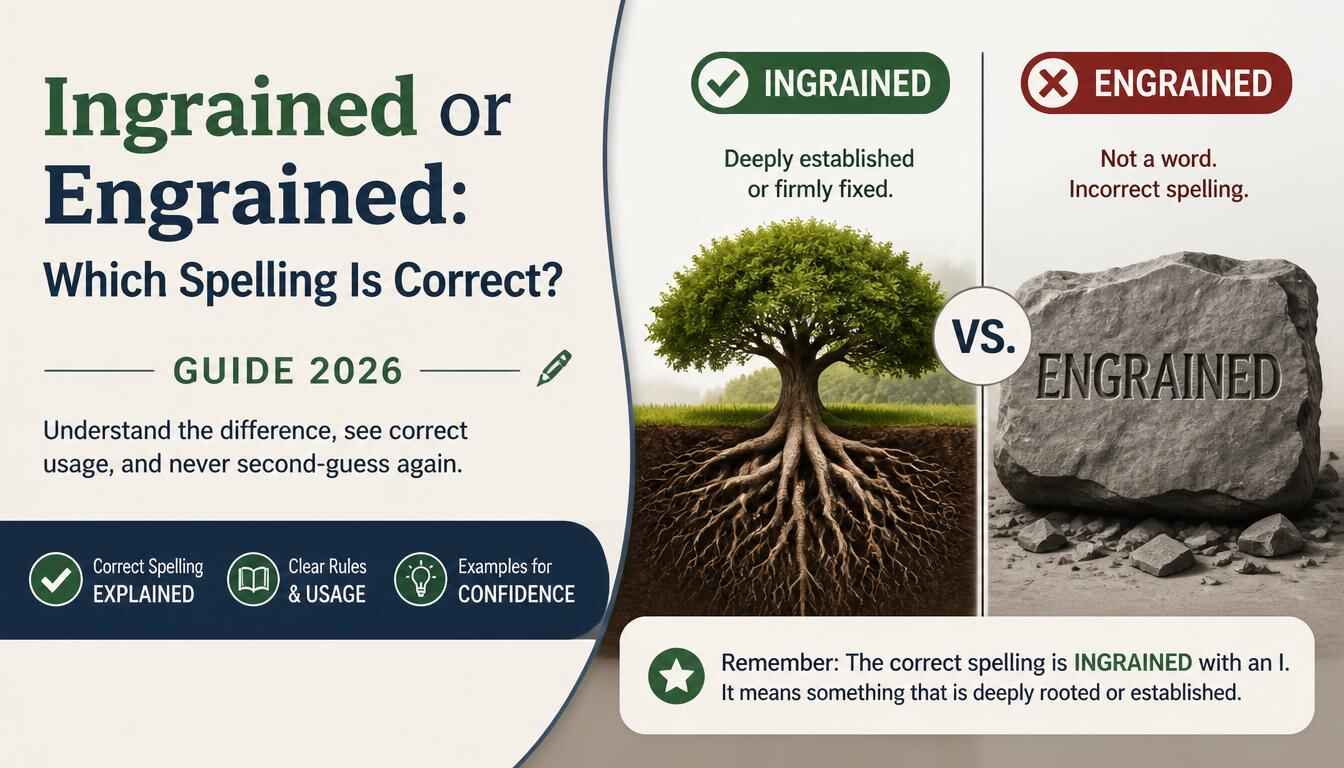
Ingrained or engrained—which spelling should you use? In American English, ingrained is the preferred choice for everyday, academic, and professional writing. However, engrained is also a recognized spelling variant, and both words generally have the same meaning: deeply established, firmly fixed, or embedded in something.
For example, you would usually write, “Checking her work became an ingrained habit.” You can also encounter the spelling engrained in published writing, but ingrained is the more conventional choice when you want your writing to sound familiar and consistent to American readers.
The distinction is primarily about spelling preference rather than a difference in meaning. Both forms can describe a deeply rooted belief, a long-standing behavior, or dirt that has become embedded in fabric. Understanding how the words work in different contexts makes it easier to choose the right form.
Is It Engrained or Ingrained ?
Ingrained is the recommended spelling for general American English. Engrained is a recognized alternative, not automatically a spelling mistake. If you are writing an essay, business email, blog post, or other general text, choose ingrained unless you have a specific reason to preserve the alternative spelling.
The two forms are closely related and share the same core meanings. They can describe something that has become firmly established over time or something that has worked its way deeply into a material.
Consider these examples:
- Preferred: Good study habits became ingrained through daily practice.
- Alternative: Good study habits became engrained through daily practice.
Both sentences communicate the same idea. The first is the safer default for American readers because ingrained is the conventional form.
Which Spelling Is Preferred in American English?
In American English, ingrained is the form to choose when you want a straightforward, conventional spelling. Major dictionaries list the word with meanings related to something firmly established or worked into a material’s fibers. American Heritage Dictionary, for example, defines ingrained in terms of both deep-rooted conditions and substances embedded in a texture or fiber. Collins also recognizes engrained as a variant.
This distinction matters because a word can have more than one accepted spelling without both forms being equally suitable as the default choice for every audience.
For example, if you are preparing a school assignment, writing an article for a US audience, or editing company documentation, using ingrained consistently is a practical decision. You do not need to replace it with engrained to communicate a different meaning.
Is Engrained Incorrect?
No. Engrained is a recognized spelling variant of ingrained. It appears in dictionary entries and published writing, so it is too strong to label it universally incorrect.
However, recognition does not mean that both spellings are equally familiar to every reader or equally preferred by every editor. A writer may choose ingrained because it is the conventional form in American English, while an existing text may contain engrained.
The useful rule is simple: recognize both forms, but use ingrained as your default.
Do Ingrained and Engrained Mean the Same Thing?
Generally, yes. Neither spelling normally signals a separate meaning.
Both can refer to:
- A habit that has developed through repetition.
- A belief or attitude that is difficult to change.
- A custom that has become established within a group.
- Dirt or a stain that has worked deeply into a material.
For example, “The fear was deeply ingrained” and “The fear was deeply engrained” express essentially the same idea. The choice is a matter of spelling preference, not a meaningful change in the sentence.
What Does Ingrained Mean?
Ingrained is an adjective that describes something firmly established, deeply rooted, or difficult to remove or change. It is often used for habits, beliefs, attitudes, and behaviors that have developed over time. It can also describe dirt or another substance that has become embedded in a material.
The word is useful because it conveys more than the simple existence of something. It suggests that the habit, belief, or substance has become established deeply enough that removing or changing it may be difficult.
Ingrained Habits, Beliefs, and Attitudes
In figurative use, ingrained describes something that has become a lasting part of a person’s behavior, thinking, or character.
For example:
- Her ingrained habit of arriving early made her a reliable team member.
- His belief in fairness was deeply ingrained.
- Years of practice made the movement feel ingrained.
- The organization has an ingrained culture of helping new employees.
- It can be difficult to change ingrained assumptions about unfamiliar people.
In each example, the word suggests that something has developed or persisted over time. It does not necessarily mean that the habit or belief can never change. It means that the pattern is firmly established and may take effort to alter.
For instance, a person may have an ingrained habit of checking their phone whenever they receive a notification. Recognizing the habit is one step toward changing it, but repeated behavior may make it difficult to break.
Similarly, an ingrained belief may influence how someone interprets a situation, even when new information challenges that belief.
Ingrained Dirt and Physical Substances
The word also has a literal meaning. It can describe dirt, grease, stains, or other substances that have worked deeply into the fibers, grain, or pores of a material.
Examples include:
- The old carpet had ingrained dirt near the entrance.
- Regular washing did not remove the ingrained grease from the fabric.
- The cleaner treated the ingrained stain before washing the shirt.
- Dust had become ingrained in the rough surface.
Here, ingrained does not describe a mental habit or belief. It describes a physical substance that is difficult to remove because it has penetrated a material.
This is an important part of the word’s meaning. The figurative and literal uses are different applications of the same general idea: something has become deeply fixed or embedded.
What Does Deeply Ingrained Mean?
Deeply ingrained means firmly established to a considerable degree. The phrase often describes a habit, feeling, belief, or attitude that has become difficult to change.
For example:
- A deeply ingrained fear can influence a person’s decisions.
- The family had a deeply ingrained tradition of gathering every Sunday.
- Punctuality was a deeply ingrained part of the team’s culture.
- The stain was deeply ingrained in the carpet fibers.
The word deeply emphasizes the strength or extent of the condition. It is not essential in every sentence, but it helps stress how firmly something has become established.
Compare these two sentences:
“The habit was ingrained.”
“The habit was deeply ingrained.”
Both are correct. The second places greater emphasis on how firmly the habit was established.
What Does Engrained Mean?
Engrained is a recognized variant spelling of ingrained. It can describe something firmly established in the mind or character, as well as dirt or another substance embedded in a material.
For example:
- The tradition was engrained in the family.
- Years of repetition made the response engrained.
- The fabric contained engrained dirt.
These sentences use the alternative spelling without changing the central meaning.
For general American English writing, however, ingrained is the more conventional choice. If you are starting a new article or document, there is little practical reason to prefer engrained when ingrained communicates the same idea in a familiar form.
Is Engrained a Real Word?
Yes. Engrained is a recognized word form, not merely an accidental misspelling. Dictionary references treat it as a variant of ingrained.
That does not mean every reader will prefer it. Some readers may interpret it as a mistake because ingrained is the spelling they expect. In edited writing, consistency and audience expectations matter alongside whether a variant is recognized.
If you see engrained in a book, article, or email, consider the context before correcting it. The writer may be using an accepted alternative rather than making an error.
Does Engrained Have a Different Meaning?
In ordinary usage, no significant difference in meaning separates engrained from ingrained.
For example:
| Ingrained | Engrained |
|---|---|
| The habit became ingrained over time. | The habit became engrained over time. |
| The belief was ingrained in her thinking. | The belief was engrained in her thinking. |
| Ingrained dirt remained on the carpet. | Engrained dirt remained on the carpet. |
The sentences in each row communicate essentially the same idea. The first column is the recommended choice for conventional US writing.
Do not confuse this spelling variation with engraved, which is a different word with a different meaning.
Ingrained vs. Engrained in Sentences
Seeing the words in context is one of the easiest ways to understand their use. The following examples show how ingrained works in common situations and how the alternative spelling would fit into the same sentences.
Examples With Ingrained
1. Habit
“Reading for twenty minutes before bed became an ingrained habit.”
The sentence describes a repeated behavior that has become a regular part of someone’s routine.
2. Belief
“Her belief that everyone deserves respect was deeply ingrained.”
Here, the word describes a belief that is firmly established in her thinking.
3. Workplace culture
“Clear communication is ingrained in the company’s daily operations.”
The word suggests that communication is an established part of how the company works.
4. Behavior
“After years of practice, the athlete’s movements seemed ingrained.”
The sentence emphasizes that repeated practice made the movements familiar and established.
5. Memory
“The childhood song was ingrained in his memory.”
This means that he remembered the song very clearly and that it had become firmly fixed in his memory.
6. Physical dirt
“The ingrained mud was difficult to remove from the hiking boots.”
Here, the word describes mud that had become embedded in the material or surface.
Examples With Engrained
The alternative spelling can be used in similar contexts:
- “Her ingrained sense of responsibility shaped her decisions.” Alternative: “Her engrained sense of responsibility shaped her decisions.”
- “The routine became ingrained after months of practice.” Alternative: “The routine became engrained after months of practice.”
- “The cleaning solution helped loosen the ingrained dirt.” Alternative: “The cleaning solution helped loosen the engrained dirt.”
These examples illustrate the same core meaning. For a new piece of writing aimed at US readers, choose ingrained for consistency and familiarity.
Which Spelling Sounds More Natural in a Sentence?
In most everyday American English contexts, ingrained is the safer and more familiar option.
For example, “The habit was deeply ingrained” is a natural way to describe a behavior that has become difficult to change. The alternative “The habit was deeply engrained” is understandable, but some readers may find it less familiar.
This is a practical editing recommendation rather than a claim that the alternative cannot be used. If a publication has a specific style preference, follow it consistently.
READ MORE >>> Boujee vs Bougie: Meaning, Spelling, Slang, Pronunciation & Usage
How to Use Ingrained Naturally in a Sentence
Knowing the definition is only part of using a word correctly. It also helps to understand which phrases commonly appear with it and how it fits into a sentence.
Ingrained in Me, In My Mind, or In a Culture
The construction ingrained in is common when describing something firmly established within a person, group, or system.
Examples:
- “The importance of honesty was ingrained in me from childhood.”
- “That memory is ingrained in my mind.”
- “Respect for customers is ingrained in the company’s culture.”
- “The routine became ingrained in the team’s daily work.”
In these examples, in introduces the person, mind, culture, or system in which something has become established.
You may also encounter other sentence constructions, depending on the meaning and the surrounding words. Do not assume that in and into can always be substituted for one another. Choose the preposition that makes the sentence clear and natural.
Common Phrases With Ingrained
Several combinations are especially useful in everyday writing.
| Phrase | Meaning | Example |
|---|---|---|
| Deeply ingrained | Firmly established | The belief was deeply ingrained. |
| Ingrained habit | A well-established behavior | Checking the lock became an ingrained habit. |
| Ingrained belief | A firmly held idea | The experience challenged an ingrained belief. |
| Ingrained attitude | A lasting way of thinking | The training addressed an ingrained attitude. |
| Ingrained culture | An established group practice or mindset | Cooperation was part of the ingrained culture. |
| Ingrained dirt | Dirt embedded in a surface or material | The brush removed some ingrained dirt. |
These phrases show why context matters. The same adjective can describe a positive habit, an unhelpful assumption, a shared custom, or a physical stain.
Ingrain, Ingrained, and Other Word Forms
Ingrain is the verb form. It means to establish something deeply in the mind or character, or to work a substance into a material. Ingrained can function as an adjective describing the resulting condition, and it is also the past-tense and past-participle form of the verb.
Examples:
- Present-tense verb: “The coach tries to ingrain good habits through practice.”
- Past tense: “The coach ingrained the routine through repetition.”
- Adjective: “The routine is ingrained.”
- Present participle: “The coach is ingraining the routine through daily drills.”
The form you choose depends on the grammar of the sentence. Use ingrain when describing the action of establishing something; use ingrained when describing something that is already established or when the sentence requires the past form.
Ingrained vs. Engraved: What Is the Difference?
Although the spellings look similar, ingrained and engraved are different words. Unlike ingrained and engrained, they are not interchangeable variants.
Ingrained means deeply established or embedded. Engraved means cut, carved, or marked into a surface, often to create a design, inscription, or lettering.
| Word | Meaning | Example |
|---|---|---|
| Ingrained | Deeply established or embedded | The habit was ingrained. |
| Engrained | Recognized variant of ingrained | The habit was engrained. |
| Engraved | Cut or marked into a surface | Her name was engraved on the ring. |
Use ingrained when talking about habits, beliefs, attitudes, or dirt that has become embedded in a material.
Use engraved when something has been physically marked or carved onto an object.
For example:
- Correct: “The value of honesty was ingrained in him.”
- Correct: “The jeweler engraved her initials on the bracelet.”
- Incorrect for the intended meaning: “The jeweler ingrained her initials on the bracelet.”
The last sentence uses ingrained where engraved is needed. If the intention is to describe a physical inscription, the words cannot be swapped simply because their spellings look alike.
Why Ingrained Is the Better Choice for US Writing
Choosing the conventional spelling makes writing easier for readers to process and helps maintain consistency across a document. Since ingrained is the preferred default in American English, it is a sensible choice for articles, reports, schoolwork, business communications, and other general writing.
Should You Change Engrained When Editing a Document?
That depends on the purpose of the edit.
If you are writing or revising a US-facing article, using ingrained consistently is a practical choice. If you are editing a document that already uses engrained, you can standardize the spelling when consistency is part of the editing task.
However, do not assume every occurrence needs correction simply because it uses the alternative form. First consider the publication’s style, the author’s intended meaning, and whether the text is being quoted.
What If a Quotation Uses Engrained?
If a source uses engrained in a direct quotation, preserve the original spelling when quoting it verbatim. Changing a word inside a quotation can misrepresent the source’s wording.
If you are paraphrasing rather than quoting directly, you can use ingrained in your own sentence, provided you preserve the original meaning.
Will Spell-Check Flag Engrained?
A spelling checker may accept engrained, suggest ingrained, or handle the word differently depending on its dictionary and settings. A warning alone does not prove that a word is invalid, just as a word passing spell-check does not guarantee that it is the best choice for a particular audience.
When you are unsure, check a reliable dictionary and consider the context. For ordinary US writing, choosing ingrained avoids unnecessary uncertainty.
Frequently Asked Questions
Is ingrained or engrained correct?
Both are recognized spellings, but ingrained is the preferred default for American English. Use it in general writing unless you have a specific editorial reason to choose the alternative.
Is engrained a real word?
Yes. Engrained is a recognized variant of ingrained. It is not automatically an error, although it may be less familiar to some readers.
Do ingrained and engrained mean the same thing?
Yes, in ordinary usage they share the same core meaning. Both can describe a deeply established habit or belief, or a substance embedded in a material.
What does ingrained mean?
Ingrained means firmly established, deeply rooted, or embedded. It can describe a habit, belief, attitude, custom, or physical substance such as dirt.
Is “deeply ingrained” correct?
Yes. Deeply ingrained is a natural expression used to emphasize that a habit, belief, feeling, or other condition is firmly established.
Is it ingrained in me or engrained in me?
Both forms can express the same idea, but ingrained in me is the preferred choice for conventional American English writing.
Is ingrained the same as engraved?
No. Ingrained describes something deeply established or embedded. Engraved describes something cut, carved, or marked onto a surface, such as initials on a ring.
Should I use ingrained in formal writing?
Yes. Ingrained is the recommended default for formal and professional US writing because it is the conventional spelling.
Conclusion
When deciding between ingrained or engrained, choose ingrained for general American English writing. It is the conventional spelling for something deeply established, difficult to change, or embedded in a material.
Engrained is also a recognized spelling variant and generally carries the same meaning, so it is not automatically incorrect. The main difference is which form you choose to use, not what the word means.
Remember the distinction between ingrained and engraved, too. A habit can be ingrained, but a name can be engraved on a ring.
When in doubt, use ingrained for clear, conventional American English.
The spelling guidance above is consistent with dictionary entries that recognize engrained as a variant and define ingrained in both figurative and literal senses.