
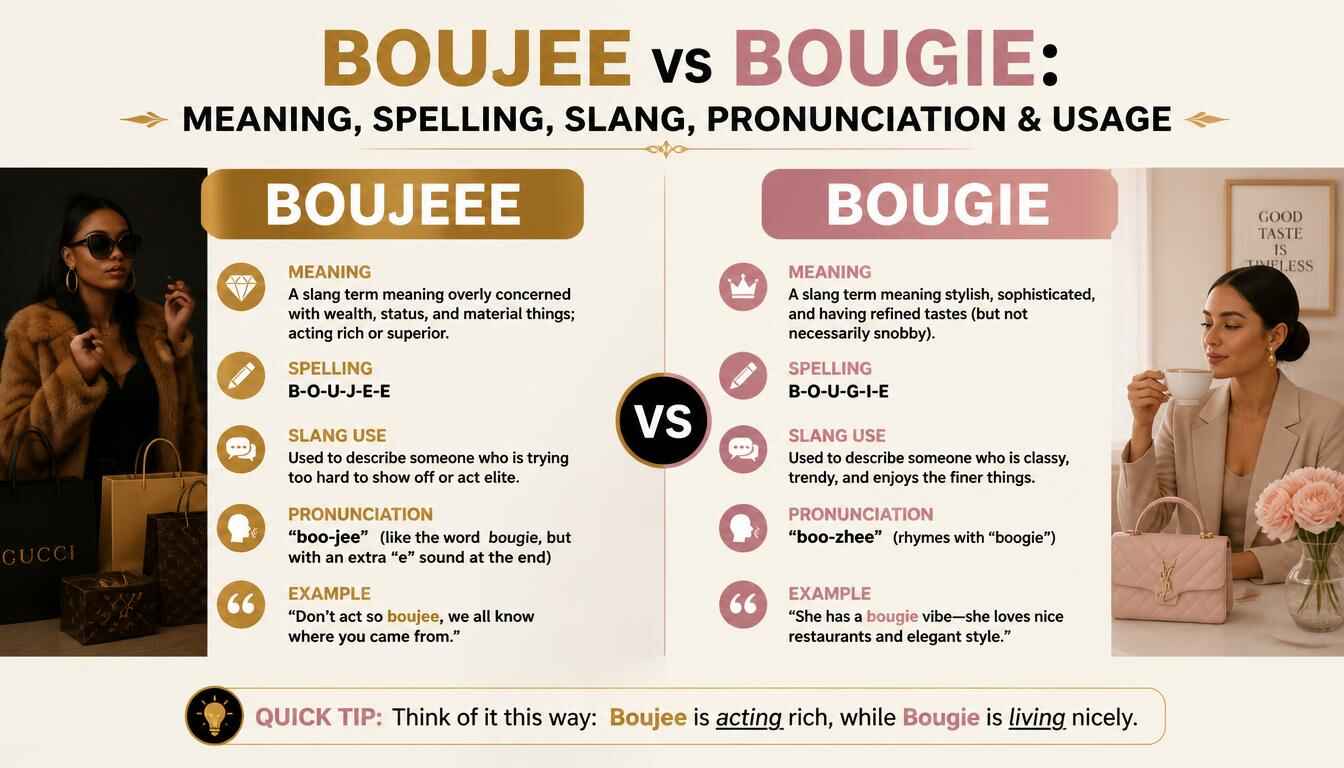
Boujee vs bougie is mostly a question of spelling, style, and cultural context, not two completely different definitions. Bougie is the more established spelling of the slang term, while boujee is a recognized variant that became especially visible through hip-hop and internet culture. Both can describe someone or something that seems fancy, luxurious, upscale, status-conscious, or overly concerned with expensive tastes. Merriam-Webster lists boujee as a less common variant of bougie, while Cambridge labels bougie as informal and gives it a sometimes disapproving sense in U.S. English.
The important point is that there is no universal rule saying bougie is always negative and boujee is always positive. In real American English, the two forms overlap considerably. The spelling can suggest a different tone or vibe, but the context, speaker, and situation matter more than the final letters.
Bougie vs. Boujee at a Glance
| Feature | Bougie | Boujee |
|---|---|---|
| Basic meaning | Fancy, upscale, luxury-oriented, status-conscious | Similar meaning |
| Spelling | More established | Variant/stylized spelling |
| Tone | Can be playful, admiring, or critical | Often playful, trendy, or celebratory |
| Common context | Everyday slang and lifestyle talk | Social media, music, memes, pop culture |
| Formal English | Still informal | Very informal |
| Relationship | Established slang form | Variant of bougie |
| Pronunciation | Usually “BOO-zhee” in U.S. English | Usually pronounced similarly |
The biggest takeaway is simple:
Bougie and boujee usually point to the same general idea, but they can carry different stylistic associations.
Merriam-Webster explicitly treats boujee as a less common variant of bougie, which is strong evidence against treating them as completely separate words.
What Does “Bougie” Mean?
Bougie is informal slang describing someone or something associated with luxury, expensive tastes, social status, comfort, or an upscale lifestyle.
Depending on the context, it can be:
- complimentary,
- humorous,
- self-deprecating,
- teasing,
- or critical.
For example:
That hotel is pretty bougie.
Here, the speaker may simply mean that the hotel feels luxurious or upscale.
But:
He’s getting a little bougie since he started shopping at designer stores.
This may suggest that the person has become more status-conscious or pretentious.
Cambridge defines the slang adjective in U.S. English as informal and disapproving, connecting it with the middle class and with placing importance on money, education, social class, or expensive and unusual things.
Dictionary.com similarly describes bougie as slang that can refer to luxury, upper-middle-class aspirations, or concern with appearances and status.
Bougie does not necessarily mean “rich”
This is an important distinction.
Someone does not have to be wealthy to be called bougie.
For example:
I can’t afford a luxury vacation, but I had a very bougie brunch today.
The word is describing the experience or taste, not proving the person’s income.
That is why someone can jokingly call an expensive coffee, elaborate dinner, designer outfit, or fancy hotel bougie without claiming that the person is actually wealthy.
What Does “Boujee” Mean?
Boujee is a popular variant spelling of bougie. It is commonly used in informal slang to describe something fancy, luxurious, stylish, glamorous, or associated with an upscale lifestyle.
The word became especially recognizable through hip-hop and popular culture, most notably through Migos’ 2016 song “Bad and Boujee.” Dictionary.com notes that the song helped popularize the spelling and gave it a more modern cultural identity.
For example:
That rooftop restaurant is so boujee.
Her vacation photos look boujee.
We had a little boujee dinner last night.
In these examples, boujee often sounds playful or celebratory rather than strictly judgmental.
But that is a tendency, not a rule.
A person can absolutely use boujee negatively:
He acts boujee just because he bought a new car.
So it would be inaccurate to say that boujee can only be positive.
Boujee vs Bougie Meaning: Are They Actually Different?
The honest answer is:
Usually, not in a strict dictionary sense.
The two words have substantial overlap.
If someone says:
That restaurant is bougie.
and another person says:
That restaurant is boujee.
Most listeners will understand both sentences as saying the restaurant feels fancy, upscale, luxurious, or expensive.
The difference is more about spelling, cultural association, and tone.
A useful way to think about it
Bougie often feels like the established slang spelling.
Boujee often feels more deliberately modern, playful, or connected to pop culture.
But context can override those impressions.
That’s why saying:
“Bougie always means fake rich, while boujee means genuinely rich”
would be too simplistic.
Some internet explanations make that distinction, but dictionary evidence supports a much broader overlap. Dictionary.com explicitly says boujee is influenced by and often interchanged with bougie, while Merriam-Webster treats boujee as a variant.
Boujee vs Bougie Slang Difference
The slang difference is mainly about the feeling the spelling gives the reader.
Bougie may suggest:
- expensive tastes
- sophistication
- status-conscious behavior
- pretension
- luxury
- upscale preferences
- middle-class or upper-middle-class aspirations
Boujee may suggest:
- luxury
- glamour
- confidence
- fashionable living
- social-media culture
- hip-hop influence
- playful self-expression
But there is considerable overlap.
For example:
She’s so bougie about her coffee.
This can sound like playful criticism.
She’s living her boujee coffee-shop fantasy.
This sounds more celebratory.
The sentence context, not just the spelling, creates most of the difference.
Boujee vs Bougie Spelling: Which Is Correct?
If you’re asking which spelling is the more established form, choose:
bougie
If you’re intentionally writing modern casual slang, social-media language, dialogue, or pop-culture language, you may see:
boujee
That does not mean boujee is simply a spelling mistake.
Merriam-Webster records boujee as a variant of bougie, specifically identifying it as less common.
Dictionary.com also lists boujee as an alternate spelling alongside bougie and boujie.
So which one should you choose?
For general English writing:
Bougie is the safer choice.
For a deliberately casual or trendy voice:
Boujee can be appropriate.
For example, a dictionary-style explanation might naturally use:
bougie
while an Instagram caption might intentionally say:
Feeling boujee tonight.
The choice is therefore often about register and voice, not simply right versus wrong.
Boujee vs Bougie Pronunciation
In U.S. English, bougie is commonly pronounced approximately like:
BOO-zhee
Cambridge gives the U.S. pronunciation as /ˈbuː.ʒi/. The middle sound is the “zh” sound heard in words such as vision.
The spelling boujee is generally pronounced similarly in slang usage.
That creates an interesting problem for learners: the spelling does not necessarily tell you the pronunciation.
Why does “bougie” look so unusual?
Because the spelling reflects a complicated history involving bourgeois and related French forms rather than straightforward English spelling rules.
Also remember that bougie has another English pronunciation and meaning when referring to a medical instrument or candle-related noun. Dictionary.com lists those separate noun senses and their pronunciation variants.
For the modern slang meaning, however, the American pronunciation is generally the BOO-zhee sound.
Boujee vs Bougie vs Bourgeoisie
This is where the history gets interesting.
These words are related, but they are not interchangeable.
Bourgeoisie
Bourgeoisie is a historical and sociological term referring broadly to the middle class, with a particularly important meaning in Marxist theory concerning the class that owns the means of production.
It is a much more formal and historically loaded word.
Bourgeois
Bourgeois is the related adjective and noun.
It can refer to:
- the middle class,
- middle-class values,
- conventional attitudes,
- or materialistic/status-oriented attitudes, depending on context.
Bougie
Bougie is an informal slang development associated with bourgeois and ideas of class, status, luxury, and pretension.
Boujee
Boujee is a later variant spelling that became especially prominent in modern popular culture.
So the simplified relationship is:
bourgeoisie → bourgeois → bougie → boujee
But this should be understood as a historical/linguistic relationship, not as four words with identical meanings.
Dictionary.com traces the slang forms through the French bourgeoisie, while Collins describes the slang bougie as shortened from bourgeois.
Why Is “Bougie” Also the Word for a Candle?
This is a fascinating source of confusion.
English bougie also exists as a noun with a completely different history.
That bougie refers to things such as:
- a wax candle, historically,
- or a medical instrument used to dilate or examine a bodily passage.
Collins traces this noun to French bougie, associated with Bougie, the former name of Béjaïa in Algeria and historically connected with the wax trade. American Heritage likewise lists the candle/medical sense separately from the slang adjective.
So:
bougie = fancy/status-conscious
and
bougie = candle/medical instrument
are different lexical histories.
The slang bougie associated with luxury is connected to bourgeois, not derived from the French word for candle.
READ MORE >>> Worst or Worse? Meaning, Differences, Examples, and Grammar Guide
How “Bad and Boujee” Changed the Spelling’s Popularity
One of the biggest reasons people recognize boujee today is the Migos song “Bad and Boujee,” released in 2016.
The song brought the spelling into mainstream hip-hop and internet culture, where it spread rapidly through memes, captions, social media, and everyday slang. Dictionary.com specifically credits the song with helping popularize this spelling and its modern cultural meaning.
The cultural meaning was also more nuanced than simply:
“rich.”
The song’s use of boujee connected luxury and status with a sense of being successful while retaining a connection to a less formal or more humble background.
Contemporary discussions of the song have emphasized this tension between luxury and authenticity, which helps explain why boujee developed such a strong modern identity.
That cultural history matters because it explains why many people now associate boujee with a playful, confident, aspirational type of luxury.
Is Boujee a Real Word?
Yes.
It is an established informal variant of bougie, although it is not the preferred spelling for every context.
Merriam-Webster lists boujee as a less common variant of bougie.
That means you should not automatically correct someone who writes:
“This hotel is so boujee.”
In casual English, the spelling is recognizable and established.
However, if you are writing an edited article and simply want the more established spelling, bougie is usually the safer option.
Is Bougie a Compliment or an Insult?
It can be either.
This is one of the most important things to understand about the word.
Positive
This restaurant is so bougie. I love it.
Here, bougie means fancy or luxurious, with admiration.
Playful
I felt bougie ordering a $9 latte.
The speaker is joking about treating themselves to something expensive.
Negative
He’s too bougie to eat anywhere without a dress code.
Here, the word criticizes someone for being overly concerned with status or luxury.
Self-deprecating
I know I’m bougie, but I need my hotel to have good coffee.
Here, the speaker is using the label humorously about themselves.
Dictionary.com and Cambridge both reflect the fact that the term can carry disapproving or disparaging associations, particularly when it describes status-conscious behavior.
So before calling someone bougie, consider your relationship with them and the tone of the conversation.
Is Boujee a Compliment or an Insult?
The same rule applies to boujee.
It can be:
positive:
Your new apartment looks so boujee!
playful:
We’re getting boujee tonight and ordering dessert.
critical:
She has become way too boujee for our old neighborhood.
The spelling may make the word feel more playful or contemporary, but it does not guarantee a positive meaning.
This is why context matters more than the final two letters.
When Should You Use “Bougie”?
Use bougie when you want the more established slang spelling.
It works naturally in sentences about:
Food
That restaurant is pretty bougie.
Fashion
She’s wearing a very bougie outfit.
Travel
We stayed at a bougie hotel downtown.
Home décor
Their new apartment is incredibly bougie.
Lifestyle
He’s into bougie fitness studios.
Personality
She’s not rich; she’s just a little bougie.
Because the word is informal, it is better suited to conversation, lifestyle writing, social media, dialogue, and casual content than to highly formal academic prose.
When Should You Use “Boujee”?
Choose boujee when the spelling itself fits the tone.
It works especially naturally in:
- social media captions
- memes
- casual texts
- pop-culture discussions
- playful dialogue
- hip-hop-related contexts
- informal lifestyle content
For example:
Living my boujee era.
We went full boujee for dinner.
A little boujee, a little budget-conscious.
The spelling can make the sentence feel more playful and internet-native.
READ MORE >>> Worst or Worse? Meaning, Differences, Examples, and Grammar Guide
Bougie vs. Boujee: Real-Life Examples
Example 1: Restaurant
That restaurant is bougie.
This may simply mean upscale.
That restaurant is boujee.
This can feel more playful or trendy.
Example 2: Vacation
We booked a bougie hotel.
This suggests luxury or expensive tastes.
We’re having a boujee vacation.
This sounds more like celebrating the luxury experience.
Example 3: Fashion
She has a bougie sense of style.
This could be admiration or criticism.
Her outfit is so boujee.
This often sounds more enthusiastic or playful.
Example 4: Coffee
You are getting very bougie with that coffee order.
This is likely teasing.
This coffee is so boujee.
This can be an affectionate description of an elaborate or expensive drink.
Common Mistakes With Bougie and Boujee
Mistake 1: Saying one is always correct
Bougie is the more established spelling, but boujee is a recognized variant.
Mistake 2: Saying they always have opposite meanings
They don’t.
There is substantial overlap.
Mistake 3: Assuming boujee means wealthy
Not necessarily.
It can describe taste, appearance, behavior, or lifestyle, not actual income.
Mistake 4: Treating bourgeoisie and bougie as synonyms
They are related historically but have different meanings and registers.
Mistake 5: Forgetting that bougie can be insulting
Calling someone bougie may imply that they are pretentious, materialistic, or overly concerned with status.
Mistake 6: Assuming boujee is “bad spelling”
It is better described as an informal variant spelling, not simply a typo. Merriam-Webster explicitly records it as a variant.
A Simple Rule for Choosing Between Them
If you’re stuck, ask:
Do I want the established spelling?
Use:
bougie
Do I want a deliberately casual, trendy, pop-culture spelling?
Use:
boujee
Am I discussing social class historically?
You may actually need:
bourgeois or bourgeoisie
Am I writing formal academic prose?
Consider avoiding both slang terms unless they are the subject of discussion.
Instead, use a precise phrase such as:
- status-conscious
- materialistic
- upscale
- luxury-oriented
- upper-middle-class
- pretentious
depending on what you actually mean.
Is “Boujee” Offensive?
It can be, depending on context.
The term has roots in slang associated with African American communities, and its history includes criticism of people perceived as overly concerned with middle-class or upper-class status.
Dictionary.com describes boujee as hip-hop slang and traces its development through this cultural history.
That does not mean every modern use is offensive. The word is now widely used in American popular culture, often humorously or self-referentially.
Still, there is an important distinction between:
“My brunch is so boujee.”
and:
“Those people are bougie.”
The first is usually a light description of an experience.
The second labels a group of people and may carry a stronger judgment.
Context, relationship, intent, and tone matter.
Boujee vs Bougie: The Bottom Line
Bougie and boujee are usually two spellings of closely related modern slang, not two completely separate words.
Bougie is the more established spelling and is the safer choice when you simply need the conventional slang form.
Boujee is a recognized variant that became strongly associated with hip-hop, pop culture, social media, and a playful approach to luxury.
The most important distinction is not:
bougie = one meaning boujee = another meaning
Instead, think:
same broad idea, different spelling and cultural flavor.
If you are describing an upscale restaurant, expensive outfit, luxury vacation, fancy coffee, or status-conscious lifestyle, either may be understood in casual American English.
The If you’re writing generally and want the established spelling, choose bougie.
If you’re deliberately using a playful, contemporary, social-media-style voice, boujee may fit better.
And if you’re talking about the historical social class, don’t substitute either slang term for bourgeoisie. That word carries a much more specific historical and sociological meaning.