
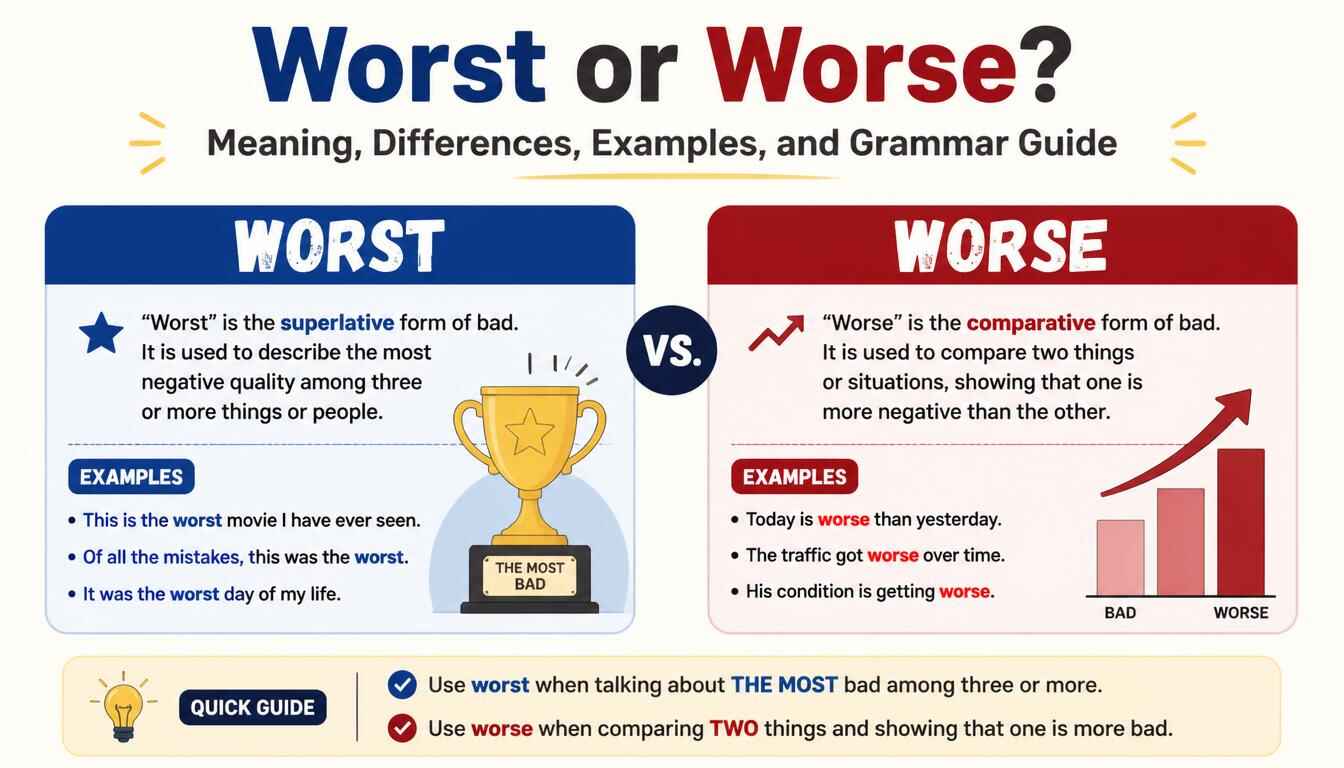
Worst or worse? Both words are correct, but they are used differently. Worse is the comparative form of bad, while worst is the superlative form. Use worse when you compare something with another thing or with an earlier condition, and use worst when you mean the most negative, severe, or unfavorable possibility. For example, “Today is worse than yesterday,” but “Today was the worst day of the week.”
The difference looks small, but it causes a surprising number of mistakes. The good news is that once you understand what the sentence is actually doing, choosing between worse and worst becomes much easier.
Worse vs. Worst: The Quick Answer
Here is the simplest way to remember the difference:
| Word | Grammar | Main use | Example |
|---|---|---|---|
| worse | Comparative | Compares or describes decline | My cold is worse today. |
| worst | Superlative | Describes the most negative level | This is the worst cold I’ve ever had. |
| bad | Base form | Describes something negative | I have a bad cold. |
The basic sequence is:
bad → worse → worst
Think of it as increasing degrees of negativity:
The weather is bad. Today’s weather is worse than yesterday’s. Friday had the worst weather of the week.
Cambridge similarly defines worse as the comparative of bad and worst as the superlative.
What Does “Worse” Mean?
Worse means more unpleasant, less good, more difficult, or more severe than something else or than an earlier condition.
It is the comparative form of bad.
For example:
- This restaurant is worse than the one downtown.
- My headache is worse today.
- Traffic is getting worse.
- The second test was worse than the first.
- The situation became worse overnight.
Notice something important: worse does not always need “than.”
That is one of the most useful details to understand.
In:
My headache is worse today.
the comparison is understood. The headache is worse than it was before.
In:
My headache is worse than yesterday.
the comparison is stated directly.
So, “worse without than” is completely normal English when the reference point is understood from context. Cambridge provides the same general pattern with expressions such as get worse and even worse.
What Does “Worst” Mean?
Worst means the most unpleasant, severe, undesirable, or negative.
It is the superlative form of bad.
Examples:
- That was the worst movie I’ve ever seen.
- This is the worst traffic I’ve experienced all year.
- She had the worst experience of everyone in the group.
- That was the worst mistake I could have made.
- We prepared for the worst.
Unlike worse, which normally establishes a comparison, worst identifies an extreme.
You do not need to list every possible option for worst to work.
For example:
Prepare for the worst.
The sentence does not name three or more possibilities. It means to prepare for the most unfavorable possible outcome.
The Real Difference Between Worse and Worst
The traditional shortcut is:
Worse = two Worst = three or more
That is useful, but it is not the entire story.
A better rule is:
Worse expresses a comparative difference. Worst identifies an extreme.
Compare these:
This laptop is worse than my old laptop.
You are comparing two laptops.
Now:
This is the worst laptop I’ve ever owned.
You are identifying an extreme across your experience.
The same principle works with situations rather than physical objects:
My situation is worse today.
The current situation has declined from an earlier state.
This is the worst situation I’ve ever faced.
This identifies the lowest or most serious point in a broader set of experiences.
Bad → Worse → Worst
Learning the three forms together makes the distinction easier:
| Degree | Form | Example |
|---|---|---|
| Basic | bad | The weather is bad. |
| Comparative | worse | Today’s weather is worse than yesterday’s. |
| Superlative | worst | Today had the worst weather of the week. |
This is an irregular comparison. You do not normally form the standard English sequence as bad → badder → baddest.
Instead, learn the complete pattern:
bad → worse → worst
It works similarly to:
good → better → best
Compare:
This option is better than that one.
and:
This is the best option.
The negative equivalent is:
This option is worse than that one.
and:
This is the worst option.
Is It Worse or Worst?
The answer depends on the sentence.
Use “worse” when something is being compared
This version is worse than the original.
My second attempt was worse.
The weather is getting worse.
The traffic is worse today.
Use “worst” when something represents the extreme
This is the worst version.
That was the worst mistake.
It was the worst day of my life.
Prepare for the worst.
A useful question to ask yourself is:
Am I describing a change or comparison, or am I identifying the extreme?
If it is a comparison or decline, worse is usually the answer.
If it is the most negative point or outcome, worst is usually the answer.
Worse Than or Worst Than?
The standard phrase is worse than.
Correct
This movie is worse than the first one.
My new phone is worse than my old phone.
The traffic is worse than I expected.
Incorrect for a normal comparison
This movie is worst than the first one.
My new phone is worst than my old phone.
Why?
Because worse is the comparative form, and than commonly introduces the thing being compared.
Worst is superlative.
You can say:
This is the worst movie I’ve seen.
But not normally:
This movie is worst than that one.
So when you see than after this type of adjective comparison, worse is the form you should normally choose. Cambridge explicitly demonstrates the comparative pattern worse than, and grammar-checking resources flag constructions such as “worst than” as nonstandard.
Getting Worse or Getting Worst?
The correct phrase is getting worse.
The weather is getting worse.
His condition is getting worse.
Traffic is getting worse every evening.
The situation is getting worse.
Why?
Getting worse describes a change from one condition to a less favorable condition.
It does not mean that the situation has reached the absolute worst possible point.
Compare:
The situation is getting worse.
The situation is deteriorating.
But:
The situation is at its worst.
The situation has reached its most severe point.
This distinction is important:
getting worse = deterioration
at its worst = extreme condition
Even Worse or Even Worst?
The standard expression is even worse.
Correct
The second storm was even worse.
The traffic became even worse after 5 p.m.
Things got even worse when the power went out.
Usually incorrect
The traffic became even worst.
The word even can intensify a comparative:
worse → even worse
The superlative is different:
This was the worst day of the year.
Cambridge specifically gives even worse as a normal use of the comparative form.
At Worse or At Worst?
The standard phrase is at worst.
At worst, we may have to cancel the trip.
The repair will take, at worst, three days.
At worst, we’ll lose a little money.
At worst means in the most unfavorable possible situation.
“At worse” is not the standard fixed expression.
The important distinction is:
at worst = the most unfavorable possibility
For example:
At worst, we will arrive an hour late.
The speaker is describing the extreme end of the expected possibilities.
READ MORE >>> Friend or Freind: Correct Spelling, Meaning & Examples
Worst Case or Worse Case?
The standard expression is worst case.
We need to prepare for the worst case.
What is the worst case if the project is delayed?
In the worst case, we will have to start again.
Worse case is generally incorrect when you mean the most unfavorable possible situation.
This is one of the most common searches surrounding this topic, and current grammar pages consistently identify worst case as the standard expression.
Why “worst case” works
You are not comparing one case with another.
You are identifying the most unfavorable case among the possible outcomes.
Therefore:
worst case
not:
worse case
Worst Case Scenario or Worse Case Scenario?
The standard phrase is:
worst-case scenario
For example:
What is the worst-case scenario?
We prepared for the worst-case scenario before launching the project.
In the worst-case scenario, the company could lose money.
Here, worst-case functions as a compound adjective modifying scenario, so the hyphen is normally used.
You can also say:
We prepared for the worst case.
Here, worst case functions as a noun phrase, so the hyphen is unnecessary.
Compare
Noun phrase:
We prepared for the worst case.
Compound adjective:
We prepared a worst-case plan.
This distinction is useful in professional, academic, and business writing.
Can “Worse Case” Ever Be Correct?
There is an important nuance here.
Although worse case is wrong when you mean the established expression worst case, the individual words worse and case can theoretically occur together when worse is genuinely making a comparison.
For example:
Of the two cases, this is the worse case.
The intended meaning is:
This case is worse than the other case.
However, this wording is less natural than:
Of the two cases, this is the worse of the two.
That version makes the comparison much clearer.
So the practical rule is:
- Most unfavorable possible situation: worst case
- Comparison between two cases: the worse of the two
This is an important distinction that a simple “worse = two, worst = three” rule does not fully explain.
The Worse of the Two vs. The Worst
This is one of the trickiest parts of the topic.
When exactly two choices are being compared, the worse can be correct.
Of the two options, this is the worse one.
Why?
Because worse is comparing Option A with Option B.
But if you are identifying the most negative option in a larger set:
Of all five options, this is the worst one.
The pattern is:
two specific alternatives → the worse of the two
an extreme among a larger set → the worst
This is why the simplistic statement “never use worst for two things” needs some qualification. Grammar depends on the structure and meaning of the comparison.
“That’s the Worst” or “That’s Worse”?
Both can be correct, but they mean different things.
“That’s worse”
This usually implies a comparison or change.
I thought the first plan was bad, but that’s worse.
The second plan is more negative than the first.
“That’s the worst”
This identifies an extreme.
I’ve seen five proposals, and that’s the worst.
It means that proposal is the least favorable of the relevant choices.
You can also use:
That’s the worst!
In everyday American English, this can be an emotional expression meaning something is extremely unpleasant, disappointing, annoying, or frustrating.
For example:
“My flight was canceled again.”
“Ugh, that’s the worst.”
Here, the speaker is not performing a formal mathematical comparison. The worst is being used as an emphatic expression.
“Worse” Without “Than”
A common misconception is:
“If there is no than, I should use worst.”
That is wrong.
Worse can absolutely appear without than.
Examples:
My headache is worse today.
Things are getting worse.
The weather could get worse.
His performance became worse after the break.
The situation is worse than we expected.
In the first four examples, the comparison is either understood or expressed through a change in condition.
Cambridge lists get worse and even worse as standard uses.
So do not use the presence or absence of than as your only test.
Common Expressions With “Worse”
Several everyday expressions naturally use worse.
Getting worse
The weather is getting worse.
Worse than ever
Traffic is worse than ever.
Make matters worse
Missing the deadline will make matters worse.
Go from bad to worse
The situation went from bad to worse.
For the worse
The change was for the worse.
Take a turn for the worse
His condition took a turn for the worse.
These are established patterns, so replacing worse with worst can make the sentence incorrect.
Common Expressions With “Worst”
Likewise, worst appears in several fixed expressions.
At worst
At worst, we will lose one day.
Prepare for the worst
We should prepare for the worst.
The worst is over
Don’t worry. The worst is over.
At its worst
The storm was at its worst overnight.
Worst-case scenario
Let’s consider the worst-case scenario.
The worst of all
The delay was annoying, but the cost was the worst of all.
Learning these phrases as complete expressions can make correct usage much more automatic.
Worse Can Be an Adjective, Adverb, or Noun
Another detail that is often overlooked is that worse does more than modify nouns.
Worse as an adjective
This is a worse situation.
Here, worse describes situation.
Worse as an adverb
She performed worse on the second test.
Here, worse describes how she performed.
Worse as a noun
The worse is yet to come.
Here, worse refers to a bad or more unpleasant development as a thing.
The same general flexibility helps explain why the word appears in many sentence structures.
Worst Can Also Be an Adjective, Adverb, or Noun
Worst as an adjective
This is the worst mistake.
The Worst as an adverb
He performed worst of all.
Worst as a noun
We should prepare for the worst.
Understanding these roles prevents you from thinking that worst can only appear directly before a noun.
Common Mistakes With Worse and Worst
Here are some mistakes worth avoiding.
| Incorrect | Correct |
|---|---|
| worst than | worse than |
| worse case | worst case |
| worse-case scenario | worst-case scenario |
| getting worst | getting worse |
| even worst | even worse |
| at worse | at worst |
| the worse day of my life | the worst day of my life |
| more worse | worse |
| most worst | worst |
Why these mistakes happen
The words are closely related and both describe negative situations. The spelling difference is only one letter, and worse and worst can sound quite similar in ordinary speech.
The safest approach is not to memorize dozens of isolated corrections. Understand the grammatical job each word performs.
A Fast Test for Choosing the Right Word
When you’re stuck, use this three-step test.
Step 1: Ask what the sentence means
Are you describing:
- a change?
- a comparison?
- the most negative possibility?
Step 2: Try the “better/best” test
Replace the word mentally.
If better would work, worse is probably needed.
This option is ___ than the other.
better than works.
Therefore:
This option is worse than the other.
If best would work, worst is probably needed.
This is the ___ option.
best works.
Therefore:
This is the worst option.
Step 3: Check whether you mean an extreme
If you mean:
the most negative
choose worst.
If you mean:
more negative than another point or option
choose worse.
Real-Life Examples
School
My second essay was worse than my first.
The final essay was the worst one I submitted all semester.
Work
Sales are worse this month than last month.
This is the worst quarterly result we’ve had this year.
Travel
The traffic was worse than we expected.
Friday was the worst day to travel.
Weather
The rain is getting worse.
The storm was at its worst overnight.
Technology
The new update is worse than the previous version.
That was the worst software issue we’ve experienced.
Everyday conversation
I feel worse today.
That was the worst day ever.
These examples show that the same grammar applies across different contexts.
A Practical Editing Trick for Emails
Suppose you are writing:
“This problem is worst than the previous problem.”
Stop and identify the relationship.
You are comparing two problems.
Therefore:
“This problem is worse than the previous problem.”
Now consider:
“This is the worse problem we’ve faced all year.”
Here you are identifying the most severe problem among many problems throughout the year.
Therefore:
“This is the worst problem we’ve faced all year.”
This approach is more reliable than simply looking for a particular word.
Memory Trick: Worse Has “-er,” Worst Has “-st”
A simple memory aid is to connect the endings with familiar comparison forms:
worse → comparative
worst → superlative
Think:
bigger → biggest better → best worse → worst
Another quick reminder:
Worse compares. Worst crowns the extreme.
If you are moving from one bad condition to a more negative one, use worse.
If you have reached the most negative point, use worst.
Mini Practice Quiz
Choose worse or worst.
- This movie is ___ than the first one.
- That was the ___ decision I made.
- My cold is getting ___.
- This is the ___ restaurant I’ve visited.
- The second option is ___ than the first.
- At ___, we’ll have to postpone the meeting.
- Things became even ___ after the announcement.
- We need to prepare for the ___.
- This is the ___ of the two options.
- This is the ___ option of the five.
Answers
- worse
- worst
- worse
- worst
- worse
- worst
- worse
- worst
- worse
- worst
Number 9 is especially useful because it demonstrates the nuance:
the worse of the two
is correct because exactly two alternatives are being compared.
Frequently Asked Questions
Is worse or worst correct?
Both are correct words, but they have different grammatical functions. Worse is comparative, while worst is superlative.
Is it worse or worst?
It depends on the sentence. Use worse for a comparison or deterioration and worst for the most negative or extreme condition.
Is worse than or worst than correct?
The standard form is worse than.
This is worse than before.
Worst than is not the normal standard-English comparative construction.
Is getting worse or getting worst correct?
Getting worse is correct when a situation is becoming more negative or severe.
The weather is getting worse.
Is even worse or even worst correct?
Use even worse.
The traffic became even worse.
Is it at worse or at worst?
The standard expression is at worst.
At worst, we will lose one day.
Is it worst case or worse case?
Use worst case when you mean the most unfavorable possible outcome.
In the worst case, we will have to cancel.
Is it worst case scenario or worse case scenario?
The standard expression is worst-case scenario.
We considered the worst-case scenario.
Can worse be used without than?
Yes. Worse does not require than.
My headache is worse today.
The comparison with an earlier condition is understood.
Can “the worse” ever be correct?
Yes. The worse can be correct when comparing two specific things.
Of the two choices, this is the worse one.
But for the most negative option in a larger set, use the worst.
Is “the worst of the two” always wrong?
Not necessarily. Although the worse of the two is the clearer comparative choice, real usage can vary. For precise formal writing, when exactly two items are being compared, the worse of the two is usually the clearest construction.
What is the correct order: bad, worse, worst?
The standard sequence is:
bad → worse → worst
Is “more worse” correct?
In standard English, normally no. Worse already expresses the comparative degree.
Say:
This is worse than before.
not:
This is more worse than before.
Is “most worst” correct?
No. Worst already expresses the superlative degree.
Say:
This is the worst result.
not:
This is the most worst result.
Does American English use worse and worst differently?
No major difference changes the basic rule. American English uses worse as the comparative form and worst as the superlative form of bad.
Final Rule to Remember
If you remember only one thing, remember this:
Worse = comparative or becoming more negative. Worst = the most negative or extreme.
So:
- worse than ✅
- getting worse ✅
- even worse ✅
- the worse of the two ✅
- worst case ✅
- worst-case scenario ✅
- at worst ✅
- prepare for the worst ✅
- worst than ❌
- getting worst ❌
- even worst ❌
- at worse ❌
- worse case ❌ when you mean the standard “most unfavorable outcome”
The most reliable strategy is to look at the meaning of the sentence, not just the number of words or whether than appears. Worse normally tells you that one condition is more negative than another or that a condition has deteriorated. Worst identifies the extreme—the least favorable, most severe, or most unpleasant possibility.
Once you see that distinction, worst or worse stops being a guessing game and becomes a straightforward grammar choice.