
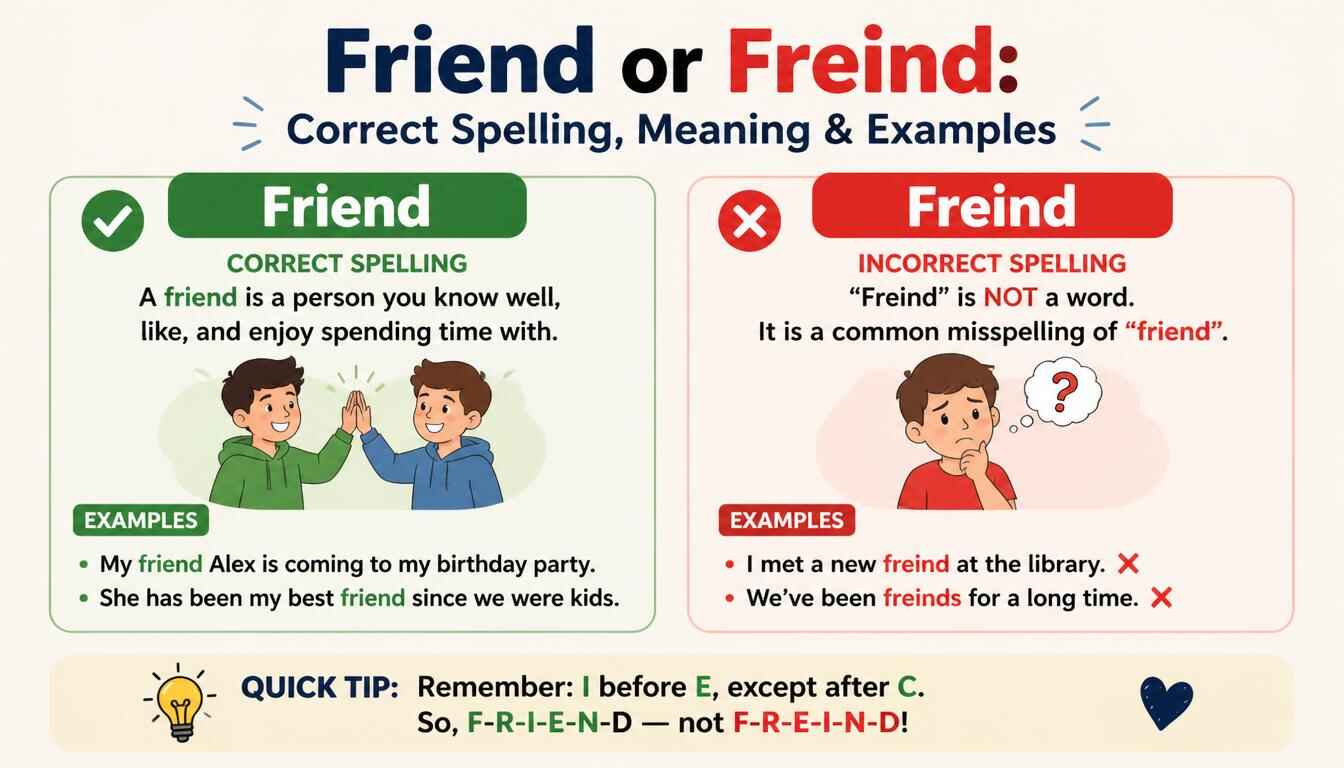
Friend or freind? The correct spelling is friend. Freind is a common misspelling caused by reversing the i and e in the middle of the word. If you mean a person you know, like, trust, or have a relationship with, always write friend.
The correct spelling is:
F-R-I-E-N-D → friend
Not:
F-R-E-I-N-D → freind
The mistake is easy to make because both versions contain the same letters, and the pronunciation does not clearly reveal the spelling. But once you remember FRI + END = FRIEND, the correct form becomes much easier to recognize.
Friend vs. Freind at a Glance
| Word | Correct? | Meaning | Example |
|---|---|---|---|
| friend | ✅ Yes | A person you know and like or trust | She is my best friend. |
| freind | ❌ No | Common misspelling of friend | She is my best freind. |
There is no difference in meaning between the two forms. The issue is simply that friend is the standard spelling, while freind is a spelling error.
What Does “Friend” Mean?
A friend is generally someone you know well and like, often with a relationship based on trust, affection, companionship, or mutual support.
Cambridge defines friend as a person you know well and like, while Oxford includes related uses involving people on a social-media contact list.
A friendship can take many forms. For example, you might have a:
- best friend
- close friend
- childhood friend
- school friend
- work friend
- family friend
- old friend
- mutual friend
- online friend
Examples:
- My friend lives across the street.
- I called an old friend yesterday.
- She has been my closest friend since college.
- A mutual friend introduced us.
- My childhood friend moved to another state.
The word can describe both casual and very close relationships.
Why Is “Freind” Incorrect?
Freind is incorrect because the two middle vowels are in the wrong order.
Correct:
FR-I-E-N-D
Incorrect:
FR-E-I-N-D
The difference is only one small letter reversal, but that reversal changes the standard spelling.
This is a spelling mistake, not a grammar difference. Someone who writes freind usually means exactly the same thing as friend; the reader can normally understand the intended word, but the spelling should still be corrected in polished writing.
For example:
❌ My freind helped me with my homework.
✅ My friend helped me with my homework.
How Do You Spell Friend Correctly?
Spell friend like this:
F-R-I-E-N-D
A useful way to break it down is:
FR + IE + ND = FRIEND
The important part is the IE in the middle.
If you remember only one thing from this article, remember:
FRI + END = FRIEND
That gives you a visual structure rather than forcing you to recall six individual letters.
Why Do People Spell “Friend” as “Freind”?
There are several reasons this mistake happens.
1. The i and e are easy to reverse
The two vowels sit directly next to each other:
friend → ie
Because freind contains exactly the same letters, the incorrect version can look surprisingly familiar.
2. Pronunciation does not reveal the spelling
In standard English, friend is pronounced /frend/. Cambridge and Oxford both give this pronunciation.
The written ie does not sound like a separate long “i” sound. As a result, someone who learns the word mainly by hearing it has little reason to know which vowel comes first.
3. Fast typing causes letter-order mistakes
When typing quickly, people often produce a familiar word without consciously checking every letter. A tiny reversal such as ie → ei can slip through unnoticed.
This is particularly common in:
- text messages
- social media
- emails
- notes
- school assignments
- fast online conversations
4. English spelling patterns are inconsistent
English contains both ie and ei spellings:
- friend
- believe
- chief
- field
but also:
- receive
- ceiling
- deceive
- receipt
So simply remembering that one vowel combination “usually” comes first isn’t enough to solve every spelling question.
Does “I Before E” Explain Friend?
The familiar spelling rhyme is:
“I before E except after C.”
It can help you remember friend, because friend contains ie.
However, it is better to treat this as a memory aid rather than an absolute rule. English has many exceptions and words whose spelling cannot be predicted perfectly from this rhyme.
For friend, the safest approach is simply to remember the actual spelling:
friend
If you regularly confuse friend and freind, the visual pattern FRI + END is more reliable than trying to apply a complicated spelling rule every time.
How Is “Friend” Pronounced?
The standard pronunciation of friend is:
/frend/
The vowel sound is similar to the vowel in words such as:
- bed
- red
- send
- ten
This is important because the spelling and pronunciation do not correspond letter-for-letter.
You cannot hear the word and automatically know that it should be spelled friend rather than freind.
That is why spelling memory matters here.
Friend as a Noun
The most common use of friend is as a noun.
It refers to a person with whom you have a relationship involving liking, affection, trust, companionship, or support.
Examples:
- James is my best friend.
- I met an old friend at the store.
- She introduced me to her friends.
- My friends are coming over tonight.
- He became a close friend during college.
- A friend gave me some useful advice.
The word can be used for different degrees of closeness. Someone may be an acquaintance rather than a friend, while a best friend or close friend usually implies a stronger relationship.
Can “Friend” Be Used as a Verb?
Yes.
In modern English, especially in social-media contexts, friend can also function as a verb.
For example:
I friended her on Facebook.
Here, friended means that the person was added to someone’s list of friends or contacts.
Oxford and Cambridge both recognize this modern verb usage.
Common forms include:
- friend
- friends
- friended
- friending
For example:
- I friended him yesterday.
- She friended several classmates online.
- They are already friends on the platform.
- He is friending people from his new class.
The noun remains much more familiar, but the verb is an established modern usage.
Friend, Friends, Friend’s, or Friends’?
Once you know how to spell friend, you also need to know how its related forms work.
Friend
Use friend for one person.
Maria is my friend.
Friends
Use friends for more than one person.
My friends are coming over.
Friend’s
Use friend’s when something belongs to one friend.
My friend’s car is outside.
The apostrophe comes before the s because there is one friend.
Friends’
Use friends’ when something belongs to multiple friends.
My friends’ cars were parked outside.
The apostrophe comes after the s because friends is already plural.
Quick reference
| Form | Use | Example |
|---|---|---|
| friend | One person | My friend called. |
| friends | More than one | My friends called. |
| friend’s | Belonging to one friend | My friend’s phone rang. |
| friends’ | Belonging to multiple friends | My friends’ phones rang. |
None of these forms begins with freind.
READ MORE >>> Preety or Pretty: Correct Spelling, Meaning & Examples in English
Is “Friend” Spelled Differently in American and British English?
No.
For this word, there is no American-versus-British spelling difference.
American English:
friend
British English:
friend
The standard spelling remains the same.
So if you’re writing for an American audience, use friend. If you’re writing for a British audience, use friend as well.
Friend Word Family
The word friend belongs to a broader family of related English words.
Friendship
Friendship means the relationship between friends.
Their friendship lasted for many years.
The historical formation of friendship comes from friend + -ship.
Friendly
Friendly describes someone or something that is kind, pleasant, or welcoming.
The staff were very friendly.
Befriend
Befriend means to become a friend to someone or treat someone as a friend.
She befriended a new student at school.
Friendless
Friendless means having no friends.
Friended
Friended is the past tense of the social-media verb.
I friended him after the meeting.
Friending
Friending is the -ing form.
She was friending people from her new class.
Knowing these related forms can reinforce the spelling because they all preserve the friend base.
The History Behind the Spelling of “Friend”
The spelling of friend is not a modern invention.
Etymological sources trace the word to Old English frēond, with related Germanic forms. Etymonline connects it to a Germanic form meaning “lover” or “friend” and ultimately to an Indo-European root associated with loving. Dictionary.com likewise traces the word through Old English.
The historical forms of the word were not always identical to today’s spelling. English changed substantially over the centuries, and older forms included spellings such as frend and freend.
So modern friend should not be understood as a word whose spelling was designed around today’s “I before E” rhyme. Its spelling developed through the history of English.
That is one reason memorizing the modern form is more useful than trying to derive it from a single rule.
Is “Freind” Ever Correct?
For ordinary modern English, freind is not the standard spelling of friend.
If you are writing about a companion, someone you trust, or someone you know and like, use:
friend
You may encounter freind in:
- typos
- informal messages
- spelling exercises
- user-generated content
- historical or unusual texts
But encountering a spelling does not make it the standard modern form.
For normal American English writing, choose friend.
Friend vs. Freind in Different Types of Writing
The spelling does not change depending on where you use it.
| Situation | Correct |
|---|---|
| Text message | friend |
| friend | |
| School assignment | friend |
| College essay | friend |
| Resume or professional writing | friend |
| Social media | friend |
| Personal letter | friend |
| Business communication | friend |
For example:
Text:
I’m meeting a friend tonight.
School:
The main character develops a strong friendship with his friend.
Professional:
A friend recommended your organization.
Social media:
I added my friend yesterday.
The context changes, but the spelling does not.
Common Misspellings of Friend
Freind is not the only typo people can make.
Common incorrect forms include:
- freind
- frend
- firend
- freinds
- friendd
- friiend
The most important one for this search query is freind, because it contains the correct letters in the wrong order.
Correct
friend
Incorrect
freind
A quick visual check of the middle helps:
fr + ie + nd
not:
fr + ei + nd
Easy Ways to Remember “Friend”
Memory trick 1: FRI + END
Break the word into:
FRI + END
That gives you:
FRIEND
The word begins with FRI, not FRE.
Memory trick 2: Think of Friday
Friday starts with FRI.
So think:
FRI — Friday — Friend
This creates a useful visual connection and is especially helpful if you often forget whether the word starts with fri or fre.
Memory trick 3: Protect the “IE”
Look directly at the middle:
frIEnd
The important pair is IE.
Memory trick 4: Proofread the middle, not the whole word
If you know you make this particular mistake, you don’t need to reread every letter.
Simply check:
Does the middle say IE?
If yes, you’re probably on the right track.
Examples: Friend vs. Freind
Here are some practical examples.
Example 1
❌ She is my best freind.
✅ She is my best friend.
Example 2
❌ I invited all my freinds to dinner.
✅ I invited all my friends to dinner.
Example 3
❌ My freind’s car is outside.
✅ My friend’s car is outside.
Example 4
❌ He became a good freind during college.
✅ He became a good friend during college.
Example 5
❌ I need to ask my freind for help.
✅ I need to ask my friend for help.
The meaning is usually obvious even when freind appears, but the standard spelling remains friend.
A Simple Rule to Remember
If you’re ever unsure between friend and freind, don’t overthink it.
Use:
FRI + END = FRIEND
The correct spelling contains IE:
friend ✅
The reversed version contains EI:
freind ❌
That single visual distinction solves the problem.
Frequently Asked Questions
Is it “friend” or “freind”?
Friend is the correct spelling. Freind is a common misspelling caused by reversing the i and e.
How do you spell friend correctly?
Spell it:
F-R-I-E-N-D
A useful memory pattern is FRI + END.
Is “freind” a real English word?
Freind is not the standard modern English spelling of the word friend. In ordinary American English writing, use friend.
Why do people spell friend as freind?
The most common reason is that the i and e are easy to reverse. Pronunciation also does not clearly tell you which vowel comes first, and fast typing can make the reversal easier to miss.
What is the plural of friend?
The plural is friends.
I invited my friends to dinner.
What is the possessive form of friend?
For one friend, use friend’s:
My friend’s house is nearby.
For multiple friends, use friends’:
My friends’ houses are nearby.
Is friend a noun or a verb?
It can be both.
As a noun:
She is my friend.
As a verb, especially in social-media contexts:
I friended him online.
Modern dictionaries recognize this verb usage.
How do you pronounce friend?
Friend is pronounced /frend/. The pronunciation does not directly reveal the written ie, which is one reason the word can be misspelled.
Is friend spelled differently in American and British English?
No. Friend is spelled the same in both American and British English.
What is the easiest way to remember friend?
Remember:
FRI + END = FRIEND
You can also associate FRI with Friday, which begins with the same three letters.
Is “I before E except after C” a reliable rule for friend?
It can be used as a memory aid for friend, but it should not be treated as a perfect rule for all English spelling. English has many exceptions and competing spelling patterns.
Final Answer: Friend or Freind?
When choosing between friend or freind, use friend.
Friend is the standard English spelling for a person you know, like, trust, or have a relationship with. Freind is a common spelling mistake caused by reversing the i and e.
Remember:
FRI + END = FRIEND
So write:
My friend is coming over. ✅
Not:
My freind is coming over. ❌
The easiest way to avoid the mistake is to remember the IE in the middle of friend and connect FRI with Friday.