
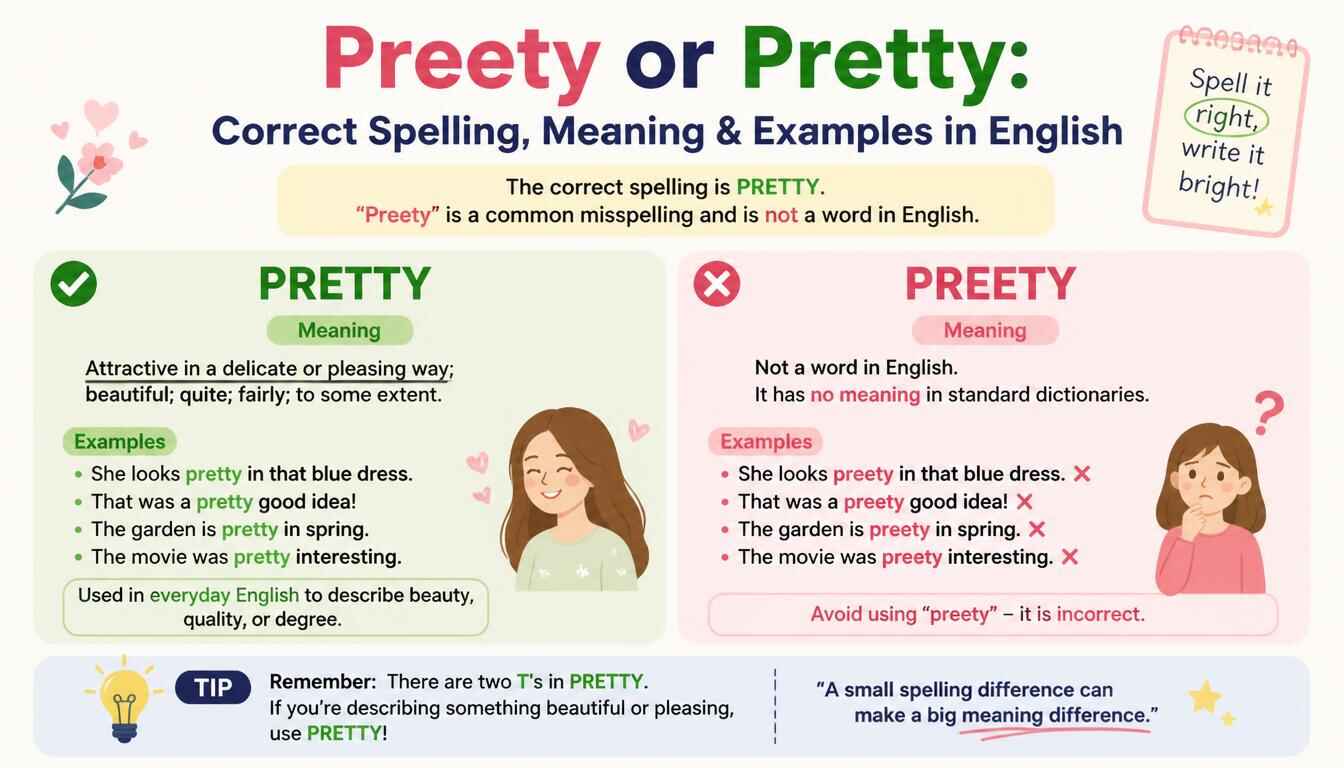
Preety or pretty? The correct spelling is pretty. Preety is a common misspelling caused by adding an extra e and leaving out one of the two t’s in the standard spelling. If you want to describe someone or something as attractive, pleasant, or appealing, write pretty.
The correct spelling is:
P-R-E-T-T-Y → pretty
Not:
P-R-E-E-T-Y → preety
The mistake is understandable because pretty is pronounced /ˈprɪt̬.i/ in American English, so its pronunciation can make an ee spelling seem logical. But the standard written form has two t’s and only one e after the pr.
Preety vs. Pretty at a Glance
| Spelling | Correct? | Meaning | Example |
|---|---|---|---|
| pretty | ✅ Yes | Attractive, pleasant, or appealing | She wore a pretty dress. |
| preety | ❌ No | Common misspelling of pretty | She wore a preety dress. |
There is no difference in meaning between the two forms because preety is not the standard spelling of a separate English word.
For normal American English writing, use pretty.
How Do You Spell Pretty?
The correct spelling is:
P-R-E-T-T-Y
The easiest part to remember is the double T:
PRETTY
not:
PREETY
A useful visual trick is to look at the middle:
PRE + TT + Y
The two t’s are the spelling feature most likely to disappear when someone types the word quickly.
If you are proofreading your writing and see preety, stop and check the word. You almost certainly want pretty.
Why Is “Preety” Incorrect?
Preety is incorrect because it does not follow the standard spelling of pretty.
Compare them:
- pretty → correct
- preety → incorrect
The incorrect version introduces an extra e:
pretty → preety
while losing one of the two t’s.
This mistake can happen because English spelling is not always predictable from pronunciation. The American pronunciation of pretty is roughly /ˈprɪt̬.i/, so a learner hearing the word may naturally think of an ee sound.
But spelling is based on the established written form, not simply on how a word sounds.
What Does “Pretty” Mean?
The most familiar meaning of pretty is attractive, pleasant, or pleasing to look at.
Cambridge defines the adjective in terms of being pleasant to look at or attractive in a delicate or charming way. Oxford similarly describes pretty as attractive without necessarily implying the stronger quality associated with beautiful.
For example:
- She has a pretty smile.
- That’s a pretty dress.
- We stayed in a pretty little town.
- The garden has pretty flowers.
- What a pretty view!
The word can describe:
- people
- faces
- smiles
- clothes
- houses
- gardens
- flowers
- colors
- scenery
- music
- objects
Pretty as an Adjective
Pretty is commonly used as an adjective.
An adjective describes a noun, so you can use pretty before or after a noun in appropriate constructions.
Examples:
She bought a pretty dress.
They live in a pretty house.
The garden looks pretty in spring.
He gave her a pretty necklace.
When describing people, pretty traditionally suggests an attractive or delicate appearance. Oxford notes that the word is particularly associated with girls and women in many traditional uses, while words such as attractive, good-looking, or beautiful can be broader.
For modern writing, context matters more than trying to force rigid rules about who can be called pretty.
Pretty as an Adverb
One of the most important meanings competitors sometimes underemphasize is pretty as an adverb.
In this use, pretty means something like fairly, quite, or to a considerable degree.
Examples include:
- The test was pretty difficult.
- I’m pretty sure.
- That restaurant is pretty good.
- The movie was pretty interesting.
- It’s pretty cold outside.
- She runs pretty quickly.
Cambridge describes this use as informal and explains that pretty can come before an adjective or another adverb to indicate a degree that is substantial but not necessarily extreme.
Oxford similarly lists pretty as an adverb meaning to some extent, fairly, with examples such as pretty good and pretty hard.
What does “pretty good” mean?
Pretty good usually means fairly good, quite good, or good to a significant degree.
The new restaurant is pretty good.
Depending on tone and context, it can be close to “quite good” or “very good,” but it is generally less emphatic than simply saying excellent.
What does “pretty sure” mean?
Pretty sure means fairly or very confident, depending on context.
I’m pretty sure I left my keys on the desk.
It does not necessarily mean absolute certainty.
What does “pretty much” mean?
Pretty much is an especially common expression meaning almost, nearly, or to a large extent.
I’ve pretty much finished my homework.
That means the homework is almost completely finished.
Cambridge specifically identifies pretty much/well as an expression meaning “almost.”
Can “Pretty” Be a Noun?
Yes, although this use is much less common.
Dictionary.com lists pretty as a noun and gives pretties as the plural for attractive objects or things such as ornaments or decorative items.
For example:
The shop was filled with little pretties.
This noun use is much less common in everyday American English than the adjective and adverb uses.
Can “Pretty” Be a Verb?
Yes.
To pretty means to make something pretty or improve its appearance.
Examples include:
They prettied up the room before the party.
She spent the afternoon prettying the garden.
Dictionary.com lists forms including prettied and prettying, and Oxford’s word history also records pretty as a verb meaning to make pretty.
The related expression pretty up is more natural in many everyday contexts.
Pretty, Prettier, and Prettiest
The adjective pretty has regular comparative and superlative forms:
- pretty
- prettier
- prettiest
Examples:
This dress is pretty.
That dress is prettier.
This is the prettiest dress in the store.
Oxford’s American dictionary specifically gives prettier and prettiest as the comparative and superlative forms.
Notice that the spelling changes slightly:
pretty → prettier → prettiest
The final y changes to i before the comparative and superlative endings.
How Do You Pronounce “Pretty”?
In American English, pretty is pronounced approximately:
/ˈprɪt̬.i/
Cambridge gives this U.S. pronunciation, while Oxford gives the corresponding American pronunciation with the first syllable stressed.
The pronunciation is one reason the spelling can be confusing.
When you hear pretty, you hear two syllables, but you do not hear the written structure:
PRE-TT-Y
The sound therefore cannot reliably tell you that the word has two t’s and only one e after the pr.
That is why visual spelling memory is more useful here.
Pretty vs. Beautiful
The Pretty and beautiful overlap, but they are not always interchangeable.
Pretty often suggests a more delicate, pleasing, charming, or attractive quality.
Beautiful is generally stronger and broader.
For example:
She has a pretty smile.
suggests a pleasant and attractive smile.
She has a beautiful smile.
can suggest a stronger or more striking quality.
Oxford’s comparison of appearance words explains that pretty often suggests a delicate attractiveness, while beautiful generally expresses a stronger sense of beauty.
Other useful alternatives include:
- attractive
- lovely
- charming
- good-looking
- appealing
- gorgeous
The best choice depends on the person, object, tone, and context.
Common Phrases With “Pretty”
The word appears in many familiar English expressions.
Pretty good
Means fairly or quite good.
The movie was pretty good.
Pretty sure
Means fairly confident.
I’m pretty sure that’s the right address.
Pretty much
Means almost or nearly.
We’ve pretty much finished.
Pretty soon
Means in a fairly short time.
I’ll call you pretty soon.
Pretty please
An informal, often playful way to make a request.
Can I have one more cookie, pretty please?
Pretty penny
An idiom meaning a large amount of money.
That car must have cost a pretty penny.
Sitting pretty
An idiom meaning to be in a favorable or advantageous position.
After securing the contract, the company was sitting pretty.
These expressions demonstrate why learning pretty as a vocabulary word is more useful than treating the query as a simple spelling correction.
Is “Pretty” Spelled the Same in American and British English?
Yes.
The standard spelling is:
pretty
in both American and British English.
The core pronunciation is also very similar, although American and British speech naturally have accent differences. Cambridge gives both U.S. and U.K. pronunciation information.
So whether you’re writing:
- an American email
- a British article
- a school assignment
- a social-media caption
- a professional document
the spelling remains:
pretty
The History of “Pretty”
The history of pretty is more interesting than its modern spelling suggests.
Etymonline traces the word to Old English forms including prættig, associated with meanings such as cunning, clever, skillful, or crafty. Over time, the meaning developed through Middle English and gradually moved toward senses involving something fine, pleasing, or attractive.
Dictionary.com likewise traces pretty through Old English and Middle English forms.
This means the modern meaning “attractive” is the result of a long semantic development. The word did not begin with exactly the meaning it has today.
Its history also helps explain why trying to construct the modern spelling from pronunciation alone is unreliable.
Easy Ways to Remember the Spelling of Pretty
1. Remember the double T
The most useful rule is simple:
Pretty has two T’s.
Write:
PRETTY
not:
PREETY
2. Think “pretty” has a strong middle
Visually, the TT gives the word its distinctive middle:
PRE-TT-Y
That makes it easier to spot when you’ve accidentally typed preety.
3. Say the spelling while proofreading
If this is a word you frequently misspell, mentally check:
P-R-E-T-T-Y
You don’t need to analyze the whole word every time. Just verify the double T.
4. Watch for the extra E
When you see:
P-R-E-E-T-Y
you should immediately recognize the problem: there are two E’s where standard pretty has only one.
READ MORE >>> Develope or Develop: Which Spelling Is Correct?
Common Misspellings of Pretty
The most relevant misspelling for this article is:
preety ❌
But other incorrect forms can appear as well:
- prety ❌
- preetty ❌
- pritty ❌
- preeety ❌
The correct form remains:
pretty ✅
Spelling resources such as Word.Tips and WhichIsCorrect specifically identify preety, prety, and related variants as misspellings.
Examples of “Pretty” Used Correctly
Here are examples covering its most useful meanings.
Describing a person
She looked pretty in her new dress.
Describing clothing
That’s a pretty blue jacket.
The Describing a place
We stayed in a pretty little town.
Describing nature
The garden was filled with pretty flowers.
Describing something pleasant
That’s a pretty song.
As an adverb
The assignment was pretty difficult.
Expressing confidence
I’m pretty sure he’s right.
With “much”
We’ve pretty much completed the project.
These examples show that pretty is much more versatile than its basic definition of “attractive” suggests.
Frequently Asked Questions
Is it “preety” or “pretty”?
Pretty is correct. Preety is a misspelling.
How do you spell pretty?
Spell it:
P-R-E-T-T-Y
Remember the double T.
Is “preety” a word?
Preety is not the standard spelling of the English word pretty. In normal American English writing, use pretty.
Why do people spell pretty as preety?
The pronunciation can make the spelling seem intuitive because pretty contains an /i/ sound. A writer may therefore insert an extra e and produce preety. The standard spelling, however, is pretty, with one e and two t’s.
What does pretty mean?
As an adjective, pretty usually means attractive, pleasant, charming, or pleasing to look at. It can also function as an adverb meaning fairly or quite.
Is pretty an adjective?
Yes. For example:
She wore a pretty dress.
Is pretty an adverb?
Yes. For example:
The test was pretty difficult.
This use means something like fairly or quite and is especially common in informal English.
Can pretty be a noun?
Yes, although this is uncommon. Pretties can refer to attractive decorative things or ornaments.
Can pretty be a verb?
Yes. To pretty means to make something attractive. Forms include prettied and prettying.
What is the comparative of pretty?
The comparative is prettier.
This garden is prettier than the other one.
What is the superlative of pretty?
The superlative is prettiest.
That was the prettiest flower in the garden.
What does “pretty much” mean?
Pretty much generally means almost, nearly, or to a large extent.
I’ve pretty much finished my work.
Cambridge specifically recognizes pretty much/well with the meaning “almost.”
Is pretty the same in American and British English?
Yes. The standard spelling is pretty in both varieties of English.
What is the easiest way to remember pretty?
Remember:
PRETTY has two T’s.
If you see preety, look for the extra E and missing T.
Final Answer: Preety or Pretty?
When choosing between preety or pretty, use pretty.
Pretty is the standard English spelling. Preety is a common misspelling, usually caused by the pronunciation making an extra e seem plausible.
The easiest rule is:
PRE-TT-Y = PRETTY ✅
PRE-E-T-Y = PREETY ❌
And remember that pretty is more than an adjective. It can also work as an adverb, and less commonly as a noun or verb. Its common expressions include pretty good, pretty sure, pretty much, pretty soon, and sitting pretty.
So whenever you’re writing an email, school assignment, article, message, or social-media post, choose:
pretty ✅
not:
preety ❌