
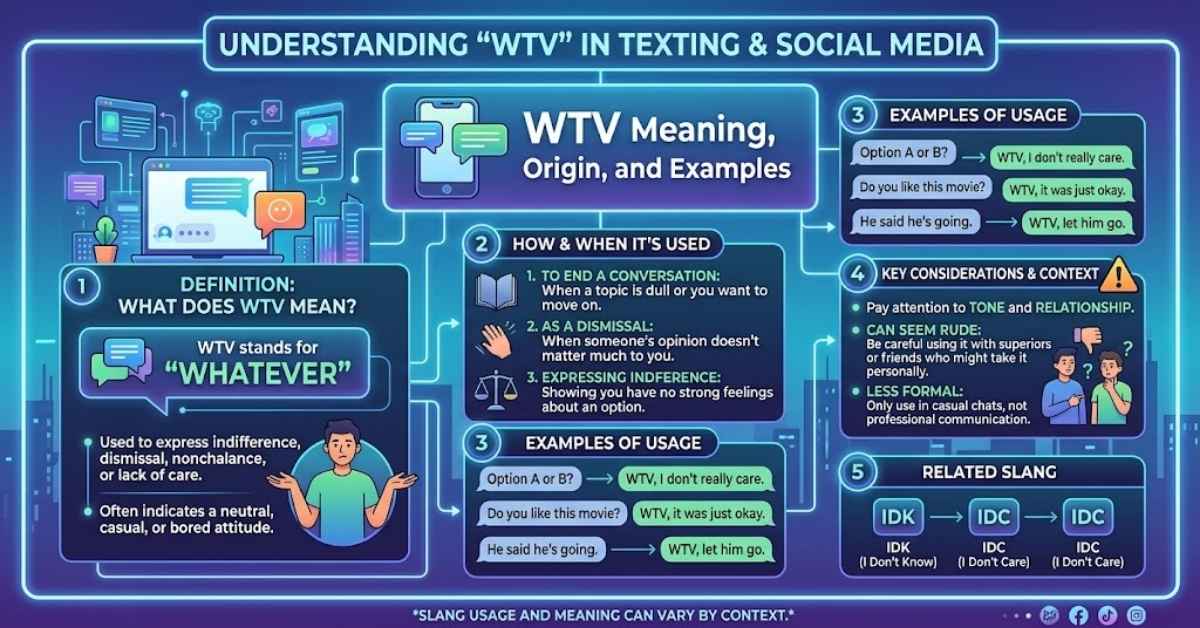
WTV meaning in text is usually “whatever.” People use this texting abbreviation to show that they have no particular preference, do not mind what happens, or want to move on from a conversation. Depending on the situation, WTV can sound relaxed, indifferent, sarcastic, or dismissive.
You might see “wtv” in a Snapchat message, an Instagram DM, or a conversation with a friend. Although the definition is simple, understanding the sender’s tone can be a little more complicated. Here’s what WTV means, how people use it, and how to respond naturally.
What Does WTV Mean in Text?
WTV stands for “whatever.” It is an informal abbreviation used in text messages and online chats to express indifference, acceptance, or a lack of preference.
For example:
Friend: “Do you want pizza or burgers tonight?”
You: “Wtv, you choose.”
In this conversation, WTV means that either option is fine. The sender is leaving the decision to the other person rather than expressing a strong preference.
Now consider a different exchange:
Friend: “Why are you still upset about what happened?”
You: “Wtv.”
Here, the same abbreviation might sound dismissive or suggest that the sender no longer wants to discuss the issue.
The important distinction is that WTV does not always mean “I don’t care about you.” It can simply mean that a particular choice or topic does not matter much to the sender.
What Does WTV Mean in Slang?
The WTV meaning in slang is the same as its standard texting meaning: “whatever.” It is part of informal internet language, where shorter expressions help people communicate quickly.
Depending on the situation, WTV can express several different attitudes.
| Meaning | Example | What it communicates |
|---|---|---|
| No preference | “Wtv, you pick.” | Either option is fine. |
| Acceptance | “Wtv works for me.” | The proposed choice is acceptable. |
| Indifference | “Wtv happens, happens.” | The outcome is not a major concern. |
| Annoyance | “Wtv, forget it.” | The person may be frustrated. |
| Dismissal | “Wtv.” | The person may want to end the discussion. |
WTV is common in casual digital conversations because it is short and easy to understand. However, it is not ideal for formal emails, professional discussions, or serious conversations where a brief response could be misinterpreted.
What Does WTV Mean on Snapchat?
The WTV meaning on Snapchat is usually “whatever.” People use it in direct messages, replies to Snaps, and conversations with friends.
For example:
Friend: “Should I post this picture or the other one?”
You: “Wtv, they both look good 😂”
Here, WTV suggests that either picture is fine.
In another situation, someone might ask, “Are you still mad at me?” and receive only “wtv.” That reply may feel cold because it does not clearly answer the question.
Snapchat does not give WTV a completely different standard meaning. The surrounding conversation helps determine whether it sounds friendly, neutral, or dismissive.
If you are unsure what someone means, consider the messages that came before it instead of assuming that a short reply signals anger.
What Does WTV Mean on Instagram?
The WTV meaning on Instagram is also “whatever.” You may encounter the abbreviation in direct messages, comments, Story replies, or group conversations.
Here are a few examples:
In an Instagram DM
“Which outfit should I wear?”
“Wtv you feel confident in!”
The sender is essentially saying that the decision is yours.
In a comment
“People are arguing about this again. WTV.”
This could suggest that the commenter is uninterested in the debate.
In a Story reply
“Should I go out tonight or stay home?”
“Wtv you want, it’s your night.”
Here, the sender is giving the other person freedom to choose.
Although the platform changes, the basic definition remains the same. Instagram users can use WTV to express flexibility, indifference, or frustration, depending on the conversation.
What Does WTV Mean From a Girl?
When a girl texts WTV, she usually means “whatever.” However, the abbreviation alone cannot tell you whether she is annoyed, relaxed, disappointed, or simply letting you decide.
The context matters more than the sender’s gender.
Consider these situations:
1. She has no preference
You: “Should we watch a movie or go for a walk?”
Her: “Wtv, I’m good with either.”
This likely means that she is comfortable with both options.
2. She may be frustrated
You: “Why didn’t you tell me you were upset?”
Her: “Wtv.”
This response could suggest that she does not want to continue the discussion. It might also reflect frustration or disappointment, but the message alone cannot confirm which feeling she has.
3. She is being casual
You: “What should we order?”
Her: “Wtv lol.”
She may simply be leaving the decision to you.
If WTV appears during a sensitive conversation, avoid immediately assuming the worst. You could ask, “Are you okay, or do you want to talk about it?” A calm question is more reliable than trying to decode someone’s feelings from an abbreviation.
The same principles apply if a guy, partner, or friend sends WTV.
Is WTV Rude or Passive-Aggressive?
WTV is not automatically rude. Its tone depends on what the sender is responding to and how the conversation is going.
For example, “WTV, you choose 😂” usually sounds more relaxed than a standalone “wtv.” after an argument.
Here is a practical comparison:
| Message | Possible interpretation |
|---|---|
| “Wtv, I’m fine with anything.” | Flexible and relaxed |
| “Wtv you want is okay.” | Letting someone else choose |
| “Wtv lol.” | Casual, playful, or indifferent |
| “Wtv 🙄” | Possibly annoyed or dismissive |
| “Wtv.” after a serious disagreement | Potentially cold or dismissive |
These interpretations are not fixed rules. A period does not prove that someone is angry, and an emoji does not guarantee that a message is friendly.
If the conversation is important, look at the person’s usual communication style and the issue being discussed. One short reply is rarely enough to establish what someone genuinely feels.
How Do You Reply When Someone Says WTV?
Your response should match the situation. You do not need to overthink every short message, but you also do not have to ignore a potentially dismissive response.
If the conversation is casual
Try a simple reply:
- “Okay, I’ll choose.”
- “Cool, let’s do that.”
- “Sounds good!”
- “All right, your loss 😂”
These responses keep the conversation moving without making the abbreviation a bigger issue than it needs to be.
If the message seems dismissive
You can respond calmly:
- “Okay, but I’d like to understand what you think.”
- “Are you upset, or do you genuinely not mind?”
- “If you don’t want to discuss it now, that’s fine.”
- “Let me know when you’re ready to talk.”
The goal is to clarify the situation instead of escalating it.
If you are unsure what the sender means
Ask a direct question: “Do you mean either option is fine, or do you not want to talk about it?”
This gives the person an opportunity to explain their meaning. It is especially useful in relationships, where a vague response can otherwise lead to unnecessary misunderstandings.
LEARN MORE: Fein Meaning
WTV vs. IDC and NVM: What’s the Difference?
WTV is similar to several other texting abbreviations, but the expressions do not communicate exactly the same thing.
| Abbreviation | Full form | Typical meaning |
|---|---|---|
| WTV | Whatever | No preference, indifference, or dismissal |
| IDC | I don’t care | Lack of concern or interest |
| NVM | Never mind | Withdraw a question or request |
| IDK | I don’t know | Uncertainty or lack of information |
| TBH | To be honest | Introducing an honest opinion |
| STFU | Shut the f* up | A vulgar demand for someone to stop talking |
For example, “WTV, you choose” often means the sender has no preference. “IDC” can sound more directly indifferent, while “NVM” generally means that the person no longer needs an answer or wants to drop the subject.
The distinction depends on the sentence. WTV and IDC can both sound dismissive, but neither expression automatically proves that the sender is angry.
Frequently Asked Questions
What does WTV stand for in texting?
WTV stands for “whatever.” It is an informal texting abbreviation used to express indifference, flexibility, acceptance, or dismissal.
What does WTV mean in chat?
In chat, WTV usually means “whatever.” It can indicate that someone has no preference or that they want to stop discussing a subject.
What does WTV mean from a girl?
It usually means “whatever,” just as it does when anyone else uses it. The sender may be relaxed, indifferent, or frustrated, so consider the surrounding conversation before drawing conclusions.
What does WTV mean on Snapchat?
On Snapchat, WTV generally means “whatever.” It is used in Snaps, direct messages, and casual conversations to express a lack of preference or a dismissive attitude.
What does WTV mean on Instagram?
On Instagram, WTV usually means “whatever.” It appears in DMs, comments, and Story replies, with the same context-dependent meaning found in ordinary texting.
Is WTV a bad word?
No. WTV itself is not a swear word; it is an abbreviation for “whatever.” However, it can sound rude or dismissive in certain situations.
Does WTV mean someone is mad at you?
Not necessarily. Someone may use WTV because they have no preference, feel indifferent, or want to end a conversation. Look at the context before assuming that they are angry.
Is WTV the same as whatever?
Yes. In ordinary texting and internet slang, WTV is a shortened form of “whatever.” It conveys essentially the same meaning, although the shorter form can sometimes feel more abrupt.
Can I use WTV in professional messages?
It is better to avoid WTV in formal or professional communication. Write “Either option works for me” or “I’m happy with either choice” when you want to sound clear and polite.
Final Thoughts
The WTV meaning in text is usually “whatever.” It is a common abbreviation in casual messages and on platforms such as Snapchat and Instagram.
The expression can show that someone has no preference, accepts a choice, feels indifferent, or wants to end a discussion. Its tone depends on the surrounding conversation, not simply on the three letters.
If someone sends you WTV, don’t automatically assume they are upset. Read the context, consider your relationship, and ask for clarification when the conversation matters.