
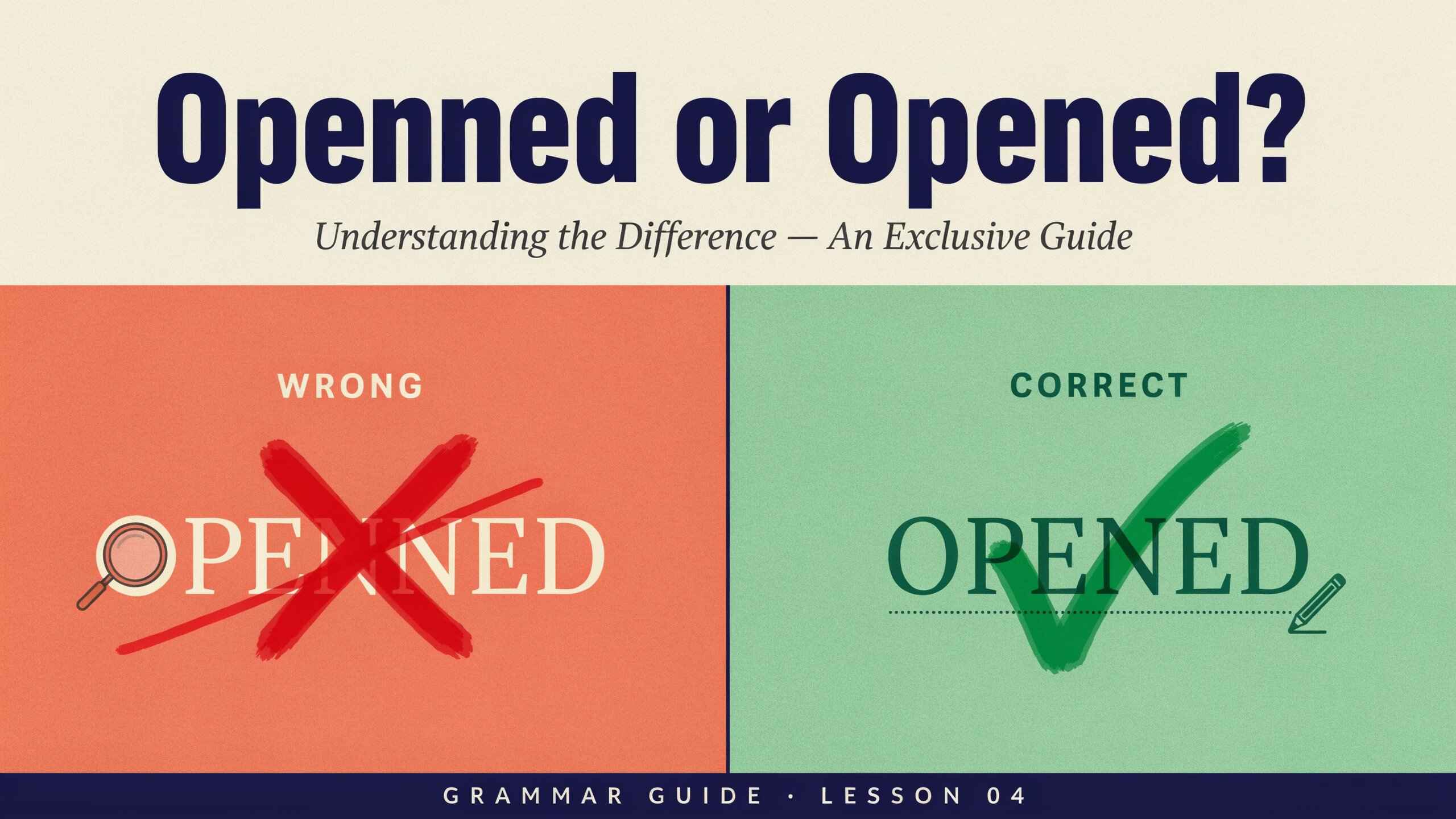
Openned or opened? The correct spelling is opened. Openned is an incorrect spelling of the past tense and past participle of open.
The correct formation is:
open + -ed = opened
The extra n in openned is not needed. The confusion is understandable because English has many words that double a final consonant before adding an ending, such as stop → stopped and plan → planned. However, consonant doubling does not apply to every verb.
In this guide, you’ll learn why opened is correct, why the n is not doubled, how open, opened, and opening differ, and how to use each form naturally in a sentence.
Quick Answer: Is It Openned or Opened?
Opened is correct.
Openned is not the standard spelling of the past tense or past participle of open. Standard English uses opened. Cambridge lists open → opened → opened as the base form, past simple, and -ed form of the regular verb.
| Form | Correct? | Example |
|---|---|---|
| open | Yes | Please open the door. |
| opens | Yes | She opens the store at 9. |
| opened | Yes | She opened the door. |
| opening | Yes | She is opening the door. |
| openned | No | Incorrect spelling |
| openning | No | Incorrect spelling |
The simplest way to remember the answer is:
open + ed = opened
Not:
open + ned = openned
Why Is “Opened” Spelled With One N?
The main reason people get this spelling wrong is that English really does have a consonant-doubling pattern.
For example:
- stop → stopped
- plan → planned
- drop → dropped
- prefer → preferred
Seeing these words can make open → openned look reasonable.
But the doubling rule has conditions. You cannot simply double the final consonant of every verb before adding -ed or -ing.
Open Does Not Meet the Doubling Conditions
The word open has two syllables:
O-pen
The stress falls on the first syllable. Cambridge’s grammar guidance explains that when a multisyllabic word ends in a vowel followed by a single consonant, the consonant is doubled before endings such as -ed or -ing when the relevant final syllable is stressed. It specifically lists open among words where the consonant is not doubled because the final syllable is unstressed.
So:
open → opened
not:
open → openned
Why Does “Stop” Become “Stopped”?
Compare these examples:
| Base verb | Past form | What happens? |
|---|---|---|
| stop | stopped | Final p doubles |
| plan | planned | Final n doubles |
| drop | dropped | Final p doubles |
| prefer | preferred | Final r doubles |
| open | opened | Final n does not double |
| visit | visited | Final t does not double |
| listen | listened | Final n does not double |
This is why the idea that “you always double the final consonant before -ed” is incorrect.
The spelling depends on the word’s structure and, for relevant multisyllabic words, its stress pattern. Cambridge also notes that the vowel before the final consonant matters in the doubling pattern.
The Practical Rule for “Open”
You don’t need to memorize a complicated spelling formula just to spell this word correctly.
Start with the base verb:
open
Add the regular past-tense ending:
open + ed
The result is:
opened
There is no extra n.
Why Do People Write “Openned”?
The mistake comes from applying a real English spelling pattern in the wrong situation.
Someone who knows:
stop → stopped
may naturally wonder:
open → openned?
Someone who knows:
plan → planned
may think the same thing.
But open follows a different pattern.
This is important because simply telling someone “openned is wrong” doesn’t explain why the mistake is tempting in the first place.
A Simple Way to Check the Spelling
When you’re unsure, return to the base word.
Base word: open
Past-tense ending: -ed
Correct result: opened
You don’t need to insert another n.
A useful memory line is:
OPEN + ED = OPENED
That works because you’re starting with the actual base word rather than trying to guess the spelling from similar-looking words.
Open, Opens, Opened, and Opening: The Complete Word Family
Looking at the main forms together makes the spelling much easier to understand.
| Verb form | Word | Example |
|---|---|---|
| Base form | open | Please open the door. |
| Third-person singular | opens | She opens the store at 9. |
| Simple past | opened | She opened the store yesterday. |
| Past participle | opened | She has opened the store. |
| Present participle | opening | She is opening the store. |
The key pattern is:
open → opened → opening
Notice that neither opened nor opening doubles the n.
So the incorrect forms are:
❌ openned ❌ openning
The correct forms are:
✅ opened ✅ opening
This also shows why opened should not be treated as an unusual or irregular form. It is the regular past and -ed form of open.
Open vs. Opened: What Is the Difference?
Open and opened are related, but they don’t always perform the same grammatical job.
One of the most useful distinctions is:
open can describe a current state opened can describe an action that happened
Use “Open” for a Current State
Consider:
The door is open.
The sentence describes the door’s current condition. It tells us that the door is not closed.
Similarly:
The store is open.
This normally means the store is currently operating or available to customers.
Cambridge specifically explains that open can be an adjective meaning “not closed,” while opened is the past form of the verb open.
Use “Opened” for a Completed Action
Now compare:
Sarah opened the door.
Here, the focus is on what Sarah did.
Another example:
The manager opened the store at 9 a.m.
This tells us about the action of opening the store.
State vs. Action
| Sentence | Main idea |
|---|---|
| The door is open. | Current state |
| Sarah opened the door. | Completed action |
| The store is open. | Current business status |
| The manager opened the store. | Action of starting the business |
This distinction is more useful than simply saying that open is “present” and opened is “past.” The word open can also be an adjective, while opened is the past form of the verb.
What Is the Past Tense of Open?
The past tense of open is opened.
For example:
I opened the window this morning.
She opened the package yesterday.
We opened the meeting with a short introduction.
The restaurant opened last year.
The formation is straightforward:
open → opened
There is no special irregular form.
Is “Opened” Also a Past Participle? Openned or Opened
Yes. Opened is both the simple past form and the past participle of open.
The difference becomes clearer when you look at the surrounding words.
Simple Past
She opened the door.
Here, opened is the simple past.
Present Perfect
She has opened the door.
Here, opened is the past participle used with has.
Past Perfect
She had opened the door before I arrived.
Here, opened is again the past participle, this time used with had.
So it is not accurate to think of opened as meaning only “something happened in the past.” The same form can serve different grammatical functions depending on the construction.
How Is “Opened” Used in Passive Voice?
Opened can also appear in passive constructions.
Compare:
The employee opened the door.
This is active voice because the employee performs the action.
Now:
The door was opened by the employee.
This is passive voice because the door is the focus of the sentence.
Another example is:
The new library was opened last month.
Here, the sentence focuses on the library and the event of its opening.
The important point is that opened remains the same spelling in all these constructions.
Opened vs. Opening: What Is the Difference?
Another natural source of confusion is opened versus opening.
A simple way to distinguish them is:
- opened usually presents the action as completed
- opening can describe an action in progress
Opened
She opened the door.
The sentence presents the opening as a completed action.
Opening
She is opening the door.
The action is happening now.
Opening as a Noun
Opening can also be a noun:
The opening of the new store attracted a large crowd.
Here, opening refers to the beginning or launch of the store.
Is “Openning” Correct?
No.
The correct spelling is:
opening
not:
openning
The word family is:
open → opened → opening
The n stays single.
What Does “Opened” Mean?
Opened is the past simple and past participle of open. The meaning of the verb depends on what is being opened.
Opening a Physical Object
She opened the window.
He opened the package.
I opened the drawer.
Here, something is moved or separated so it is no longer closed or can be accessed.
Opening a Business
The restaurant opened in June.
In this context, opened means the business began operating.
Opening a Meeting or Event
The speaker opened the meeting with a short introduction.
Here, opened means began.
Opening a Digital File
I opened the document on my laptop.
In this context, opened means accessing the file so that it can be viewed or used. Cambridge includes computer documents and programs among the uses of open.
Opening an Account or Making Something Available
She opened a new bank account.
The company opened applications to the public.
These examples show that opened isn’t limited to physically opening doors, windows, or containers. The verb can also describe starting something, making something available, or accessing something.
READ MORE >>> Roaster or Roster: Which Word Is Correct?
“The Store Is Open” or “The Store Is Opened”?
This is an especially useful distinction because both forms can be grammatically possible in different contexts, but they don’t communicate the same thing.
“The Store Is Open”
The store is open.
This describes the store’s current status. You would naturally use it when telling someone that the store is currently operating.
“The Store Opened”
The store opened at 9 a.m.
This describes the event or action of the store beginning business.
“The Store Was Opened”
The store was opened by the owner last year.
This focuses on the action and uses a passive construction.
| Sentence | Meaning |
|---|---|
| The store is open. | Current status |
| The store opened at 9 a.m. | The business began operating |
| The store was opened by the owner. | The action is expressed passively |
This distinction is supported by standard grammar guidance: open is used as an adjective for a current “not closed” state, while opened is the past form of the verb.
Yes — this heading is useful because “openned or opened sentences” is a natural follow-up search intent. I’d add it as an H2 and focus on practical examples rather than repeating the spelling explanation.
Openned or Opened Sentences
The correct spelling is opened, so use opened in sentences when describing the past action of opening something. Openned is an incorrect spelling.
Correct Sentences With “Opened”
- I opened the door when I heard the bell.
- She opened the window to let in some fresh air.
- He opened the package carefully.
- We opened the email this morning.
- Sarah opened the book and started reading.
- The store opened at 9 a.m.
- They opened a new restaurant downtown.
- The teacher opened the discussion with a question.
- I opened the file on my computer.
- He opened a new bank account last month.
Incorrect Sentences With “Openned”
These sentences contain the common spelling mistake:
- ❌ I openned the door.
- ❌ She openned the window.
- ❌ He openned the package.
- ❌ We openned the email.
- ❌ The store openned at 9 a.m.
The correct versions are:
- ✅ I opened the door.
- ✅ She opened the window.
- ✅ He opened the package.
- ✅ We opened the email.
- ✅ The store opened at 9 a.m.
“Opened” in Different Sentence Patterns
Past action:
I opened the door five minutes ago.
Present perfect:
She has opened the package.
Past perfect:
They had opened the store before we arrived.
Passive voice:
The door was opened by the receptionist.
These examples all use opened, never openned.
Quick Tip
If you’re writing a sentence and wondering whether to use openned or opened, remember:
open + ed = opened
So:
Opened = correct
Openned = incorrect
This section is worth adding because it directly satisfies the sentence/examples intent without unnecessarily creating another long explanation of the spelling rule.
Common Mistakes With “Opened”
1. Writing “Openned”
❌ She openned the door.
✅ She opened the door.
The extra n is unnecessary.
2. Writing “Openning”
❌ The store is openning tomorrow.
✅ The store is opening tomorrow.
The n is not doubled in opening.
3. Confusing “Opened” With “Opens”
Consider:
The store opens every morning at 8.
This describes a regular schedule.
But:
The store opened at 8 yesterday.
This refers to a particular event in the past.
The correct form depends on what you mean, not simply on the word store or opening.
4. Using “Opened” When You Mean a Current State
If you mean that something is currently not closed, open is usually the appropriate choice:
The door is open.
Rather than:
The door is opened.
The latter can be possible in a different grammatical construction, but it doesn’t normally express the simple current state that the first sentence expresses.
Is “Openned” Ever Correct?
For standard English, openned is not the correct spelling of the past tense or past participle of open.
Use:
opened
If you encounter openned somewhere, it may simply be a typo or another nonstandard occurrence. But when you’re writing standard English, the correct form is opened.
The useful distinction is therefore:
opened = standard English form openned = incorrect spelling of that form
Is “Opened” the Same in American and British English?
Yes. The standard spelling is opened in both American and British English.
There is no US-versus-UK choice such as color/colour involved here.
So whether you’re writing for an American or British audience, use:
opened
The grammar and spelling of this verb form do not change between the two varieties in this respect.
Examples of “Opened” in Different Contexts
The following examples show how opened works beyond the most obvious door-and-window examples.
Physical Objects
She opened the front door.
He opened the box carefully.
Businesses
The coffee shop opened at 7 a.m.
A new grocery store opened downtown last month.
Meetings and Events
The director opened the meeting with a brief speech.
The conference opened with a discussion about technology.
Digital Content
I opened the email this morning.
She opened the file and reviewed the document.
Accounts and Services
He opened a new bank account.
The company opened registration to the public.
Beginning Something
The speaker opened the discussion with a question.
In each case, opened communicates an action that has been completed or a past event, while the exact meaning of open depends on the context.
A Simple Way to Remember the Correct Spelling
If you often hesitate between opened and openned, use the base-word method.
Step 1: Start With the Base Word
open
Step 2: Add the Past-Tense Ending
open + ed
# 3: Check the Result
opened
You don’t need to insert another n.
Remember the Whole Pattern
A useful mental sequence is:
open → opened → opening
That gives you three common forms at once and helps prevent both openned and openning.
Opened vs. Openned: Quick Comparison
| Question | Answer |
|---|---|
| Correct spelling | opened |
| Incorrect spelling | openned |
| Base verb | open |
| Past tense | opened |
| Past participle | opened |
| Present participle | opening |
| Does the N double? | No |
| Is “openning” correct? | No |
| US/UK spelling difference? | No |
Frequently Asked Questions
Is it openned or opened?
Opened is correct. Openned is an incorrect spelling of the standard past tense and past participle of open.
Is openned a word?
It is not the standard spelling of the verb open. In standard English writing, use opened.
How do you spell opened?
The correct spelling is opened:
O-P-E-N-E-D
It contains one n.
Why isn’t opened spelled openned?
Because the final n of open is not doubled when -ed is added. The correct formation is open + ed = opened. The consonant-doubling pattern does not apply to open.
What is the past tense of open?
The past tense is opened.
She opened the door.
What is the past participle of open?
The past participle is also opened.
She has opened the door.
Is opened a verb?
Opened is a verb form: it is the simple past form of open. It is also the past participle of the same verb. Depending on the construction, a form of opened can also be used in an adjective-like way.
What is the difference between open and opened?
Open can be the base form of the verb or an adjective describing something that is not closed. Opened is the past form and past participle of the verb open.
The door is open.
She opened the door.
Is it opening or openning?
The correct spelling is opening with one n.
She is opening the door.
Openning is incorrect.
Why does “stop” become “stopped” but “open” become “opened”?
Consonant doubling depends on the spelling and stress pattern of the word. Stop fits the pattern that doubles its final p, while open does not fit the conditions for doubling its final n.
Is “the store is open” or “the store is opened” correct?
If you mean the store is currently operating, the store is open is the natural choice.
The store is open until 9 p.m.
If you’re describing an action, opened may be appropriate:
The store opened at 9 a.m.
The store was opened by the owner last year.
Conclusion
Opened is the correct spelling. Openned is not the standard spelling of the past tense or past participle of open.
The easiest way to remember it is:
open + ed = opened
The n does not double because open does not meet the conditions for final-consonant doubling. That’s different from words such as stop → stopped and plan → planned.
It also helps to remember the complete pattern:
open → opens → opened → opening
Use open when you mean a current state or the base verb, opened for the simple past and past participle, and opening for an ongoing action or related noun.
So if you’re deciding between openned or opened, the correct standard-English spelling is opened. Openned or Opened