
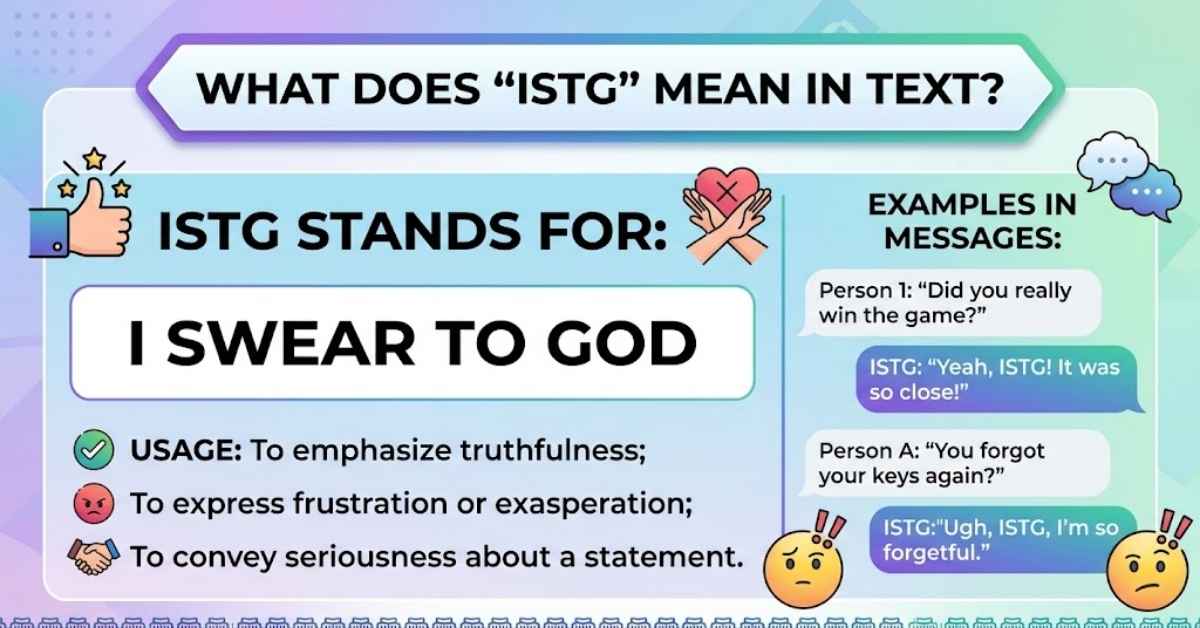
ISTG meaning in text is “I swear to God.” People use this common texting abbreviation to emphasize that they are telling the truth, making a serious promise, expressing frustration, or reacting strongly to something. Depending on the conversation, ISTG can sound sincere, annoyed, surprised, excited, or playful.
For example, if a friend texts, “ISTG I didn’t take your charger,” they are strongly insisting that they are telling the truth. If someone writes, “ISTG this is the funniest video ever 😂,” they are emphasizing how funny they find it.
The key is to read the entire message rather than assume ISTG always signals anger. Here is how to understand it in texts, Instagram messages, social media comments, and everyday conversations.
What Does ISTG Mean in Text?
ISTG stands for “I Swear to God.” It is an informal internet initialism used in text messages, online chats, comments, and direct messages.
In everyday English, ISTG often communicates one of these ideas:
- “I’m telling the truth.”
- “I really mean it.”
- “I promise.”
- “Seriously!”
- “I can’t believe this!”
- “I’m getting frustrated.”
The exact interpretation depends on what comes next and what the conversation is about.
Consider these examples:
| Text message | Likely meaning |
|---|---|
| “ISTG, I didn’t touch your phone.” | I’m telling the truth. |
| “ISTG, this song is amazing.” | I genuinely love this song. |
| “ISTG, if you cancel again, I’m going alone.” | I’m frustrated and serious about my decision. |
| “ISTG, that scared me 😂” | I’m emphasizing how shocking or funny the experience was. |
| “ISTG I’ll call you tonight.” | I’m making a strong promise. |
Notice that ISTG does not have one fixed emotional meaning. It strengthens the statement around it.
What Does ISTG Mean in Chat and Slang?
The ISTG meaning in chat is generally the same as its meaning in texting: “I swear to God.” In internet slang, it acts as an emphasis marker that makes a message sound more intense.
People may use it when someone doubts them, when they are annoyed by a repeated problem, or when they want to make a reaction more expressive.
1. When someone wants to be believed
Example:
Friend A: “You ate the last slice of pizza.”
Friend B: “ISTG, I didn’t even see it.”
Here, the sender is insisting that the statement is true.
2. When someone is frustrated
Example:
“ISTG, my Wi-Fi stops working every time I need it.”
The sender is complaining about an annoying situation. They may be genuinely upset, or they may be exaggerating for humor.
3. When someone is excited or impressed
Example:
“ISTG, that concert was incredible!”
The abbreviation adds enthusiasm. The sender is emphasizing how strongly they feel about the experience.
4. When someone makes a promise
Example:
“ISTG I’ll send you the pictures when I get home.”
The sender is trying to reassure the recipient that they intend to follow through. However, using ISTG does not guarantee that the promise will be kept.
What Does ISTG Mean on Instagram?
The ISTG meaning on Instagram is also “I swear to God.” It does not have a separate standard definition on Instagram.
You might see it in Instagram DMs, comments, Reel captions, Story replies, or conversations with friends. The meaning depends on the message and the situation.
Examples:
- In a DM: “ISTG, I didn’t leave you on read on purpose.” This emphasizes an explanation.
- In a comment: “ISTG this outfit is perfect.” This expresses strong approval.
- In a Story reply: “ISTG, that was the best day ever.” This emphasizes a positive memory.
- In a conversation: “ISTG if he says that again…” This may signal frustration, a warning, or playful exaggeration.
If someone sends you “ISTG” after you question something they said, they are probably emphasizing their claim. If they use it while reacting to a funny Reel, they may simply be adding dramatic emphasis.
Important: Instagram does not determine the meaning by itself. The words surrounding ISTG matter more than the platform.
What Does ISTG Mean in Social Media?
The ISTG meaning in social media remains “I swear to God,” whether it appears in a post, comment, caption, direct message, or group conversation.
The abbreviation is useful in casual online communication because it adds emotional emphasis without requiring a long explanation.
Here is how it may appear across different platforms:
| Platform or setting | Example | Likely interpretation |
|---|---|---|
| “ISTG, this Reel is hilarious.” | Strong amusement | |
| Snapchat | “ISTG I sent you that yesterday.” | Insisting on a fact |
| TikTok | “ISTG this trend is everywhere.” | Emphasis or mild frustration |
| Text message | “ISTG I’m on my way.” | Reassurance |
| Group chat | “ISTG you guys are too much 😂” | Playful teasing |
These are illustrative examples, not platform-specific definitions. The abbreviation itself keeps its usual meaning across these settings.
What Does ISTG Mean in English?
In simple English, ISTG means “I swear to God,” but its conversational meaning is often closer to “I’m serious,” “I really mean it,” or “I’m telling you the truth.”
For example:
- “ISTG, I saw him at the store.” → “I’m telling you, I really saw him.”
- “ISTG, this is so annoying.” → “This is seriously annoying.”
- “ISTG, I’ll be there at six.” → “I promise I’ll be there at six.”
- “ISTG, that was unbelievable.” → “Seriously, that was unbelievable.”
The literal expansion includes religious wording, but people do not always intend a formal religious oath when they use it online. Some use it casually as an expression of emphasis.
Still, not everyone is comfortable using the phrase. If you want to avoid religious wording, you can say “I’m serious,” “I promise,” “honestly,” or “I’m telling you.”
What Does ISTG Mean From a Girl?
The ISTG meaning from a girl is usually the same as it is from anyone else: “I swear to God.”
It does not automatically mean that she is flirting, angry, upset, or romantically interested. Her actual message and your relationship provide better clues.
For example:
If she is explaining something:
“ISTG, I didn’t tell anyone your secret.”
She is emphasizing that she did not share the information.
If she is joking with you:
“ISTG you’re the most dramatic person ever 😂”
She may be teasing you in a friendly way.
If she is frustrated:
“ISTG, you never listen to me.”
She may feel ignored or irritated, particularly if the conversation has already been tense.
If she is excited:
“ISTG, you have to watch this movie.”
She is emphasizing how strongly she recommends it.
Does ISTG from a girl mean she likes you?
Not by itself. A girl using ISTG does not provide reliable evidence of romantic interest. Look at the broader conversation, whether she initiates contact, how she communicates with you, and what she actually says.
Even those signals should be interpreted carefully. The abbreviation alone cannot tell you how she feels.
What Does ISTG Mean From a Boy?
The ISTG meaning from a boy is also “I swear to God.” The definition does not change based on gender.
A boy might use ISTG to emphasize honesty, express annoyance, make a promise, or react to something surprising.
Examples include:
- “ISTG, I didn’t know about the plan.” — He is emphasizing that he did not know.
- “ISTG, that game was impossible.” — He is expressing frustration or disbelief.
- “ISTG, I’ll help you tomorrow.” — He is making a strong promise.
- “ISTG you’re hilarious 😂” — He is emphasizing that he finds something funny.
Does ISTG from a boy mean he is angry?
Not necessarily. A message such as “ISTG, stop doing that” can sound irritated, but “ISTG, that was amazing” communicates enthusiasm.
The surrounding words, punctuation, and previous conversation are much more useful than the sender’s gender.
How Can You Tell Whether ISTG Is Serious, Playful, or Frustrated?
When you see ISTG in a message, use these four clues to interpret it more accurately.
1. Read the words that follow it.
“ISTG, I didn’t do it” is usually an insistence. “ISTG, this is hilarious” is more likely to express amusement. “ISTG if you do that again…” can sound like a warning.
2. Consider the conversation before it.
If you have been arguing about something, ISTG may sound defensive or frustrated. If you are sharing jokes with a friend, the same abbreviation may be playful.
3. Notice punctuation and emojis.
An “ISTG!!!” may look more intense than a casual “istg 😂.” Emojis can provide clues, but they do not guarantee that a message is friendly or sarcastic.
4. Think about your relationship with the sender.
Close friends may use dramatic expressions without intending to offend anyone. A similar message from someone you barely know may feel more confrontational.
A useful rule is to interpret the whole sentence first and the abbreviation second. ISTG adds emphasis; the rest of the message usually tells you what is being emphasized.
How Do You Reply When Someone Says ISTG?
There is no single correct response to ISTG. Your reply should address what the person is actually saying.
| Situation | Possible reply |
|---|---|
| They are insisting that something is true. | “Okay, I hear you.” |
| They are making a promise. | “Sounds good. I’ll count on that.” |
| They are frustrated. | “I get why that’s annoying.” |
| They are joking. | “Haha, I know 😂” |
| They are expressing surprise. | “Right? I couldn’t believe it either.” |
| You don’t understand the message. | “What do you mean?” |
| Their tone feels confrontational. | “Can you explain what you’re upset about?” |
Funny replies to ISTG
If you are chatting with a friend and the mood is light, you could say:
- “Okay, okay, I believe you 😂”
- “You’re being so dramatic.”
- “I hear you!”
- “Not the ISTG 😭”
- “You sound very serious right now.”
Choose a playful reply only when the conversation supports that tone. A joke may not help if the person is genuinely upset.
What if you don’t believe them?
You do not have to accept a statement just because someone uses ISTG.
You can reply calmly:
- “I understand, but I’m still confused.”
- “Can you explain what happened?”
- “I hear what you’re saying. Let me think about it.”
- “I need a little more information before I can be sure.”
The goal is to respond to the claim, rather than treating the abbreviation as proof that the claim is true.
Is ISTG Rude, Offensive, or Inappropriate?
ISTG is informal, but it is not automatically rude. Friends may use it casually, while the same expression can sound aggressive in an argument.
There is also a religious consideration. Because ISTG stands for “I swear to God,” some people may regard the wording as disrespectful or inappropriate when used casually. Others use it as a familiar expression without intending a literal oath.
If you are unsure how someone feels about the phrase, a neutral alternative is safer.
| Instead of ISTG | You can say |
|---|---|
| To emphasize honesty | “I’m telling the truth.” |
| To make a promise | “I promise.” |
| To express frustration | “This is really frustrating.” |
| To show surprise | “Seriously?” |
| To emphasize an opinion | “Honestly, I really think so.” |
ISTG is generally better suited to casual texts and informal online conversations than formal emails, academic work, job applications, or professional communication.
LEARN MORE: Writen or Written
ISTG vs. ONG, FR, NGL, and OMG
ISTG is often used alongside other internet slang. These abbreviations overlap in some situations, but they do not all mean the same thing.
| Slang | Full form | Common purpose |
|---|---|---|
| ISTG | I swear to God | Emphasizing a claim, promise, or reaction |
| ONG | On God | Emphatic agreement or assertion |
| FR | For real | Showing agreement, sincerity, or seriousness |
| NGL | Not gonna lie | Introducing an honest opinion or admission |
| TBH | To be honest | Introducing a candid statement |
| SMH | Shaking my head | Expressing disapproval or disbelief |
| OMG | Oh my God | Expressing surprise, excitement, or shock |
For example, “FR, that movie was good” emphasizes agreement or sincerity. “NGL, I didn’t like the ending” introduces an honest opinion. “ISTG, that ending shocked me” emphasizes a strong reaction.
These expressions are related forms of informal online language, but they are not interchangeable in every sentence.
Frequently Asked Questions
What does ISTG stand for?
ISTG stands for “I swear to God.” It is a common texting initialism used to emphasize honesty, promises, frustration, surprise, or other strong reactions.
What does ISTG mean in a text message?
In a text message, ISTG usually means “I swear to God.” Depending on the words around it, it may mean “I’m telling the truth,” “I promise,” or “Seriously!”
What does ISTG mean on Instagram?
On Instagram, ISTG has the same standard meaning: “I swear to God.” It may appear in DMs, comments, captions, and Story replies to add emphasis or express emotion.
What does ISTG mean from a girl or boy?
The definition is the same regardless of gender. The sender might be sincere, frustrated, playful, or excited. The message and conversation provide better clues than gender alone.
Does ISTG mean someone is angry?
No. ISTG can express frustration, but it can also show honesty, excitement, disbelief, or humor. Read the full sentence and consider the situation before deciding that someone is angry.
Is ISTG the same as ONG?
No. ISTG means “I swear to God,” while ONG means “On God.” Both can emphasize sincerity or agreement, but they have different full forms and may be used differently depending on the conversation.
Does lowercase “istg” mean something different from “ISTG”?
No. Lowercase “istg” and uppercase “ISTG” generally have the same meaning. Capitalization or extra punctuation can change how forceful the message appears, but it does not create a new standard definition.
Can I use ISTG in professional messages?
It is usually better to avoid ISTG in formal or professional communication. Use clearer expressions such as “I can confirm,” “I promise,” “honestly,” or “I’m serious,” depending on what you mean.
Final Thoughts
The ISTG meaning in text is “I swear to God.” In everyday online conversations, it usually adds emphasis to a statement, promise, complaint, or reaction.
On Instagram and other social media platforms, the core definition stays the same. What changes is the tone: ISTG may sound sincere, playful, frustrated, or surprised depending on the message.
When you’re unsure, read the whole conversation before deciding what someone means. And if the religious wording does not suit you, alternatives such as “I’m serious,” “honestly,” and “I promise” communicate the same general ideas in a more neutral way.