
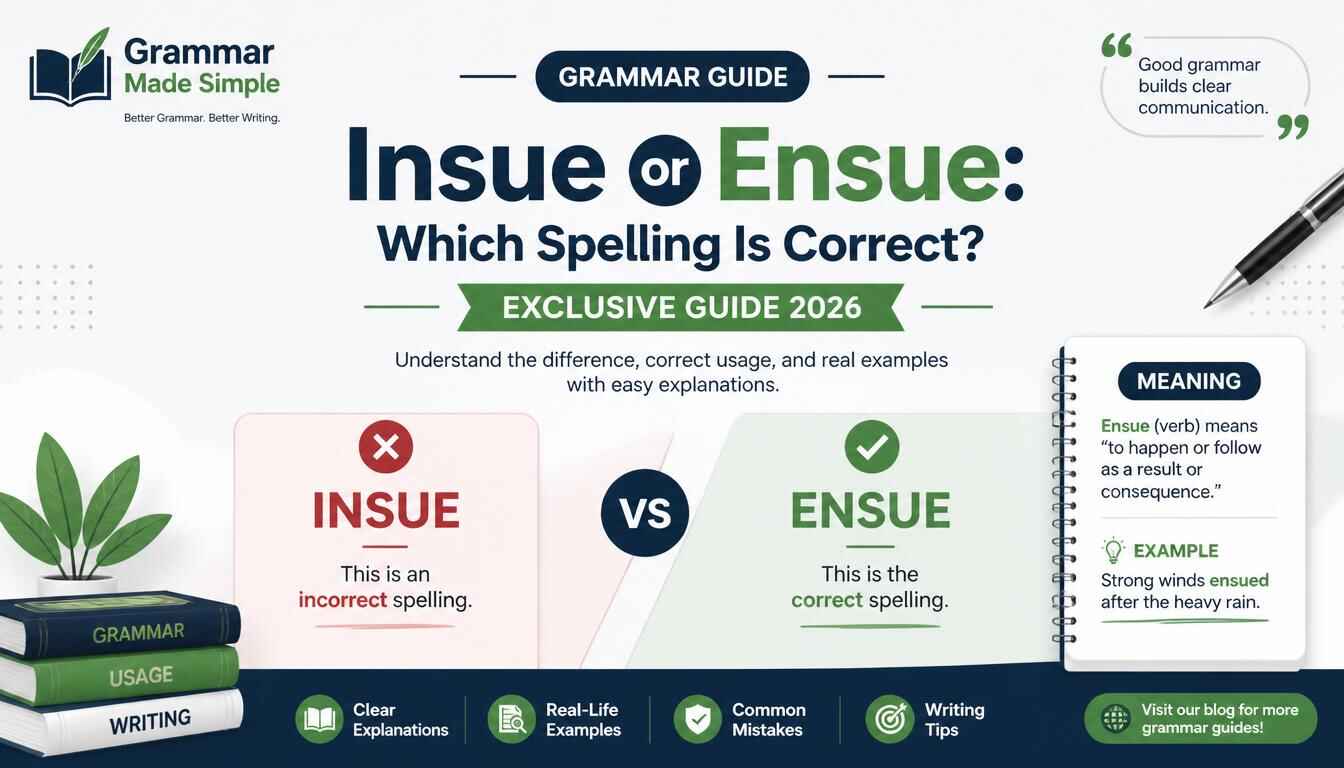
Insue or ensue? If you are wondering which spelling is correct, use ensue in modern standard English. Ensue is a formal verb meaning to happen after something else, especially as a result of it. For example, “An argument ensued after the meeting.” The spelling insue is not the standard modern form, although it is recorded as a former historical spelling of ensue.
The confusion is understandable because ensue is pronounced roughly like “in-SOO” in American English, which can make the spelling insue seem natural. But when you are writing a modern email, essay, article, report, or other piece of English, ensue is the form you want.
There is also more to this word than its spelling. Understanding what ensue means, how it works grammatically, and how it differs from words such as follow, cause, ensure, and insure can help you use it correctly and naturally.
Quick Answer: Is It “Insue” or “Ensue”?
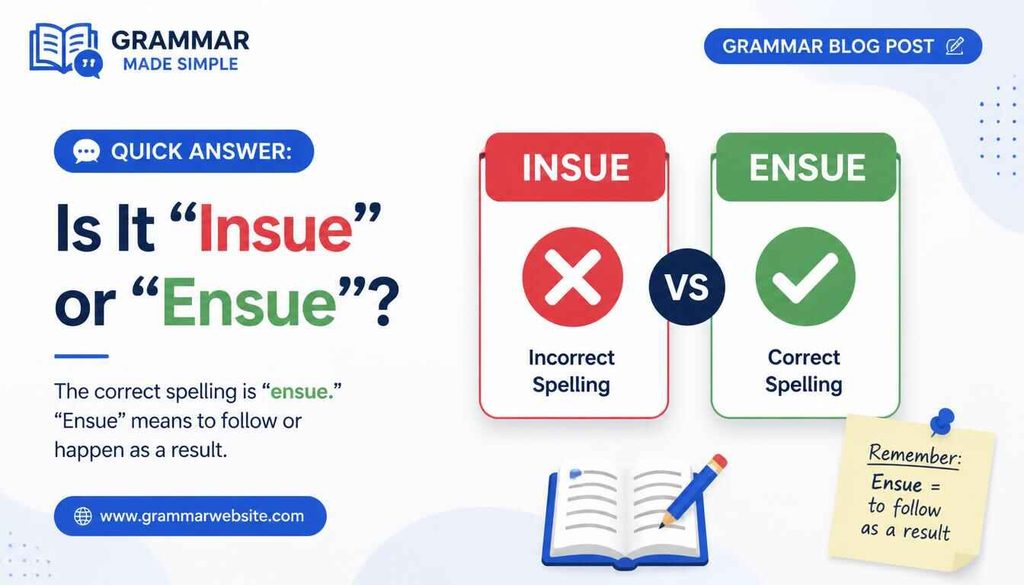
Ensue is the correct spelling in modern standard English.
It means to happen after something else, especially as a result of it. Ensue is normally an intransitive verb and is often used in formal writing. For example, “A heated discussion ensued.”
Insue is not the standard modern spelling. However, it is not accurate to say that the spelling has never existed: Oxford records insue as a former spelling of ensue.
| Spelling | Modern standard English? | Meaning |
|---|---|---|
| ensue | Yes | Happen afterward or as a result |
| insue | No | Former historical spelling of ensue |
So, if you are deciding what to type today, choose ensue.
What Does “Ensue” Mean?
Ensue means that something happens after another event, often because of or as a result of that event.
Cambridge defines it as happening after something else, especially as a result of it. Oxford gives a very similar definition: to happen after or as a result of another event. Both dictionaries classify ensue as a formal, intransitive verb.
In simple English, you can often understand ensue as:
happen afterward
or:
follow as a result
For example:
An argument ensued after the meeting.
The meeting happened first. The argument happened afterward.
Another example:
Confusion ensued when the instructions changed.
The instructions changed first, and confusion followed.
The word therefore has an important sequence idea: one event happens, and another event comes afterward.
Does “Ensue” Mean “Happen” or “Happen as a Result”?
It can be tempting to treat ensue as simply another word for happen, but that misses an important part of its meaning.
Compare:
Something unexpected happened.
This tells us that an event occurred. It does not necessarily tell us what came before it.
Now compare:
An argument ensued after the announcement.
Here, the sentence connects the argument to an earlier event. The argument came afterward, with the wording suggesting a connection between the two events.
A useful way to think about ensue is:
Event A → Event B follows
Often:
Event A → Event B follows as a consequence
That is why ensue is particularly common in sentences describing what happens after a decision, announcement, disagreement, accident, change, or other event.
Why Is “Ensue” Correct?
The modern standard spelling is ensue.
Oxford lists ensue as a formal, intransitive verb and gives its forms as ensue, ensues, ensued, and ensuing. Its word-origin information also notes that the word dates to Late Middle English and was formerly spelled insue as well.
So there are two different questions worth separating:
What is the modern spelling?
→ Ensue
Has “insue” ever existed?
→ Yes, Oxford records it as a former spelling.
This distinction is important because saying simply “insue has never been a word” gives the reader an incomplete picture.
For modern writing, however, there is no practical ambiguity:
Use ensue.
Is “Insue” a Word?
The answer depends on what you mean by “word.”
If you mean the standard modern spelling of the verb, then no: insue is not the form you should use in contemporary standard English.
But if you are asking whether insue has ever appeared as an English spelling, the answer is different. Oxford records insue as a former spelling of ensue.
That means the most accurate explanation is:
Insue is a historical spelling, but ensue is the standard modern spelling.
This distinction matters when reading older texts or studying the history of English. Historical spellings do not automatically become acceptable choices in present-day writing.
What should you use today?
For modern English, write:
An argument ensued.
Not:
An argument insued.
The same applies to other forms:
The argument ensued.
Further problems may ensue.
The ensuing debate lasted for hours.
Why Do People Confuse “Insue” and “Ensue”?
The pronunciation is one obvious reason.
Cambridge gives the American pronunciation as /ɪnˈsuː/ and the British pronunciation as /ɪnˈsjuː/. In approximate everyday spelling, this sounds something like “in-SOO” or “in-SYOO.”
That creates a natural spelling trap.
Someone who has mainly heard the word spoken may think:
“It sounds like in-sue, so perhaps it is spelled insue.”
But the standard spelling begins with en-:
en + sue = ensue
This is a good example of why pronunciation and spelling cannot always be used interchangeably in English.
How Do You Use “Ensue” in a Sentence?
The easiest pattern is:
Something + ensue
For example:
An argument ensued.
Chaos ensued.
A long silence ensued.
The event that happens afterward is normally the subject of the verb.
That grammatical point is important because ensue is intransitive. Oxford and Cambridge both identify it as an intransitive verb.
What Does “Intransitive” Mean Here?
An intransitive verb does not normally take a direct object.
Consider:
An argument ensued.
The argument is the thing that happened afterward. It is the subject.
But this sentence has the wrong structure:
❌ The announcement ensued an argument.
This treats ensue as though it means cause something.
Instead, write:
The announcement caused an argument.
Or:
An argument ensued after the announcement.
Or:
An argument followed the announcement.
This is one of the most useful rules to remember when using ensue.
Ensue Does Not Mean “Cause”
Ensue and cause can appear in similar situations, but they describe different relationships.
| Word | Main focus | Example |
|---|---|---|
| cause | Producing an event | The announcement caused confusion. |
| ensue | An event happening afterward | Confusion ensued after the announcement. |
| follow | Something coming afterward | Confusion followed the announcement. |
The difference becomes easier when you change the sentence into plain language.
The announcement caused confusion.
means:
The announcement produced confusion.
But:
Confusion ensued after the announcement.
means:
Confusion happened afterward.
The first sentence focuses on causation. The second focuses on what happened next.
That is why ensue normally does not work in a construction such as:
❌ The mistake ensued confusion.
Use:
The mistake caused confusion.
or:
Confusion ensued after the mistake.
Common Sentence Patterns With “Ensue”
Once you understand the basic grammar, several useful patterns become easy to recognize.
1. Subject + ensue
An argument ensued.
A long silence ensued.
2. Subject + ensue + after
An argument ensued after the meeting.
Confusion ensued after the announcement.
3. Subject + ensue + following
Several problems ensued following the system change.
4. Modal verb + ensue
Further complications may ensue.
A dispute could ensue if the agreement fails.
5. Ensuing + noun
The ensuing debate lasted two hours.
These patterns are often more useful to writers than simply memorizing a dictionary definition.
Ensue, Ensued, and Ensuing: What’s the Difference?
These forms are related, but they do different jobs in a sentence.
| Form | Function | Example |
|---|---|---|
| ensue | Base/present verb | A debate may ensue. |
| ensues | Third-person singular present | Confusion ensues. |
| ensued | Past tense/past participle | An argument ensued. |
| ensuing | Adjective | The ensuing debate continued. |
Cambridge identifies ensued as the past tense and past participle of ensue, while ensuing is an adjective used before nouns.
Ensue
Use the base form when appropriate:
If the negotiations fail, a dispute may ensue.
Ensues
Use ensues with a singular third-person subject in the present tense:
Confusion ensues when the instructions are unclear.
Ensued
Use ensued for something that happened in the past:
A heated argument ensued.
Ensuing
Use ensuing to describe something that happens afterward:
The ensuing argument lasted several minutes.
The easiest distinction is:
A debate ensued.
versus:
The ensuing debate lasted two hours.
In the first sentence, ensued is the verb. In the second, ensuing describes the debate.
Does “Ensue” Always Describe Something Negative?
No.
The word is often used with negative events, which can create that impression. Common combinations include:
chaos ensued
panic ensued
confusion ensued
fighting ensued
But ensue itself does not mean something bad happened.
It can describe neutral or positive events as well. Cambridge’s examples include a lively discussion, a party, a honeymoon period, and celebratory joy.
Negative
Chaos ensued after the power outage.
Neutral
A lively discussion ensued.
Positive
A celebration ensued after the announcement.
The important idea is simply what happened afterward, not whether the event was good or bad.
READ MORE >>> Payed vs Paid: Meaning, Grammar & Correct Usage Explained
Ensue vs. Follow vs. Happen vs. Result
These words overlap, but they are not interchangeable in every sentence.
| Word | Main idea | Example |
|---|---|---|
| ensue | Happen afterward, often as a consequence | An argument ensued. |
| follow | Come after something | Winter follows autumn. |
| happen | Occur | Something unexpected happened. |
| result | Occur as an outcome | Confusion resulted from the error. |
Follow is the closest everyday alternative to ensue. Cambridge and Oxford both list follow in connection with the meaning of ensue.
However, follow is broader.
For example:
Winter follows autumn.
This simply describes sequence.
But:
Confusion ensued after the announcement.
places more emphasis on what happened afterward and its relationship to the preceding event.
That is why ensue often sounds more formal or deliberate than ordinary follow.
Ensue vs. Ensure vs. Insure
These three words are easy to confuse because they look and sound similar, but their meanings are very different.
| Word | Meaning | Example |
|---|---|---|
| ensue | Happen afterward | An argument ensued. |
| ensure | Make certain | Please ensure the door is locked. |
| insure | Protect through insurance | They insured the vehicle. |
A simple memory aid is:
Ensue → something happens afterward
Ensure → make certain
Insure → insurance
If you are describing an event that happens after another event, ensue is the word you need.
Can “Ensue” Be Used for Future Events?
Yes.
Although many examples of ensue describe things that already happened, the word can also describe a possible or expected future event.
For example:
Further problems may ensue.
A dispute could ensue if the negotiations fail.
Serious delays could ensue if the road remains closed.
In these sentences, the second event has not happened yet.
The writer is saying that it may happen afterward if the first situation occurs.
So ensue is not limited to past events. Its tense and meaning depend on the rest of the sentence.
When Does “Ensue” Sound Too Formal?
Ensue is grammatically correct, but that does not mean it is the most natural choice in every situation.
Cambridge and Oxford both label the word formal.
Compare these expressions:
Casual:
What happened next?
Neutral:
What happened afterward?
More formal:
What ensued?
Similarly:
A fight happened afterward.
is understandable and conversational, while:
A fight ensued.
is more concise and formal.
This does not make ensue “too fancy” or incorrect. It simply means that register matters.
For an academic paper, formal report, news-style writing, or polished narrative, ensue may fit naturally. In everyday conversation, happen afterward or follow may sound more relaxed.
Practical Examples of “Ensue”
Here are examples showing how the word works in different contexts.
Everyday situation
A disagreement ensued after the meeting.
Formal writing
Several changes ensued following the policy revision.
Narrative writing
A long silence ensued.
Unexpected event
Confusion ensued when the instructions were changed.
Neutral situation
A detailed discussion ensued.
Positive situation
A celebration ensued after the team received the news.
Future possibility
Further complications may ensue.
Notice that the examples do not all involve conflict or disaster. The common feature is that one event is followed by another.
Common Mistakes With “Ensue”
Mistake 1: Spelling it “insue”
❌ An argument insued.
✅ An argument ensued.
The modern standard spelling is ensued.
Mistake 2: Using “ensue” to mean “cause”
❌ The announcement ensued confusion.
✅ The announcement caused confusion.
✅ Confusion ensued after the announcement.
The event that happens afterward is normally the subject of ensue.
Mistake 3: Assuming it only describes bad events
❌ A celebration cannot ensue.
✅ A celebration ensued.
The word can describe positive, neutral, or negative events.
Mistake 4: Confusing “ensue” with “ensuing”
❌ The ensuing after the meeting was unexpected.
✅ An argument ensued after the meeting.
✅ The ensuing argument was unexpected.
Ensue is the verb; ensuing commonly functions as an adjective.
Mistake 5: Assuming “ensue” is always the best replacement for “happen”
Sometimes happen, follow, or occur is more natural.
The question is not simply whether ensue is grammatically possible. Consider whether the sentence actually emphasizes what happened afterward.
A Simple “ENSUE” Test for Writers
If you are unsure whether ensue fits, use this simple four-step test.
Step 1: Identify the first event
The manager announced major changes.
Step 2: Identify what happened afterward
Employees began arguing.
Step 3: Ask whether the second event followed from the first
Yes.
Step 4: Try “ensue”
An argument ensued after the announcement.
The construction works because the argument is the event that happened afterward.
You can remember the basic idea as:
Before → After → Consequence
If your sentence describes an event occurring afterward, especially in connection with what came before, ensue may be a good choice.
A Second Grammar Test: What Happened Afterward?
Another easy way to check your sentence is to ask:
What happened afterward?
The answer should normally be the subject of ensue.
For example:
What happened afterward?
An argument.
So:
An argument ensued.
Another example:
What happened afterward?
Chaos.
So:
Chaos ensued.
But:
❌ The announcement ensued an argument.
The announcement is not the thing that happened afterward. It is the earlier event.
Instead:
The announcement caused an argument.
or:
An argument ensued after the announcement.
This simple test can help you avoid one of the most common structural mistakes with the word.
Why “Ensue” Can Be a Better Choice Than “Happen Afterward”
The phrase happen afterward is perfectly understandable, but ensue can express the relationship more compactly.
Compare:
An argument happened afterward.
with:
An argument ensued.
The second sentence is shorter and more formal. It naturally presents the argument as the event that followed what had just been described.
This is one reason ensue appears frequently in formal prose and narrative writing. It packages the idea of subsequent occurrence into a single verb.
That does not mean you should replace every instance of happen afterward with ensue. If the surrounding writing is casual, the simpler expression may be more natural.
Frequently Asked Questions
Is it “insue” or “ensue”?
Ensue is the standard modern spelling. Use ensue when you mean that something happens after another event, especially as a result of it.
Is “insue” a real word?
Insue is not the standard modern spelling, but Oxford records it as a former spelling of ensue.
What does “ensue” mean in simple English?
It means to happen afterward, often as a result of something that happened first.
Is “ensue” a formal word?
Yes. Cambridge and Oxford both mark ensue as formal.
What is the past tense of “ensue”?
The past tense is ensued.
An argument ensued.
Cambridge identifies ensued as both the past simple and past participle of ensue.
What is the difference between “ensue” and “ensuing”?
Ensue is a verb:
A debate ensued.
Ensuing is commonly an adjective:
The ensuing debate lasted an hour.
Cambridge defines ensuing as something happening after or because of something else.
Can “ensue” describe something positive?
Yes. The word is not inherently negative.
A celebration ensued.
A lively discussion ensued.
Cambridge’s examples include both neutral and positive situations.
Can “ensue” refer to something that might happen in the future?
Yes.
Further problems may ensue.
A dispute could ensue.
Is “ensue” the same as “cause”?
No. Cause means to make something happen. Ensue describes something happening afterward, often as a consequence.
Is “ensue” transitive or intransitive?
In standard modern usage, ensue is an intransitive verb.
That is why we normally write:
An argument ensued.
rather than:
The announcement ensued an argument.
Why do people spell “ensue” as “insue”?
The pronunciation can contribute to the confusion. American English pronunciation is approximately /ɪnˈsuː/, which can sound like “in-SOO.”
The standard spelling, however, is ensue.
Insue or Ensue: The Final Answer
If you are choosing between insue and ensue for modern English writing, choose ensue.
The word means that something happens after another event, especially as a result of it. It is normally an intransitive and relatively formal verb.
The most useful distinctions to remember are:
- Ensue = happen afterward or follow as a result
- Ensued = past form of ensue
- Ensuing = happening afterward; commonly used as an adjective
- Cause = make something happen
- Follow = come after
- Ensure = make certain
- Insure = provide or obtain insurance
- Insue = a former historical spelling, not the standard modern form
So if you are writing a sentence today, write:
An argument ensued after the meeting.
Not:
❌ An argument insued after the meeting.
Once you understand both the spelling and the grammar, the choice becomes straightforward: ensue is the modern form to use.