
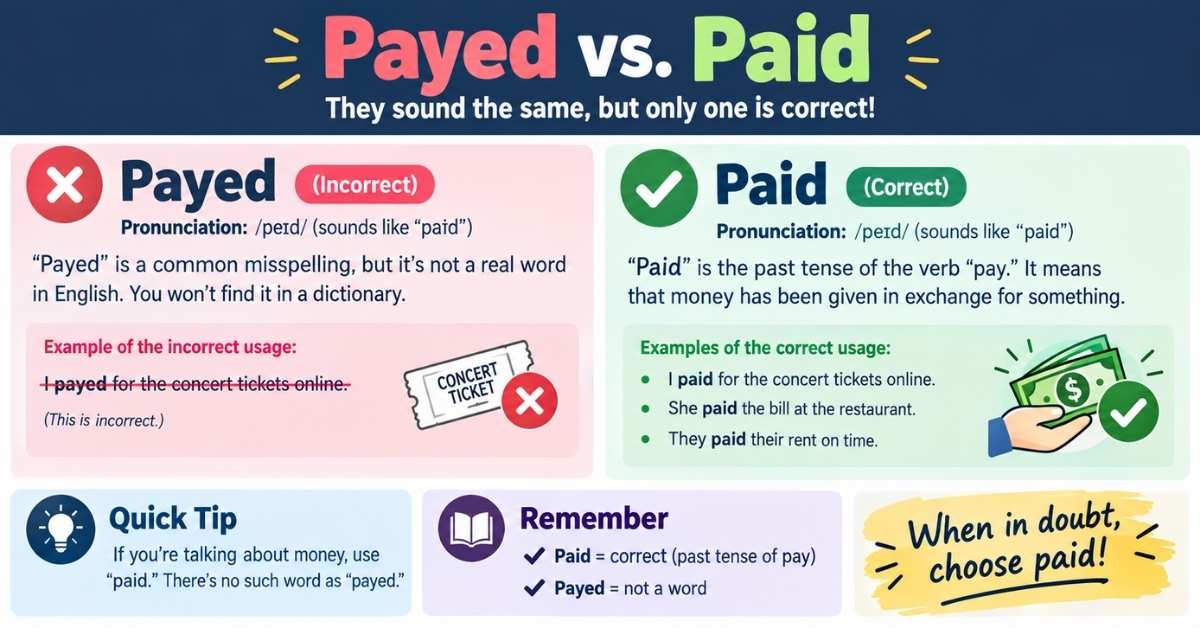
Payed vs paid is easy to settle in almost every everyday sentence: “paid” is the correct past tense and past participle of “pay” when you mean giving money, receiving compensation, giving attention, settling a debt, or using most ordinary meanings of the verb. “Payed” is a real but rare form used mainly in specialized nautical contexts. Cambridge lists paid as both the past simple and past participle of pay.
So write:
I paid the bill.
She got paid on Friday.
We paid attention.
His hard work paid off.
Do not normally write:
I payed the bill.
If you’re writing everyday American English, paid will be the correct choice almost every time.
Payed vs Paid: Quick Answer
Use paid for:
- money,
- bills,
- salaries,
- wages,
- fees,
- debts,
- purchases,
- attention,
- respect,
- successful effort,
- paid employment.
Use payed only in narrow traditional nautical senses, such as coating part of a vessel with tar or another waterproof material, or in some contexts involving letting out a rope or chain. Scribbr and Grammarly both document these specialized uses.
| Context | Correct Form |
|---|---|
| I ___ the bill. | paid |
| She got ___. | paid |
| We ___ attention. | paid |
| His work ___ off. | paid |
| They have ___ the invoice. | paid |
| A deck was ___ with tar. | payed can be correct |
| The sailors ___ out the rope. | payed or sometimes paid, depending on usage/style |
The last row is intentionally nuanced: paid also appears in nautical “pay out” usage, so the rule is not simply “rope = payed.”
What Does Paid Mean?
Paid is the normal past-tense and past-participle form of pay.
Cambridge defines it directly as the past simple and past participle of pay.
The verb pay commonly means giving money in exchange for goods or services:
I pay the rent every month.
Past:
I paid the rent yesterday.
Present perfect:
I have paid the rent already.
Paid as the Past Tense of Pay
Use paid for a completed action in the past.
Examples:
She paid $50 for the tickets.
I paid my electricity bill yesterday.
The company paid its employees on Friday.
We paid the restaurant in cash.
He paid off his credit card balance.
The pattern is:
pay → paid
not:
pay → payed
in these ordinary senses.
Paid as a Past Participle
Paid is also the past participle.
It commonly follows have, has, or had:
I have paid the invoice.
She has paid for the course.
They had paid before we arrived.
So if you’re choosing between:
have paid or have payed
choose:
have paid
The same rule applies to:
has paid
and:
had paid
Paid as an Adjective
Paid is not only a verb form.
It can also function as an adjective.
Cambridge gives examples such as paid work, paid employment, paid leave, low-paid workers, and a well-paid job.
Examples:
She is looking for paid work.
Employees receive twelve weeks of paid leave.
He has a well-paid job.
This is a paid position, not a volunteer role.
Never normally write:
payed leave
or:
well-payed job
for these meanings.
What Does Payed Mean?
Payed is rare, but it is not automatically a spelling error.
It survives in specialized nautical vocabulary.
One traditional sense of pay is to cover or seal part of a vessel with substances such as tar, pitch, grease, or another waterproof material.
Example:
The sailors payed the seams with tar.
Scribbr specifically gives this waterproofing sense as a legitimate use of payed.
Another specialized use involves letting out rope, chain, or cable by slackening it:
The crew payed out the rope slowly.
However, there is an important nuance.
Grammarly and Thesaurus.com note that paid out also occurs in nautical contexts, so payed is not universally required whenever a rope or ship appears.
For ordinary writers, the practical takeaway is:
Unless you’re discussing specialized nautical operations, use paid.
READ MORE >>> Time Flies or Flys? Correct Spelling, Meaning & Grammar
When to Use Payed vs Paid
If you’re searching when to use payed vs paid, ask one simple question:
Does the sentence involve ordinary payment, attention, compensation, debt, or effort?
Use:
paid
Examples:
I paid for lunch.
She paid attention in class.
He paid his respects.
The investment paid off.
Does it use a rare traditional nautical sense of “pay”?
Then payed may be appropriate.
Example:
The ship’s seams were payed with pitch.
This decision framework covers almost every realistic situation.
Why Is It Paid Instead of Payed?
The confusion is understandable because many English verbs form the past tense with -ed.
For example:
play → played
stay → stayed
pray → prayed
So a learner may logically expect:
pay → payed
But ordinary pay does not follow that regular pattern.
Instead:
pay → paid → paid
This makes pay an irregular verb in its usual meanings.
Compare:
say → said
lay → laid
pay → paid
The spelling needs to be learned rather than generated by simply adding -ed.
Paid Attention or Payed Attention?
The correct phrase is:
paid attention
Never:
payed attention
when you mean to focus on something.
Scribbr explicitly identifies paid attention as the correct past form of pay attention.
Examples:
I paid attention during the lecture.
The students paid close attention to the instructions.
She wasn’t paying attention earlier, but she paid attention after the warning.
Here, no money changes hands. Pay is being used figuratively to mean give or direct attention.
The past form is still:
paid
Paid Off or Payed Off?
In normal English, use:
paid off
There are two especially common meanings.
Paid Off a Debt
I finally paid off my student loan.
They paid off the mortgage early.
Effort Produced a Good Result
Her hard work paid off.
Months of training paid off when he won the race.
Scribbr confirms paid off for both the debt and successful-result senses.
Do not normally write:
Her hard work payed off.
Paid For or Payed For?
Use:
paid for
Examples:
I paid for dinner.
She paid for the tickets online.
We have already paid for the hotel.
Who paid for the repairs?
The phrase refers to ordinary payment, so paid is required.
Got Paid or Got Payed?
The standard expression is:
got paid
Example:
I got paid yesterday.
She gets paid every two weeks.
Have you been paid yet?
Here, paid describes receiving compensation or money.
Do not write:
I got payed yesterday.
for that meaning.
Paid the Bill or Payed the Bill?
Use:
paid the bill
Examples:
He paid the restaurant bill.
I paid my phone bill online.
The bill has already been paid.
Again, ordinary financial payment always calls for paid.
Well-Paid or Well-Payed?
Use:
well-paid
Example:
She found a well-paid engineering job.
Because the compound appears before a noun, a hyphen is normally useful:
a well-paid position
After the noun, style may differ:
The position is well paid.
But the word remains paid, never payed in this meaning.
Paid Leave or Payed Leave?
The correct phrase is:
paid leave
Cambridge specifically records paid leave as standard English.
Examples:
Employees receive paid parental leave.
She took two weeks of paid leave.
Likewise:
paid vacation
paid holiday
The paid employment
paid work
Payed vs Paid Grammar
The payed vs paid grammar rule becomes clearer in a verb chart.
| Form | Ordinary Meaning of Pay |
|---|---|
| Base form | pay |
| Third-person singular | pays |
| -ing form | paying |
| Simple past | paid |
| Past participle | paid |
Examples:
Present:
I pay my rent online.
Third-person present:
She pays her rent online.
Continuous:
She is paying now.
Past:
She paid yesterday.
Perfect:
She has paid already.
Notice that the -ing form is:
paying
not:
paiding
The irregular spelling specifically affects the ordinary past and past participle.
Payed vs Paid Examples
Here are natural examples covering the most common search intents.
Money
Correct:
I paid $20 for the book.
Incorrect:
I payed $20 for the book.
Salary
Correct:
Employees were paid on Friday.
Invoice
Correct:
The invoice has been paid in full.
Rent
Correct:
She paid the rent before it was due.
Attention
Correct:
Everyone paid attention during the safety briefing.
Effort
Correct:
His patience paid off.
Consequence
Correct:
He paid the price for ignoring the warning.
Respect
Correct:
Thousands paid their respects at the memorial.
Nautical Waterproofing
Correct in the specialized sense:
The workers payed the seams with tar.
That final sentence is one of the rare places where payed is genuinely appropriate.
Is “Payed” Used Differently in American and British English?
For ordinary modern English, there is no important U.S.–UK difference.
American and British speakers both normally write:
paid the bill
The paid attention
paid off the debt
got paid
paid work
GrammarDock likewise notes that both American and British English use paid for ordinary payment contexts.
The rare nautical spelling payed is specialized vocabulary rather than an American-vs.-British spelling pair like color/colour.
Is Paid an Irregular Verb?
More precisely, pay has an irregular past-tense and past-participle form in its ordinary senses:
pay → paid → paid
Regular English verbs normally take -ed:
walk → walked
play → played
But pay changes internally:
pay → paid
That irregularity is the source of most mistakes.
Can Paid Mean Something Other Than Money?
Absolutely.
Several established expressions use paid figuratively.
Paid Attention
She paid attention to the warning.
Paid Respect
He paid his respects to the family.
Paid a Compliment
She paid him a compliment.
Paid the Price
The company paid the price for poor planning.
Paid a Visit
We paid our grandparents a visit.
Paid Off
The extra practice paid off.
These examples reinforce the better rule:
Use paid for almost all ordinary senses of pay—not only financial ones.
Learn more: Time Flies or Flys?
Common Payed vs Paid Mistakes
Mistake 1: “I Payed the Bill”
Incorrect:
I payed the bill.
Correct:
I paid the bill.
Mistake 2: “She Payed Attention”
Incorrect:
She payed attention.
Correct:
She paid attention.
Mistake 3: “My Hard Work Payed Off”
Incorrect:
My hard work payed off.
Correct:
My hard work paid off.
Mistake 4: “I Have Payed”
For ordinary payment:
Incorrect:
I have payed the invoice.
Correct:
I have paid the invoice.
Mistake 5: Assuming Payed Is Always a Typo
That is also too simplistic.
Payed is a genuine specialized form in certain nautical senses.
Mistake 6: Assuming Every Nautical Sentence Requires Payed
Not necessarily.
Paid can also appear in some nautical uses, particularly with pay out.
The specialized distinction is more nuanced than many beginner explanations suggest.
Easy Way to Remember Payed vs Paid
Use this mnemonic:
If money, attention, or effort is involved, use PAID.
That covers almost every sentence you’ll ever write.
You can also remember this pattern:
say → said
pay → paid
Both replace the y with id in their common past forms.
Save payed for rare specialist maritime writing.
Frequently Asked Questions
Is It Payed or Paid?
Use paid in almost all ordinary English. Payed survives mainly in rare specialized nautical meanings.
Is Payed a Real Word?
Yes. It can describe traditional nautical actions such as coating a vessel with waterproof material or, in some usages, letting out a rope or chain.
What Is the Past Tense of Pay?
For ordinary meanings, the past tense is:
paid
Cambridge lists paid as the past simple of pay.
What Is the Past Participle of Pay?
The normal past participle is also:
paid
Example:
I have paid the bill.
Is It Paid Attention or Payed Attention?
Paid attention is correct.
Is It Paid Off or Payed Off?
Use paid off for settling a debt or when effort produces a good result.
Is It Got Paid or Got Payed?
Use:
got paid
Example:
I got paid on Friday.
Is It Paid For or Payed For?
Use:
paid for
Example:
She paid for the hotel.
Is It Have Paid or Have Payed?
For ordinary usage:
have paid
Example:
We have already paid.
Is It Paid Leave or Payed Leave?
Use paid leave. Cambridge records this standard adjective usage.
Is It Well-Paid or Well-Payed?
Use:
well-paid
Example:
He has a well-paid job.
Is Payed American or British?
Neither in the sense of a normal regional spelling difference. Both American and British English use paid for standard payment and figurative senses.
Can You Say “Payed Out the Rope”?
Yes, payed out can occur in the specialist sense of letting rope or chain run out. However, paid out is also attested in nautical usage, so do not treat payed as mandatory in every such sentence.
Final Answer: Payed vs Paid
If you’re deciding between payed vs paid, choose paid in almost every ordinary sentence.
Use:
I paid the bill.
I got paid.
She paid attention.
His hard work paid off.
We have paid already.
She has a well-paid job.
The word payed is real, but it survives mainly in specialized nautical vocabulary, particularly traditional senses involving waterproofing vessels and certain rope or chain operations.
The simplest rule is:
Money, attention, work, debt, or ordinary meaning → PAID
Rare specialist nautical sense → PAYED may be correct
For everyday American English, paid is almost always the word you need.