
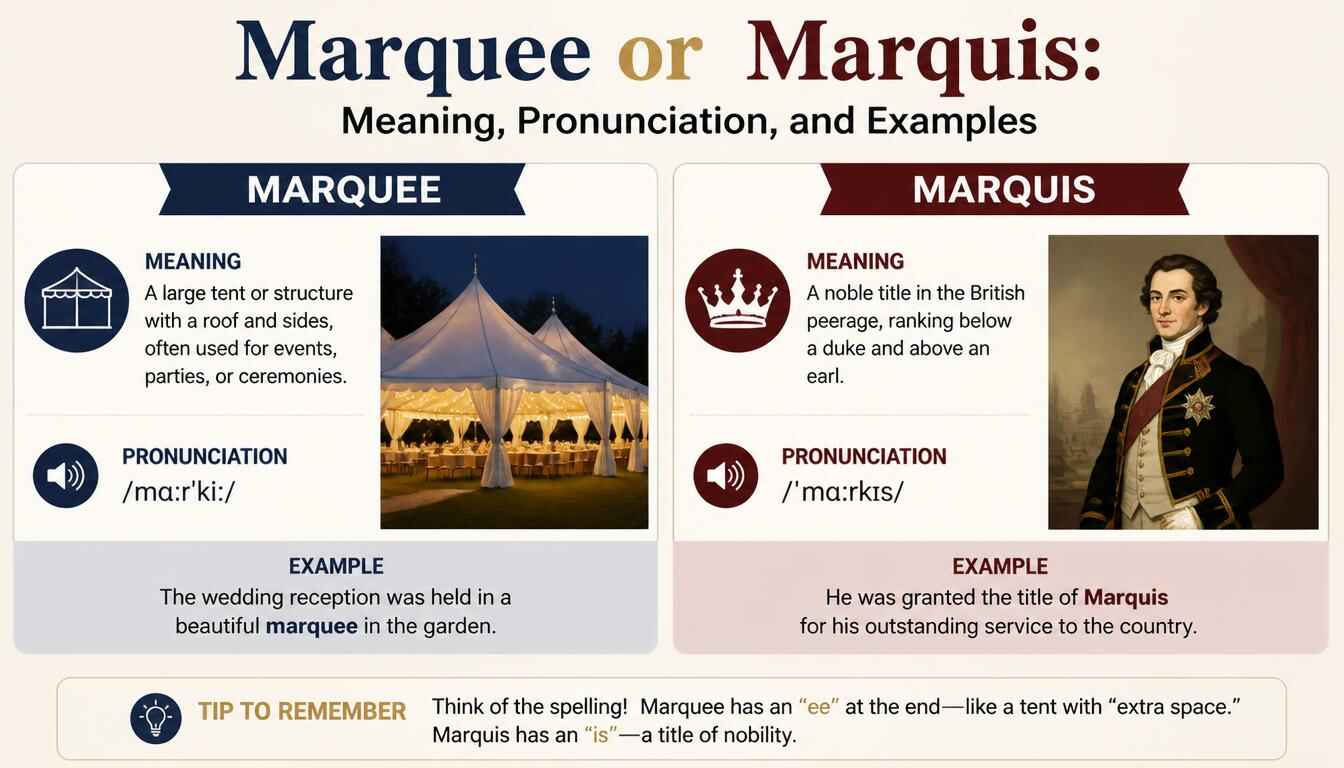
When deciding between marquee or marquis, the correct word depends on what you mean. A marquee is commonly a theater sign, an outdoor event tent, or something that attracts special attention, such as a marquee player. A marquis is a nobleman who holds a particular aristocratic rank. Although the words look and sound similar in some pronunciations, they have different meanings and cannot be used interchangeably.
Is It Marquee or Marquis?
Both marquee and marquis are correct English words, but they serve different purposes. Use marquee when referring to a theater sign, a large event tent, or a featured attraction. Use marquis when referring to a nobleman or a historical aristocratic title.
The easiest way to choose the right spelling is to consider the context. If you are talking about a wedding tent, movie theater, major sporting event, or famous performer, marquee is usually the correct choice. If you are discussing European nobility, royal ceremonies, or historical titles, marquis is generally appropriate.
| Feature | Marquee | Marquis |
|---|---|---|
| Main meaning | A sign, tent, or prominent attraction | A nobleman or aristocratic title |
| Part of speech | Noun; also an adjective | Noun |
| Common context | Theaters, events, sports, entertainment | History, nobility, aristocracy |
| Example | The theater’s marquee displayed the film title. | The marquis attended the royal ceremony. |
| Memory aid | Think of a sign or featured event | Think of a noble title |
Quick rule: A marquee is something that displays information, provides shelter, or attracts attention. A marquis is a person associated with a noble rank.
This distinction answers the common question, “Is it marquee or marquis?” Neither spelling is universally correct in every context. The intended meaning determines which word you should use.
Marquee or Marquis Meaning: What’s the Difference?
The main difference between marquee and marquis is their meaning and use. Although their spellings are similar, they belong to different contexts. Understanding each definition will help you avoid common spelling mistakes in everyday writing.
What Does Marquee Mean?
A marquee is a structure or sign associated with a building or event. In American English, it commonly refers to a sign above the entrance of a theater or another entertainment venue. The sign may display a movie title, show name, performer, or upcoming event.
The word also refers to a large tent used to provide shelter at outdoor gatherings. In addition, marquee can function as an adjective describing someone or something especially prominent, famous, or important.
Consider these examples:
- The cinema’s marquee announced the new science-fiction movie.
- We rented a marquee for the outdoor wedding reception.
- The festival attracted several marquee performers.
- The team signed a marquee player before the season began.
In the first example, marquee refers to a theater sign. In the second, it describes a temporary covered structure. In the final two examples, it means a major attraction or a highly regarded person.
Marquee as a Theater Sign or Outdoor Structure
A theater marquee is a sign or covered feature near a theater entrance. It often displays information about current films, stage performances, or other entertainment.
For example:
The theater’s bright marquee advertised three movies playing that weekend.
A marquee can also be a temporary covered structure used for weddings, parties, exhibitions, and formal outdoor events. In this sense, the word is similar to event tent or large canopy, although the exact structures can vary.
For example:
The organizers placed a large marquee on the estate lawn to accommodate the wedding guests.
If you are writing about a wedding tent, event shelter, or theater sign, marquee is the correct spelling, not marquis.
Marquee as an Adjective
In modern English, marquee is also used figuratively to describe a person, event, or feature that attracts particular attention.
Common expressions include:
- Marquee player
- Marquee event
- Marquee attraction
- Marquee performer
- Marquee matchup
- Marquee name
- Marquee client
For example, a sports team might sign a famous athlete as its marquee player. A music festival might advertise a well-known singer as its marquee performer.
In these cases, marquee does not refer to a physical sign or tent. Instead, it communicates importance, prominence, or star status.
This adjective use is especially relevant in American English, where sports and entertainment writers often describe leading athletes, major performances, and headline events as marquee attractions.
What Does Marquis Mean?
A marquis is a nobleman who traditionally holds an aristocratic rank below a duke and above an earl or count in the relevant European system of titles. The precise hierarchy and conventions vary between countries and historical periods.
The word is associated with nobility, aristocracy, hereditary titles, and European history. It is not the usual term for a theater sign, wedding tent, or famous performer.
For example:
- The marquis welcomed the visiting diplomats to his estate.
- The historical novel follows a young marquis through a royal court.
- The marquis inherited his title from his father.
- Several nobles attended the ceremony, including the marquis and the duke.
In each sentence, marquis refers to a person holding a noble title.
A marquis is not necessarily a king or a duke. These are distinct titles with different ranks and historical responsibilities. The exact status of a marquis depends on the country and period being discussed.
Marquis as a Noble Title
The title marquis is associated with European systems of nobility. Historically, a marquis could be connected with the administration or defense of a border territory, although the duties and significance of the title changed over time.
The corresponding title in British peerage is conventionally spelled marquess. In other European traditions, including French usage, marquis is the established form.
For example:
The marquis attended a formal reception alongside other members of the aristocracy.
Here, the word identifies a nobleman rather than an object or an attraction.
When discussing a real historical figure, use the spelling associated with that person’s actual title. This avoids confusing a general English explanation with the official name or title used in historical records.
Are Marquee and Marquis Interchangeable?
No. Marquee and marquis are not interchangeable, because they describe different things.
The word marquee is used for a theater sign, an event tent, or a prominent person or attraction. The word marquis identifies a noble title or the person who holds it.
Compare the following sentences:
| Sentence | Correct word | Reason |
|---|---|---|
| The theater’s ___ displayed the movie title. | Marquee | It refers to the theater sign. |
| The family rented a ___ for the wedding. | Marquee | It refers to an event structure. |
| The team signed a ___ player. | Marquee | It describes a featured athlete. |
| The ___ attended the royal ceremony. | Marquis | It refers to a nobleman. |
| The novel features a wealthy French ___. | Marquis | It refers to a noble title holder. |
The distinction becomes straightforward when you focus on the meaning rather than the similarity between the spellings.
Marquee or Marquis Pronunciation
Pronunciation is another reason readers confuse these words. Their spellings are similar, and some pronunciations of marquis sound like marquee. However, the words do not always have the same pronunciation.
How to Pronounce Marquee
The standard pronunciation of marquee is:
mar-KEE
The stress falls on the second syllable. The final sound resembles the word key.
For example, in the sentence “The marquee displayed the film’s title,” the word is pronounced with a clear emphasis on its final syllable.
When learning how to pronounce marquee, remember that the final written letters do not produce a separate syllable. The word has two syllables, with the second receiving the main stress.
How to Pronounce Marquis
The word marquis has more than one accepted English pronunciation. Common forms include:
- MAR-kwis, with the stress on the first syllable.
- mar-KEE, with the stress on the second syllable.
Pronunciation may vary according to regional usage, dictionary conventions, and the tradition associated with the title.
Because marquis can be pronounced like marquee, hearing the words alone may not tell you which one a speaker intends. The surrounding sentence provides important context.
For example, if someone says a word that sounds like mar-KEE while discussing a theater entrance, they probably mean marquee. If the discussion concerns a noble title, they may mean marquis.
Why Marquis Has More Than One Accepted Pronunciation
The word marquis comes through European title traditions, particularly French, and English has retained different pronunciation patterns. One pronunciation reflects the familiar English reading of the written form, while another follows the established pronunciation associated with the title.
Neither pronunciation should be presented as the only possible form in every context. When writing an educational article, it is more accurate to acknowledge both established variants and note that usage can depend on the speaker and context.
Do Marquee and Marquis Sound the Same?
Sometimes, yes. When marquis is pronounced mar-KEE, it sounds like marquee. When it is pronounced MAR-kwis, the difference is easier to hear.
This is why spelling matters. If you are editing a sentence, do not rely only on sound. Identify the intended meaning and select the corresponding word.
For writers, the practical rule is simple: use marquee for the sign, structure, or featured attraction, and use marquis for the noble title unless the context calls for the British form marquess.
Marquee or Marquis Examples in Sentences
The best way to understand the difference between marquee and marquis is to see how each word works in a complete sentence. The following examples cover everyday situations, entertainment, sports, events, and historical writing.
Examples of Marquee in a Sentence
Use marquee when describing a sign, a covered event structure, or something that stands out because of its importance.
| Example sentence | Meaning |
|---|---|
| The cinema updated its marquee before the movie premiere. | A theater sign displaying information. |
| We booked a marquee for the outdoor reception. | A large tent used for an event. |
| The concert featured a marquee performer from the United States. | A prominent or famous performer. |
| The championship was the weekend’s marquee event. | The main attraction of the weekend. |
| The club signed a marquee player during the transfer window. | A highly regarded or important athlete. |
| The company attracted a marquee client from the technology sector. | A particularly prominent client. |
Notice that marquee does not always describe a physical object. Its figurative meaning is common in sports, entertainment, business, and event promotion.
Examples of Marquis in a Sentence
Use marquis when referring to a nobleman or a person who holds the corresponding aristocratic title.
| Example sentence | Meaning |
|---|---|
| The marquis arrived at the palace before sunset. | A nobleman attending a formal event. |
| The marquis owned a large estate in the countryside. | A title holder associated with an estate. |
| The young marquis appeared in the historical novel. | A character with a noble title. |
| The marquis greeted the visiting ambassador. | A nobleman taking part in a formal meeting. |
| The historian studied the family records of the marquis. | A noble title holder examined through historical records. |
These sentences show why marquis belongs in discussions about nobility, aristocratic rank, royal ceremonies, and historical titles.
Marquee vs. Marquis: Incorrect and Correct Sentences
The following examples illustrate common spelling errors and their corrections.
| Incorrect sentence | Correct sentence |
|---|---|
| We rented a marquis for the wedding. | We rented a marquee for the wedding. |
| The theater’s marquis displayed the film title. | The theater’s marquee displayed the film title. |
| The team signed a marquis player. | The team signed a marquee player. |
| The marquee attended the royal ceremony. | The marquis attended the royal ceremony. |
| The novel follows a young marquee through the royal court. | The novel follows a young marquis through the royal court. |
The incorrect sentences use a real English word in the wrong context. That distinction matters: marquis is not a misspelling of marquee, and marquee is not a misspelling of marquis. Both words are valid, but they have different meanings.
Marquee in Sports, Entertainment, and Events
The figurative meaning of marquee deserves special attention because it appears frequently in American English.
In sports, a marquee player is an athlete who attracts significant attention because of their reputation, skill, or importance to a team. A marquee matchup is a particularly notable contest between prominent competitors.
In entertainment, a marquee performer may be the best-known artist at a concert or festival. A marquee event is often the main attraction on a program or schedule.
For example:
The tournament’s marquee matchup brought thousands of viewers to the broadcast.
Here, marquee means prominent or especially noteworthy. No physical sign or tent is being discussed.
In business, the same adjective can describe a prestigious client, major project, or high-profile partnership. Its exact meaning depends on context, but the central idea is prominence.
READ MORE >>> Disregulated or Dysregulated: Which Is Correct? Meaning, Usage & Easy Explanation
Spelling Marquee or Marquis: Which Is Correct?
Both spellings are correct. The question is not which spelling is universally correct, but which word fits the meaning of your sentence.
How to Spell Marquee Correctly
The spelling is marquee.
Use it when writing about theater signs, outdoor event tents, or prominent attractions. Remember the double e at the end.
Examples include:
- The theater’s marquee advertised the new film.
- A marquee covered the tables at the outdoor reception.
- The singer was the marquee performer at the festival.
A common mistake is to replace the final letters with those of marquis. Although the words look similar, their meanings are different.
How to Spell Marquis Correctly
The spelling is marquis.
Use it when referring to a nobleman or the corresponding title in a European tradition that uses this spelling. The word is associated with aristocracy, historical titles, and noble families.
Examples include:
- The marquis welcomed his guests.
- The museum displayed a portrait of a French marquis.
- The story follows a marquis living in eighteenth-century Europe.
When writing about a British peerage title, check whether marquess is the appropriate form instead.
Common Spelling Mistakes and How to Avoid Them
Most errors occur when writers remember the sound but forget the meaning.
For instance, someone writing about a wedding might type marquis because it resembles the word they have heard. Someone writing about a nobleman might choose marquee because the spelling looks familiar.
To avoid these mistakes, ask yourself what the sentence describes. Is it a sign, a tent, or a prominent attraction? Choose marquee. Is it a nobleman or a historical title? Choose marquis, or marquess when that is the appropriate title.
A spell-checker may not flag these errors because both spellings exist in English. Contextual proofreading is therefore more useful than checking spelling alone.
A Simple Trick to Remember the Difference
Use this memory aid:
Marquee = sign, shelter, or star attraction.
Marquis = noble title.
Imagine a movie theater with a bright marquee above the entrance. Then picture a historical nobleman attending a royal ceremony. Linking each word to a different image makes the distinction easier to remember.
A second useful method is to test the sentence by replacing the disputed word with a short definition. If “theater sign” or “featured player” makes sense, use marquee. If “nobleman” makes sense, use marquis.
Marquis vs. Marquess: What’s the Difference?
The words marquis and marquess are closely related, but they are not simply alternative spellings that can be substituted in every situation. Both refer to a noble rank traditionally associated with a position below a duke and above an earl or count, although title systems vary across countries and historical periods.
Marquis in European Titles
Marquis is used in French and other European title traditions. In English, it commonly appears when discussing French nobility, historical aristocrats, and noble titles associated with continental European history.
For example:
The French marquis attended the reception with members of the royal court.
The spelling is appropriate in this context because it reflects the title being discussed.
Marquess in British Peerage
In British peerage, marquess is the conventional spelling for this rank. It is a distinct title within the British system of nobility.
For example:
The marquess attended the formal ceremony alongside a duke and an earl.
When describing a British nobleman, use the established title rather than automatically replacing it with marquis.
Are Marquis and Marquess the Same Rank?
They correspond to similar aristocratic ranks, but the spelling depends on the national tradition and the specific title.
| Term | Typical context |
|---|---|
| Marquis | French and other European title traditions; also used in English |
| Marquess | Conventional British peerage spelling |
| Marquis or marquess | A noble rank traditionally below a duke and above an earl or count in relevant systems |
The feminine equivalent in English is generally marchioness, though exact title conventions depend on the tradition being discussed.
A marquis is not the same as a duke or a king. These titles represent different positions within historical systems of nobility. When writing about a specific historical person, verify the title used in reliable historical records.
Marquee and Marquis: Word Origins and Related Terms
Understanding the history of these words can help explain why they look similar despite having different meanings.
Origin and History of Marquee
The word marquee entered English through French. Its historical development is associated with words for an awning or large tent, and its modern uses expanded to include theater signs and prominent attractions.
Today, the term can describe a physical structure or function figuratively as an adjective. A marquee sign provides information, while a marquee event attracts special attention.
Related words include tent, canopy, awning, and theater sign. These words overlap with particular meanings of marquee, but they are not exact replacements in every sentence.
For example, a canopy may provide shade, while a marquee can be a large event tent. A theater sign displays information, while a marquee event is the principal attraction.
Origin and History of Marquis
The word marquis comes through French and belongs to the vocabulary of European aristocracy. Its historical association is with a noble rank connected to a territory or march, traditionally a border region.
Over time, the title became part of broader systems of nobility. Its use today is mainly historical, ceremonial, or related to established noble titles.
Related terms include nobleman, aristocrat, duke, earl, marquess, and marchioness. However, these terms are not interchangeable: each has its own meaning and place within the relevant title system.
Marquee Synonyms and Related Terms
The best synonym for marquee depends on its meaning in the sentence.
| Meaning of marquee | Related words |
|---|---|
| Theater sign | Display sign, theater sign |
| Outdoor structure | Event tent, large tent, canopy |
| Prominent attraction | Main attraction, headline event, featured performer |
| Important athlete | Star player, featured player |
These alternatives may work in some contexts, but they do not reproduce every meaning of marquee.
Marquis Synonyms and Related Terms
The word marquis can sometimes be explained using related terms such as nobleman or aristocrat. However, these words are broader descriptions rather than exact synonyms.
A duke, earl, count, and marquis are all associated with nobility in relevant systems, but their ranks and conventions differ. The word marquess is especially relevant when discussing British peerage.
A Practical Case Study: Choosing the Correct Word
Imagine that an editor is reviewing two sentences for an article about a historical film premiere.
The first sentence reads:
The theater’s marquis displayed the film title above the entrance.
The second reads:
The marquis attended the premiere with members of the royal family.
The first sentence is incorrect because it describes a theater sign. It should use marquee. The second sentence may be correct if the person attending the premiere holds the relevant noble title.
The corrected passage would read:
The theater’s marquee displayed the film title above the entrance. The marquis attended the premiere with members of the royal family.
This example demonstrates a useful editing principle: do not automatically replace one word with the other throughout a document. Check every occurrence against the meaning of the sentence.
A spelling tool might accept both words because they are valid English terms. A careful editor must still confirm that each one is appropriate in context.
Frequently Asked Questions
Is marquee or marquis the correct spelling?
Both spellings are correct, but they have different meanings. Use marquee for a theater sign, event tent, or prominent attraction. Use marquis for a nobleman or an aristocratic title associated with that spelling tradition.
Is a marquee a tent?
Yes. Marquee can refer to a large tent or covered structure used for weddings, parties, receptions, and other outdoor events. In American English, it also commonly refers to a sign above a theater entrance.
Can marquee describe a person or event?
Yes. As an adjective, marquee describes someone or something especially prominent. For example, a marquee player is a notable athlete, while a marquee event is a major attraction on a schedule.
Is a marquis a king or a duke?
No. A marquis is a nobleman holding a particular aristocratic rank. In relevant European title systems, the rank traditionally falls below a duke and above an earl or count. A king and a duke hold different titles.
Is marquis pronounced like marquee?
Sometimes. Marquee is pronounced with the stress on the second syllable, while marquis has accepted pronunciations that include both a first-syllable-stressed form and a form that sounds like marquee. The intended meaning and context help distinguish the words.
What is the difference between marquis and marquess?
Marquis is used in French and other European title traditions, while marquess is the conventional British peerage spelling for the corresponding rank. When writing about a particular nobleman, follow the spelling associated with that person’s title.
How do you use marquee and marquis in a sentence?
Use marquee for a sign, tent, or prominent attraction: “The marquee advertised the concert.” Use marquis for a noble title: “The marquis attended the ceremony.” The correct choice depends on what the sentence means.
Why do people confuse marquee and marquis?
The words have similar spellings, and some pronunciations of marquis sound like marquee. Because spell-checkers may accept both words, writers need to check their meanings rather than relying on spelling tools alone.
Final Verdict: Marquee or Marquis?
The difference between marquee and marquis becomes easy to remember once you connect each word with its purpose. Marquee refers to a theater sign, an event tent, or a prominent attraction. Marquis refers to a nobleman or an aristocratic title.
When checking the spelling marquee or marquis, consider the subject of your sentence. If you are describing a wedding structure, a cinema sign, a featured athlete, or a major event, choose marquee. If you are discussing a nobleman, European history, or an aristocratic title, choose marquis or the appropriate regional form marquess.
Both words have a legitimate place in English. The key to using them correctly is understanding their meanings and selecting the spelling that matches the context.