
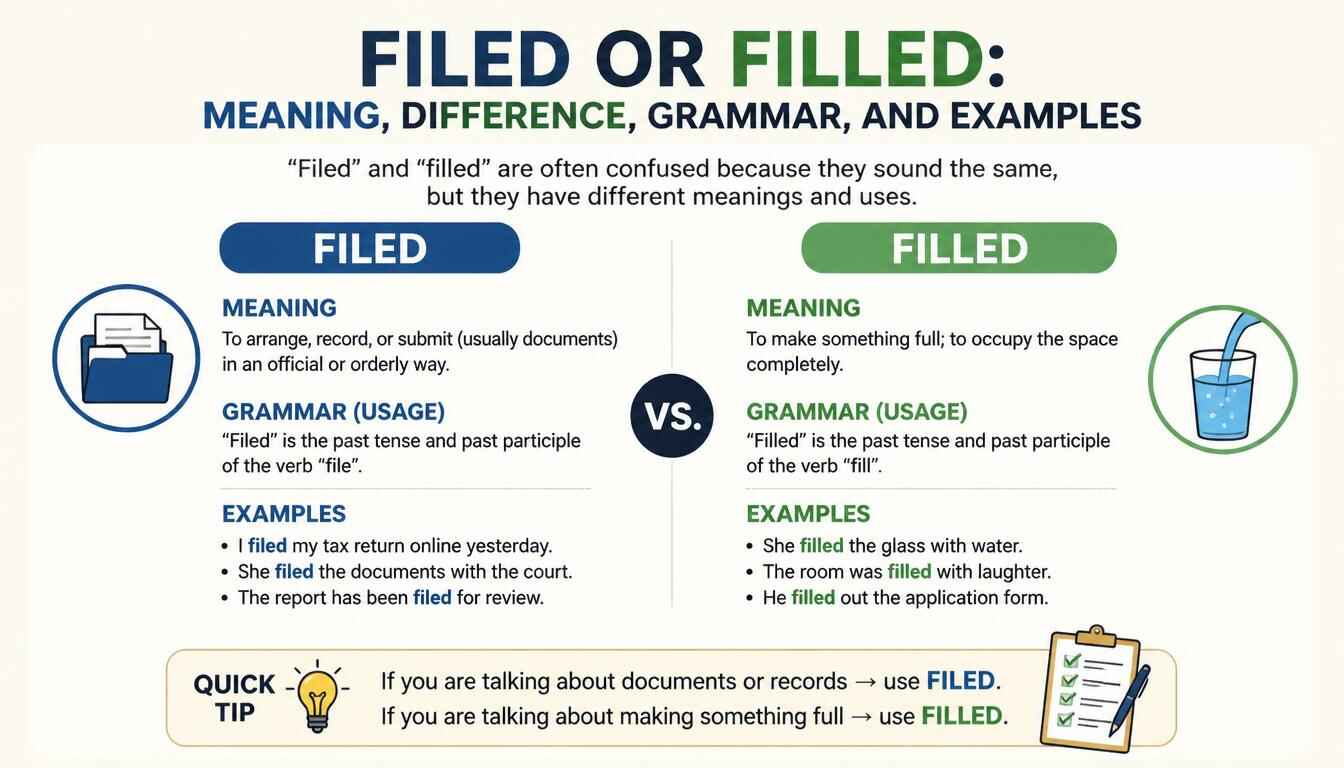
Filed or filled which word is correct? Both are correct English words, but they have different meanings. Filed is the past tense and past participle of file and commonly means submitted, officially recorded, or organized. Filled is the past tense and past participle of fill and means made full, occupied, or completed.
For example, you fill out an application by entering the required information. You may then file that application if you submit it through a formal process or place it in an official record system.
The correct word depends on the action you want to describe.
What Does Filed Mean?
Filed is the past tense and past participle of the verb file. It commonly refers to submitting documents, officially recording information, organizing records, or using a file tool to smooth a surface.
Filed Meaning: Submitted or Officially Recorded
When someone files a document, they submit it to an appropriate organization or authority, or have it officially recorded.
Examples:
- She filed a complaint with the agency.
- The company filed its annual report.
- The attorney filed a motion with the court.
- He filed his tax return before the deadline.
In these sentences, filed describes an action involving a formal document or record. It does not mean completing the document by entering information.
The exact meaning depends on the process. Filing a complaint, for example, generally involves submitting it to an authority so it can be formally handled or recorded.
Filed Meaning: Organized or Stored
Filed can also mean placing documents in an organized system so they can be found later.
Examples:
- The assistant filed the receipts by date.
- I filed the customer records in the correct folder.
- The clerk filed the paperwork after reviewing it.
Here, the focus is on organizing or storing information rather than submitting it to an outside organization.
Filed Meaning: Smoothed With a Tool
The verb file also means to smooth, shape, or remove small amounts of material using a file, a tool with a rough surface.
Examples:
- He filed the rough edge of the metal.
- She filed her nails before applying polish.
- The technician filed down the uneven surface.
This meaning is different from filing paperwork, but the past-tense spelling remains filed.
What Does Filled Mean?
Filled is the past tense and past participle of fill. It usually means making something full, putting something into a space, occupying a position, or supplying information.
Filled Meaning: Made Full
Use filled when something is supplied with liquid, material, or another substance.
Examples:
- She filled the bottle with water.
- He filled the tank with gasoline.
- The children filled their bags with books.
- Rainwater filled the container overnight.
The word does not always mean that an object is completely full. The surrounding sentence clarifies whether something was added or the available space was filled.
Filled Meaning: Occupied a Space or Position
Filled can describe occupying a space, vacancy, or available position.
Examples:
- The audience filled the theater.
- The company filled the vacant position.
- Volunteers filled every available seat.
- A new manager filled the role last month.
A company fills a position by appointing someone to a job. It may separately file the employment paperwork as part of its recordkeeping.
Filled Meaning: Completed a Form
When someone enters information into a form, they can fill out or fill in the form.
Examples:
- I filled out the application online.
- She filled in the missing address.
- Please fill in every required field.
- He filled out the registration form before the event.
In these sentences, filled describes completing the form or supplying information. It does not automatically mean the form has been submitted.
Filled in Figurative Expressions
Filled can also describe emotions, sounds, and other experiences.
Examples:
- She was filled with relief.
- His eyes filled with tears.
- The room was filled with laughter.
- The news filled them with hope.
These expressions use filled to describe something occupying or spreading through a person, space, or experience.
Filed vs. Filled: What Is the Difference?
The main difference is the action each word describes. Filed commonly refers to submitting, recording, or organizing something. Filled refers to making something full, occupying a space or position, or supplying information.
| Feature | Filed | Filled |
|---|---|---|
| Base verb | File | Fill |
| Past tense | Filed | Filled |
| Past participle | Filed | Filled |
| Common meanings | Submitted, recorded, organized, or smoothed with a file | Made full, occupied, or completed |
| Document example | Filed a complaint | Filled out an application |
| Job example | Filed the hiring records | Filled the vacant position |
| Physical example | Filed a rough edge | Filled a container with water |
When Should You Use Filed?
Use filed when the sentence describes an actual filing action, such as:
- Submitting a complaint or legal document.
- Submitting a report through a formal process.
- Organizing or storing records.
- Smoothing an object with a file tool.
For example, “The lawyer filed the documents” describes a filing action. Depending on the context, this might mean submitting them officially or placing them in an organized record system.
When Should You Use Filled?
Use filled when the sentence describes:
- Making a container or space full.
- Occupying a vacant position.
- Completing a form or supplying missing details.
- Experiencing an emotion described as filling someone.
For example, “The hiring manager filled the position” means someone was appointed to the job. “The assistant filed the hiring records” describes a separate administrative action.
A Simple Way to Remember the Difference
Ask yourself three questions:
- What action is happening? Is someone submitting a document, organizing records, making something full, or entering information?
- What is the object? Is it a complaint, bottle, form, vacancy, or rough edge?
- What is the intended outcome? Is something being recorded, stored, completed, or made full?
This approach is more reliable than memorizing a list of nouns. A form can be filled out, submitted, and filed at different stages of the same process.
Filed a Form vs. Filled Out a Form
Forms are a common source of confusion because both words can describe actions involving the same document.
What Does Filled Out a Form Mean?
To fill out a form means to complete it by entering the requested information, answering questions, or selecting the appropriate options.
Examples:
- I filled out the job application.
- She filled out the registration form.
- They filled out the application online.
In American English, fill out a form is a common expression. The form might be completed on paper or electronically.
What Does Filed a Form Mean?
To file a form means to submit it through a formal process or place it in an organized or official record system. The precise meaning depends on the context.
Examples:
- The accountant filed the required tax form.
- The employee filed a request with the department.
- The clerk filed the completed document in the office records.
Filing does not necessarily describe the act of entering information. It describes what happens to the document as part of a filing process.
Can You Fill Out a Form and Then File It?
Yes. These actions can happen in sequence.
Imagine that you need to submit an application to an office. First, you fill out the application by entering your name, address, and other required details. Next, you submit it according to the office’s instructions. If the process is described as filing the application, you can say that you filed it.
| Action | Natural expression | Meaning |
|---|---|---|
| Entering information | Filled out the form | Completed the required fields |
| Sending it to an office | Submitted the form | Delivered it through the required process |
| Completing a formal filing process | Filed the form | Submitted or officially recorded it, depending on context |
| Keeping it in an organized record system | Filed the form | Stored it for later retrieval |
Not every form is technically filed. Some forms are emailed, uploaded, handed in, or returned. Use filed only when it accurately describes the process.
Why Is “Filed Out a Form” Incorrect?
If you mean completing a form by entering information, use “filled out a form,” not “filed out a form.”
Incorrect: “I filed out the application yesterday.”
Correct: “I filled out the application yesterday.”
File out is not the standard expression for completing a form. The words file and fill are different verbs, even though their past-tense forms look similar.
READ MORE >>> Grammar or Grammer: Which Spelling Is Correct? Guide 2026
Filed vs. Filled Grammar
Both verbs are regular, but they have different base forms and meanings. Understanding their forms helps you use them correctly in different tenses.
File, Filed, and Filing
| Verb form | Example |
|---|---|
| Base form | I file the records every week. |
| Past tense | I filed the records yesterday. |
| Past participle | I have filed the records. |
| Present participle | I am filing the records now. |
The past tense and past participle are both filed.
Examples:
- She filed the report yesterday.
- She has filed the report.
- They had filed the documents before the meeting began.
Fill, Filled, and Filling
| Verb form | Example |
|---|---|
| Base form | I fill the container every morning. |
| Past tense | I filled the container yesterday. |
| Past participle | I have filled the container. |
| Present participle | I am filling the container now. |
The past tense and past participle are both filled.
Examples:
- He filled the tank last night.
- He has filled the tank.
- They had filled the seats before the show started.
Using Filed and Filled in Passive Sentences
Both words can appear in passive constructions, where the subject receives the action.
Examples:
- The complaint was filed on Monday.
- The documents were filed alphabetically.
- The position was filled last week.
- The bottles were filled with clean water.
The passive construction does not change the distinction between the verbs. Choose the word that accurately describes the action.
Filed vs. Filled Examples in Sentences
Examples of Filed in Sentences
- The company filed its annual report with the appropriate authority.
- She filed a complaint about the service.
- The clerk filed the invoices by date.
- He filed his tax return before the deadline.
- The lawyer filed a motion with the court.
- The technician filed the rough edge until it was smooth.
These examples describe submitting, recording, organizing, or shaping something with a tool.
Examples of Filled in Sentences
- She filled the glass with water.
- The new employee filled the vacant position.
- He filled out the application online.
- The hall was filled with visitors.
- Her eyes filled with tears.
- They filled in the missing information.
These examples describe physical fullness, employment, form completion, and figurative experiences.
Practice: Choose Filed or Filled
Complete each sentence with the correct word.
- The manager __ the position after interviewing several candidates.
- I __ out the application last night.
- The attorney __ the complaint with the court.
- She __ the container with fresh water.
- The assistant __ the receipts by month.
- He __ in the missing information.
Answers and explanations:
- Filled — Someone was appointed to the position.
- Filled — The applicant completed the form.
- Filed — The attorney submitted the complaint through a formal process.
- Filled — Water was added to the container.
- Filed — The receipts were organized.
- Filled — The missing information was supplied.
Common Mistakes With Filed and Filled
“I Filed Out the Form”
If you mean that you completed a form, use filled out.
- Incorrect for the intended meaning: “I filed out the form.”
- Correct: “I filled out the form.”
“She Filled a Complaint”
If you mean that someone formally submitted a complaint, the usual expression is filed a complaint.
- Incorrect for the intended meaning: “She filled a complaint with the agency.”
- Correct: “She filed a complaint with the agency.”
However, a person can fill out a complaint form. The correct wording depends on whether the sentence describes completing the form or filing the complaint.
“The Bottle Was Filed With Water”
Use filled to describe putting water into a bottle.
- Incorrect: “The bottle was filed with water.”
- Correct: “The bottle was filled with water.”
Assuming a Completed Form Has Been Filed
“I filled out the application” does not automatically mean that the application has been sent anywhere. The person may still need to submit it.
Likewise, “I filed the application” does not necessarily tell you who completed it or whether every field was filled out correctly.
Are Filed and Filled Synonyms?
No. Filed and filled are not synonyms because they generally describe different actions. Each word has alternatives that may work in particular contexts.
Synonyms for Filed
Depending on the meaning, alternatives may include:
- Submitted: She submitted a complaint.
- Recorded: The details were recorded in the system.
- Stored: The records were stored in a folder.
- Organized: The documents were organized by date.
- Lodged: In some formal contexts, this describes submitting a complaint or application.
These words are not interchangeable in every sentence. Stored may fit an example about keeping records, but it does not necessarily mean a complaint was officially submitted.
Synonyms for Filled
Depending on the meaning, alternatives may include:
- Made full: She made the container full.
- Occupied: The audience occupied every seat.
- Completed: He completed the application.
- Supplied: She supplied the missing information.
- Filled up: They filled up the tank.
Choose an alternative that preserves the sentence’s intended meaning. For instance, completed may replace filled out in a sentence about an application, but it would not normally replace filled in “Her eyes filled with tears.”
Filed vs. Filled Pronunciation
Filed and filled are not pronounced the same way. Their main difference is the vowel sound.
- Filed: /faɪld/ — rhymes with smiled.
- Filled: /fɪld/ — rhymes with build.
In filed, the vowel sound is the long “i” sound heard in time. In filled, the vowel is the short “i” sound heard in sit.
Practicing this vowel distinction can help you recognize the words when listening and avoid confusing them when writing.
Filed vs. Filled in American and British English
The core meanings of filed and filled remain distinct in both American and British English. A useful regional difference concerns the phrases used for completing forms.
Fill Out a Form vs. Fill In a Form
In American English, “fill out a form” is a common expression.
Example: “Please fill out the application before your appointment.”
“Fill in a form” is also correct and is particularly common in British English.
Example: “Please fill in the application before your appointment.”
Both expressions are widely understood. The choice often depends on regional preference and context.
Fill in the missing details also naturally emphasizes supplying absent information. However, fill in and fill out overlap when referring to completing forms.
Neither expression is the same as file a form. Filling out or filling in describes entering information; filing describes the relevant submission, recording, or storage process.
Frequently Asked Questions About Filed vs. Filled
Is it filed or filled?
Both words are correct, but they have different meanings. Use filed for submitting, recording, or organizing something. Use filled for making something full, occupying a position, or completing a form.
What is the difference between filed and filled?
Filed is the past tense and past participle of file, while filled is the past tense and past participle of fill. For example, you file a complaint but fill out an application.
Is it “filed out” or “filled out”?
Use “filled out” when you mean completing a form by entering the requested information. “Filed out” is not the standard expression for this meaning.
Do you file a form or fill out a form?
You generally fill out a form to complete it. You may then file it if the relevant process involves formal submission, recording, or storage. Not every form needs to be filed.
Is “I filed the form” grammatically correct?
Yes. “I filed the form” is grammatically correct when it describes the intended filing action. It does not mean exactly the same thing as “I filled out the form.”
Are filed and filled synonyms?
No. Filed commonly describes submitting, recording, or organizing something, while filled describes making something full, occupying a space, or completing something.
Is it “filled a position” or “filed a position”?
Use “filled a position” when someone is appointed to a vacant job or role. Filed a position does not normally express that meaning.
Are filed and filled pronounced the same way?
No. Filed is pronounced /faɪld/, while filled is pronounced /fɪld/. Their vowel sounds are different.
What are the past tense forms of file and fill?
The past tense and past participle of file are filed. The past tense and past participle of fill are filled.
Conclusion
The difference between filed and filled comes down to the action being described. Filed commonly means submitted, officially recorded, organized, or smoothed with a tool. Filled means made full, occupied a position, or supplied information.
For paperwork, remember this practical distinction: you fill out a form to complete it, and you may file it afterward as part of a formal process. When you are unsure, identify the action first, then choose the word that accurately describes it.