
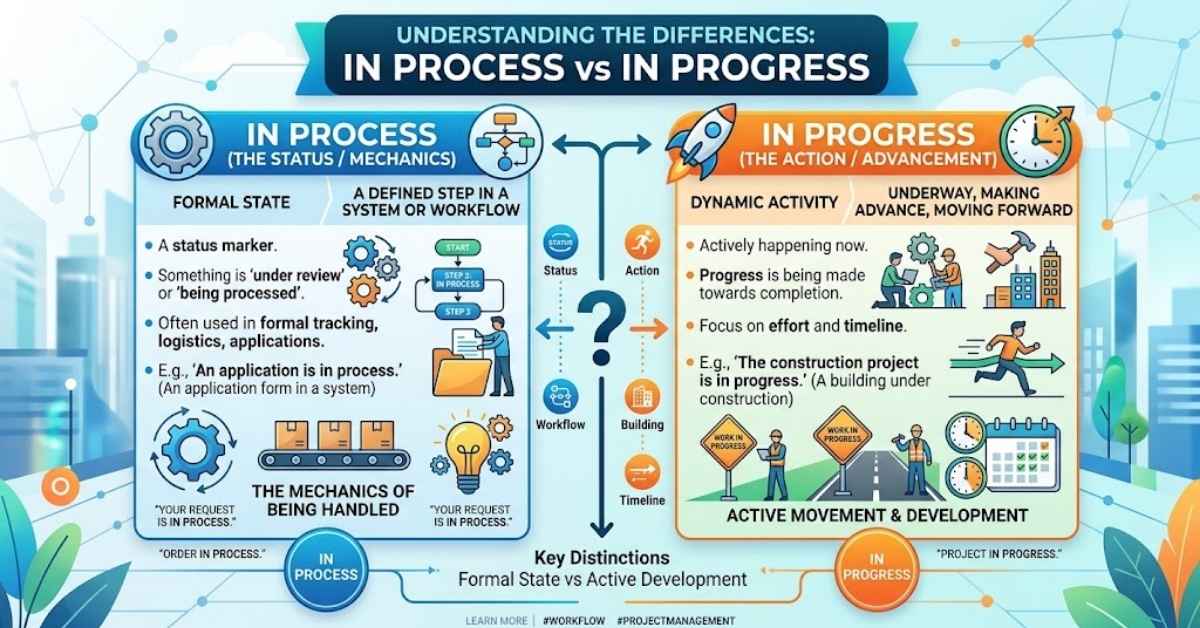
In process vs in progress can be confusing because both phrases describe something that has not finished. In most everyday American English, “in progress” is the natural choice when something is happening, continuing, or being worked on. The “In process” can also be correct, but it is more context-dependent and often emphasizes something moving through a procedure, workflow, or system. Cambridge defines in progress as something happening or being done now.
There is one important exception: “work in process” is a legitimate U.S. term, particularly in accounting and manufacturing, where it can refer to partially completed goods. Cambridge lists work in process as a U.S. form of work in progress.
So, if you simply mean that a project, meeting, repair, or task is happening, choose “in progress.”
In Process vs In Progress: Quick Difference
| Phrase | Main idea | Example |
|---|---|---|
| in progress | Something is happening or continuing | The project is in progress. |
| in process | Something is moving through a process or procedure | The request is in process. |
| being processed | Someone or a system is actively handling something | The application is being processed. |
| in the process of | Someone is currently carrying out an action | We are in the process of updating the site. |
| work in progress | Unfinished work or development | The website is a work in progress. |
| work in process | Variant/technical term, especially U.S. accounting/manufacturing | The factory tracks work in process. |
The distinction is not an absolute grammar rule. Context determines which expression sounds most natural.
What Does “In Progress” Mean?
In progress means that something has started and is currently happening, continuing, or being done.
Cambridge gives examples involving repair work, a football game, paintings, meetings, and audits.
For example:
The construction is in progress.
The meeting is in progress.
The investigation is in progress.
Repairs are in progress.
The project is still in progress.
In all of these examples, the writer is emphasizing the activity itself.
The activity has begun, but it has not finished.
That is why in progress is usually the best choice for everyday statements about ongoing work.
What Does “In Process” Mean?
In process can describe something that is underway within a process, procedure, workflow, or system.
For example:
The application is in process.
The order is in process.
The request is in process.
However, there is an important usage point here: although these sentences can be understood, “being processed” may be clearer and more natural when you specifically mean that an organization or system is handling something.
Compare:
The application is in process.
The application is being processed.
The second sentence makes the action more explicit.
This is why asking only “Is in process correct?” is not quite enough. A better question is:
What exactly am I trying to communicate?
If you simply mean “this is happening,” in progress is usually better.
If you mean “this is moving through a defined procedure,” in process may be appropriate.
In Process or In Progress: Which Is Correct?
If you’re asking in process or in progress which is correct, the answer depends on context.
Use “in progress” for ordinary ongoing activity
The project is in progress.
The meeting is in progress.
The repairs are in progress.
The investigation is in progress.
Use “in process” when the process itself matters
The request is in process.
The order is in process.
The materials are in process.
But when writing ordinary business English, you should consider whether being processed communicates the idea more clearly:
The order is being processed.
The application is being processed.
This gives the reader a direct picture of what is happening.
Why “In Progress” Is Usually Better for Ongoing Work
The word progress is connected with movement toward a further or more developed state. Cambridge defines progress as movement toward an improved or more developed state or a forward position.
That makes in progress especially natural for activities that have begun and are continuing.
Think about:
- a project
- a meeting
- a renovation
- an investigation
- construction
- a discussion
- an event
- a repair
- a painting
- an assignment
Examples:
The renovation is in progress.
The assignment is in progress.
The discussion is in progress.
The audit is in progress.
Dictionary.com likewise defines in progress as going on, underway, or happening.
A useful mental model
Think:
Progress = movement forward.
If your main idea is:
“This has started and is still happening.”
then in progress is usually the phrase you want.
When “In Process” Makes Sense
In process becomes more useful when you are emphasizing a procedure or workflow.
Imagine an application moving through several stages:
- Application submitted
- Information checked
- Documents reviewed
- Approval requested
- Final decision
If you want to emphasize that the application is moving through that system, in process can make sense.
The same idea can apply to:
- administrative procedures
- manufacturing
- production
- orders
- requests
- document processing
- technical workflows
For example:
The order is in process.
But if your audience simply needs to know that somebody is currently handling the order, this may be clearer:
The order is being processed.
That distinction gives you three useful choices:
In progress → something is happening.
In process → something is moving through a process.
Being processed → someone or something is actively handling it.
“In Process” vs “Being Processed”
These expressions are related, but their grammar and emphasis differ.
In process
This describes a state:
The application is in process.
Being processed
This uses the passive progressive construction to emphasize the action being performed:
The application is being processed.
In many professional situations, the second sentence is clearer because it tells the reader exactly what is happening.
Compare:
Your payment is in process.
Your payment is being processed.
The second version sounds more direct in many customer-service contexts.
Likewise:
Your request is in process.
Your request is being processed.
If clarity is your priority, being processed is often an excellent alternative.
“In Process” vs “In the Process Of”
Another important distinction is between:
in process
and:
in the process of
The longer expression is extremely common when describing an action that someone is carrying out.
For example:
We are in the process of updating the website.
The company is in the process of hiring new employees.
I am in the process of completing the application.
Here, in the process of is followed by a gerund (-ing form).
You should not automatically replace it with in progress.
For example:
We are in the process of updating the website.
is natural.
You could also say:
The website update is in progress.
But these sentences emphasize slightly different things.
The first focuses on the people/action involved in carrying out the update.
The second focuses on the status of the update itself.
Work in Process or Work in Progress?
This is where the answer becomes more interesting.
For ordinary writing, work in progress is the familiar phrase.
It describes something that has begun but is not yet complete.
For example:
This website is a work in progress.
The book is still a work in progress.
My painting is a work in progress.
The project remains a work in progress.
Cambridge defines work in progress as something being developed or suggested but not yet complete. Importantly, its U.S. dictionary notes “work in process” as another U.S. form.
So saying that work in process is always wrong would be misleading.
Work in Process in Accounting and Manufacturing
In accounting and manufacturing, work in process has a specialized use.
It can refer to goods that have entered production but are not yet finished.
For example, imagine a factory producing furniture.
The production stages might be:
Raw materials → partially assembled products → finished products
The partially completed products can be classified as work in process.
Accounting sources describe work in process as goods that are partially completed within the production process.
Cambridge’s business dictionary also defines work in process as a U.S. term pointing to work in progress, including its accounting meaning.
This is why the context matters.
Ordinary writing
The website is a work in progress.
Manufacturing/accounting
The company tracks its work in process inventory.
Both can be correct.
Work in Progress vs Work in Process
| Context | Preferred expression |
|---|---|
| Personal development | work in progress |
| Unfinished writing | work in progress |
| Website development | work in progress |
| Creative project | work in progress |
| General business project | work in progress |
| Manufacturing | work in process / work in progress |
| Accounting | work in process / work in progress, depending on terminology |
| WIP terminology | Both forms occur |
Cambridge even defines WIP as an abbreviation for work in progress or process.
So the common Internet advice to “always use work in progress” is useful for general writing, but too broad for specialized accounting and manufacturing contexts.
Workday In Process vs In Progress
The phrase workday in process vs in progress introduces a different issue.
If you see “In Progress” or “In Process” on a Workday job application, you should not assume that the phrase has one universal meaning across every employer.
Workday recruiting workflows can be configured by employers.
For example, UW–Madison’s official Workday guidance shows “Application Status: In Progress” for candidates at active stages such as interview, assessment, or employment agreement.
That means a Workday status should be interpreted according to the specific employer’s recruiting setup, not according to a general English dictionary definition.
Does “In Progress” on Workday mean you got the job?
No conclusion like that should be drawn from the wording alone.
The label indicates a workflow status, but it does not by itself establish that you are the preferred candidate or that an offer is coming.
Employer configurations can differ, and the employer’s direct communication is more informative than assumptions about a generic status label.
So if your Workday application says In Progress, read the accompanying messages and application details rather than trying to decode the phrase as a universal hiring signal.
In Process vs In Progress in Sentences
Here are practical side-by-side examples.
Projects
Natural:
The project is in progress.
Less natural for ordinary usage:
The project is in process.
If you simply mean that people are working on the project, in progress is the clearer choice.
Meetings
The meeting is in progress.
This is the normal expression.
The meeting is in process.
This sounds unusual unless there is a special context.
Construction
Construction is in progress.
This clearly means construction is currently happening.
Applications
Your application is being processed.
This is often clearer than:
Your application is in process.
Manufacturing
The components are in process.
This can make sense when referring to a production stage.
Creative work
The novel is a work in progress.
This is the familiar expression.
LEARN MORE: Protesters or Protestors
Common Mistakes
Mistake 1: Using “in process” for every unfinished activity
Not every unfinished thing is naturally described as in process.
For ordinary activities, use in progress:
The repair is in progress.
The meeting is in progress.
Mistake 2: Assuming “in process” is always incorrect
That goes too far.
In process exists and can be appropriate, particularly in workflow, production, and specialized contexts.
Mistake 3: Saying “work in process” is always wrong
It isn’t.
Work in process is a legitimate U.S. expression, especially in accounting and manufacturing. Cambridge explicitly recognizes it.
Mistake 4: Confusing “in process” with “in the process of”
These are not identical constructions.
The application is in process.
We are in the process of reviewing the application.
The second structure is especially natural when describing an action being carried out.
Mistake 5: Assuming a Workday status has a universal definition
Workday statuses can depend on the employer’s configuration. Official university Workday documentation demonstrates that In Progress can cover multiple active recruiting stages.
A Simple Memory Trick
Use this mental shortcut:
Progress = activity moving forward
The project is in progress.
The repairs are in progress.
Process = steps or a system
The application is moving through the process.
The request is in process.
And when you mean someone is actively handling something:
The application is being processed.
This isn’t an absolute grammar law, but it is a useful way to choose the most natural phrase.
Quick Decision Guide
Ask yourself one question:
Am I talking about something happening, or something moving through a process?
Something is happening
Use:
in progress
The meeting is in progress.
Something is moving through a procedure
Use:
in process
or, often more naturally:
being processed
The application is being processed.
Something is unfinished
Use:
work in progress
The report is a work in progress.
Something is partially manufactured
Use:
work in process or work in progress, depending on the accounting/manufacturing terminology being used.
Frequently Asked Questions
Is it “in process” or “in progress”?
For most ordinary situations, in progress is the better choice when you mean something is happening or continuing. In process can be appropriate when emphasizing a procedure, workflow, or process.
In process or in progress—which is correct?
Both expressions exist, but they are not equally natural in every context. In progress is the normal choice for ongoing activities, while in process is more context-dependent.
Do you say “in process” or “in progress”?
Say in progress when you mean that an activity is currently happening.
The project is in progress.
Use in process when the idea of a defined process or workflow is important.
Is “in process” grammatically correct?
Yes, in process can be grammatically correct, but correctness and naturalness are not always the same thing. In many ordinary sentences, in progress or being processed will sound more natural.
Is “work in process” correct?
Yes. Work in process is a recognized expression, particularly in U.S. accounting and manufacturing. Cambridge lists it as a U.S. form of work in progress.
Is “work in progress” correct?
Yes. Work in progress is the standard general expression for unfinished work or something still being developed. Cambridge defines it as something not yet complete.
What is the difference between work in process and work in progress?
In general writing, work in progress is the familiar phrase for unfinished work. Work in process is also legitimate and has an important U.S. accounting/manufacturing use for partially completed goods.
What does “in progress” mean?
In progress means something is currently happening or being done. Cambridge gives examples including repairs, meetings, games, paintings, and audits.
What does “in process” mean?
In process can mean that something is underway within a process, procedure, or workflow. Depending on the sentence, being processed may be a clearer alternative.
What does “in progress” mean on Workday?
There is no single universal interpretation for every employer’s Workday career site. Employer configurations can determine what candidates see. UW–Madison, for example, uses “In Progress” for several active recruiting stages.
Is “the project is in process” correct?
It can be understood, but if you simply mean that people are currently working on the project, “the project is in progress” is generally the more natural choice.
Is “the application is in process” correct?
It can occur, especially in workflow-related contexts, but “the application is being processed” is often clearer.
Final Answer: In Process vs In Progress
The easiest answer is:
Use “in progress” for something that is happening, continuing, or being worked on.
The project is in progress.
Use “in process” when you specifically want to emphasize a process, procedure, workflow, or production stage.
The request is in process.
When an organization is actively handling something, “being processed” may be even clearer:
The application is being processed.
And remember the important exception:
“Work in process” is not simply a mistake. It is a recognized U.S. expression, particularly in accounting and manufacturing, while “work in progress” is the familiar general expression for unfinished work.
So if you are writing a normal email, essay, report, or project update and want to say that something is underway, “in progress” is usually the safest and most natural choice.